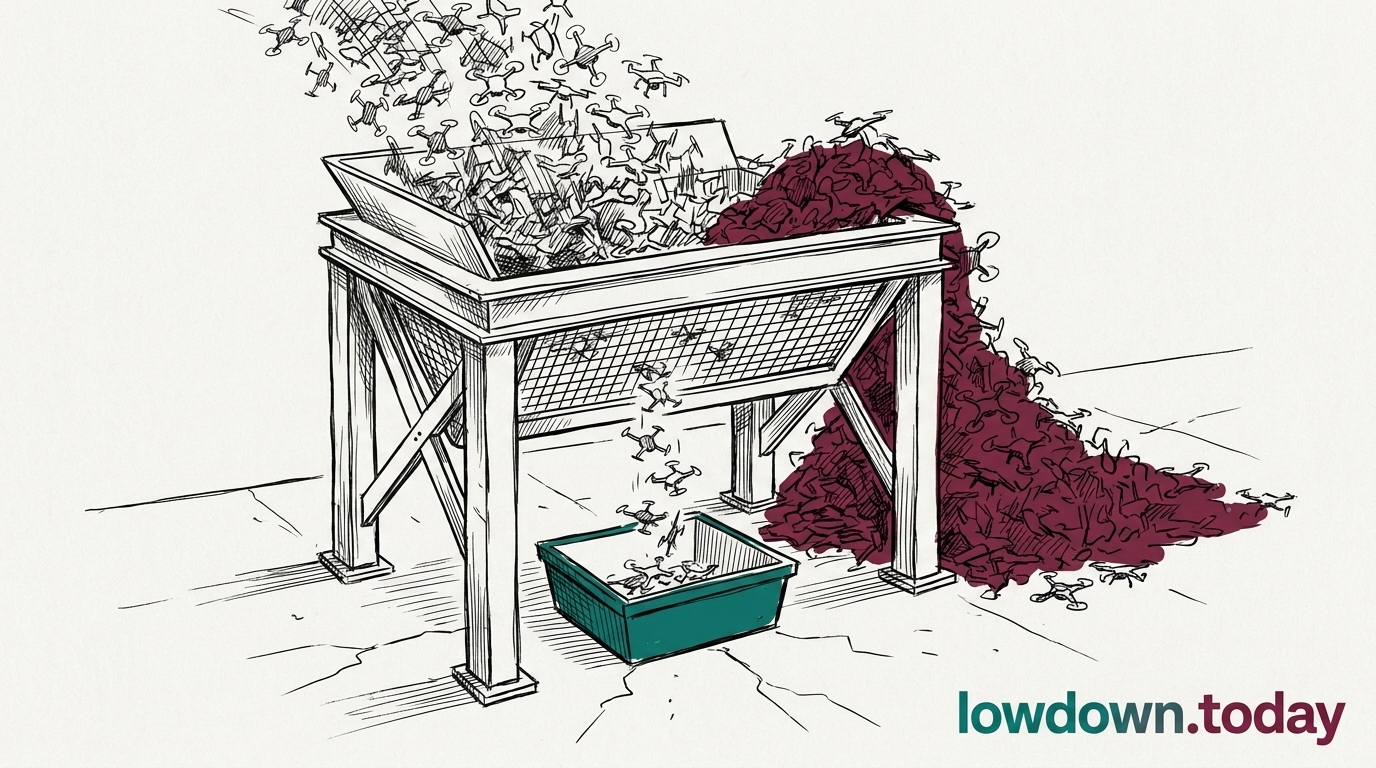
Anduril expects 2026 revenue to roughly double to about $4.3bn, up from $2.2bn, while running an operating loss near $1.2bn, with profitability not expected until 2030 1. Anduril is the US defence-AI company behind Lattice, the command-and-control software that fuses sensors and weapons into one picture, and the $5bn raise that set its $61bn valuation closed last month . At that price the company trades on roughly 27 times current revenue, a multiple that assumes Lattice becomes the default Western counter-drone software layer and that government demand stays near-certain.
Anduril's own figures expose what the multiple rests on. A 27-times-revenue valuation on a business losing $1.2bn is not pricing today's sales; it is pricing a future monopoly on the software layer plus durable Pentagon spending. Arsenal-1, the Ohio factory, already carries more than $900m in committed spend, so Anduril is buying manufacturing capacity faster than revenue arrives. The bet is Amazon-shaped: spend now, earn the platform rents later. The demand side is real, with the Pentagon's autonomous-warfare budget line lifted to $54.6bn for the next cycle underwriting the customer base.
Both assumptions are testable, and June supplied two tests. Helsing's HX-2 clearing a US Army evaluation in Lithuania chips at the idea that Anduril is the default autonomous-strike supplier. The Pentagon's Phase 1 acceptance shortfall chips at the idea that funded demand converts cleanly into delivered units. Neither sinks the thesis on its own. Together they show the certainty the multiple needs is something the company itself is still building toward, on a profit timetable it has pushed four years out.





