Skip to content
Briefings are running a touch slower this week while we rebuild the foundations.See roadmap
Russia-Ukraine War 2026
11APR

9,616 drones, 171 clashes — 17 March

3 min read
16:48UTC

Russia launched 9,616 kamikaze drones in a single day on 17 March — a 9% increase over early March, confirming that last year's surge capacity is now the daily operating tempo.

ConflictDeveloping
Key takeaway

Russia has industrialised drone attrition to a scale that renders point-defence interception alone financially unsustainable.

The front recorded 171 combat engagements on 17 March — a 61% increase over the 106 recorded on 4 March , when spring thaw was constraining armoured movement. Russian forces launched 9,616 kamikaze drones, dropped 200 guided aerial bombs across 70 airstrikes, and fired 3,715 shellings including 98 MLRS salvoes 1. At least 11 people were killed and 55 wounded.

The drone count is 9% above the 8,828 recorded on 2 March , which was itself triple the 2025 daily average. The concentrated barrage of 430 drones and 68 missiles on the night of 13–14 March was the heaviest single combined assault in months — but the 17 March data reveals something different. Even on days without a massed strike, the baseline now exceeds 9,000. What was surge capacity in 2025 is routine in March 2026. Russian drone production, bolstered by Iranian Shahed-136 airframe transfers and expanding domestic assembly lines, has outpaced the incremental improvements in Ukrainian interception capacity.

The 200 guided aerial bombs — unguided FABs fitted with UMPK satellite-guidance kits, released from aircraft flying behind Russian air defence coverage — remain the weapon category Ukraine cannot reliably intercept. Drones and cruise missiles face interception rates above 80%. Glide bombs have no operational countermeasure short of destroying the launch aircraft or pushing the front line back beyond release range. France's pending SAMP/T NG transfer may eventually extend Ukraine's engagement envelope against the bombers themselves. At present, the daily glide bomb payload arrives without answer.

Deep Analysis

In plain English

On 17 March, Russia launched nearly 10,000 small exploding drones — called kamikaze or one-way attack drones — alongside conventional missiles and massed artillery. For context: the most intense day of the Second World War Blitz on London saw roughly 350 German aircraft. Russia is now deploying more drones in a single day than most countries possess military aircraft in their entire air force. The financial logic is brutal. Each drone costs roughly $20,000–$50,000 to produce. Each interceptor missile used to shoot one down costs between $1 million and $4 million. Ukraine can win every individual intercept and still lose the economic war — because every success depletes expensive stockpiles whilst Russia replenishes cheap drones from domestic production lines financed by oil revenue.

Deep Analysis
Synthesis

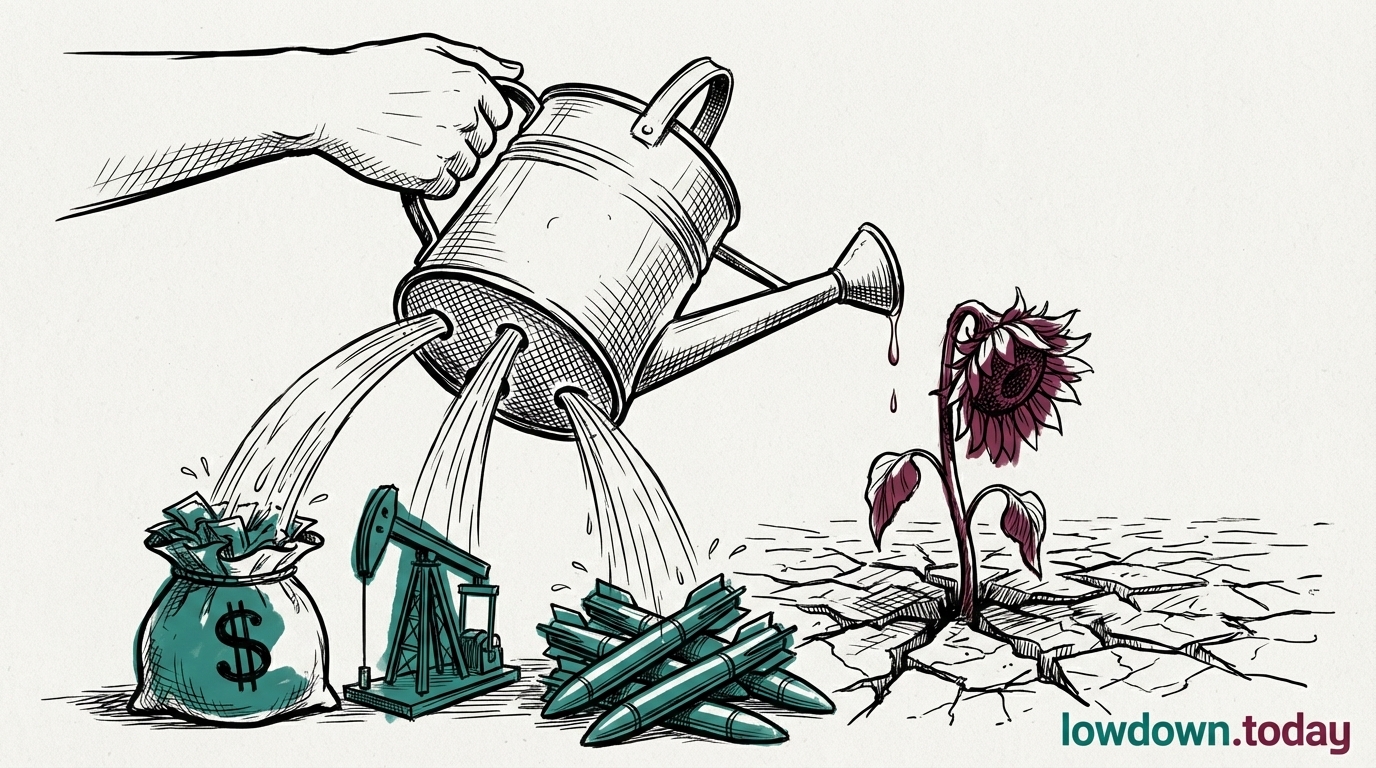
Cross-referencing Event 7 with Event 1: at €510 million per day in fossil fuel revenues and Shahed-class drone costs of $20,000–$50,000 per unit, Russia could theoretically produce 10,000–25,000 drones from a single day's energy revenue. The drone campaign is effectively self-financing through oil sales — making Western sanctions leakage directly translatable into Ukrainian civilian casualties. The economic and military narratives in this briefing are the same story told from different vantage points.

Root Causes

The drone volume reflects three structural drivers absent from the body: first, Iranian Shahed manufacturing technology transferred to Russian domestic production facilities — primarily the Alabuga special economic zone in Tatarstan — since 2023, enabling mass domestic output. Second, North Korean artillery shell supply has freed Russian industrial capacity for drone component production. Third, Chinese dual-use electronics exports — microcontrollers, sensors, and propulsion components — have continued despite Western diplomatic pressure on Beijing, sustaining the supply chain.

Escalation

The 17 March figures represent a significant intensity increase from reported 2024 daily averages. Cross-referenced with Russia's €510M daily fossil fuel revenues, this operational tempo is financially sustainable for Moscow. Absent successful Ukrainian interdiction of Russian drone production facilities, the escalation trajectory points toward sustained high-intensity attritional pressure through spring and summer 2026.

What could happen next?
1 consequence1 risk1 meaning1 opportunity1 precedent
  • Consequence

    Russia's 17 March drone volume demonstrates that point-defence interception alone has become financially untenable for Ukraine at current interceptor costs.

    Immediate · Assessed
  • Risk

    Sustained 9,000-plus drone days will exhaust Ukrainian interceptor stocks faster than Western industrial production lines can replenish them.

    Short term · Assessed
  • Meaning

    The 17 March attack intensity cross-referenced with Russian oil revenues demonstrates the drone campaign is directly financed by Western sanctions leakage.

    Immediate · Suggested
  • Opportunity

    Ukrainian deep strikes on Russian drone production facilities — Alabuga and Tatarstan in particular — could reduce output more cost-effectively than point interception at scale.

    Short term · Suggested
  • Precedent

    The 17 March figures establish a new global benchmark for industrial-era drone warfare that will define future conflict doctrine and defence procurement worldwide.

    Long term · Assessed
First Reported In

Update #5 · Trump frees 124m barrels; Russia earns €6bn

Ukrainian Ministry of Defence (mod.gov.ua)· 18 Mar 2026
Read original
Causes and effects
This Event
9,616 drones, 171 clashes — 17 March
Daily kamikaze drone volumes have settled above 9,000 as routine rather than surge, while 200 guided aerial bombs per day represent the one weapon category Ukraine cannot reliably intercept — establishing a sustained attritional bombardment rate that both military positions and civilian infrastructure must absorb indefinitely.
Different Perspectives
Rafael Grossi, IAEA Director General
Grossi's Update 349 of 7 May recorded a drone strike on ZNPP's radiation monitoring laboratory on 3 May. Rosatom's 17 May public attack on the Secretariat's neutrality degrades the diplomatic ground Grossi needs for the sixth repair ceasefire at day 60 on the single backup line.
Indian Government / Embassy Moscow
The Indian Embassy in Moscow confirmed on 18 May that an Indian national was killed and three hospitalised at a refinery construction site in the 17 May barrage. India is among the largest buyers of discounted Russian crude; the fatality forces a diplomatic protest without changing the purchasing posture.
Recep Tayyip Erdogan, Turkish President
Erdogan met Zelenskyy in Ankara for nearly three hours on 15 May before the Istanbul session, recovering Turkey's 2022 mediator role and reducing Trump's leverage by hosting bilateral talks without Washington in the room. Turkey hosts the NATO Ankara summit on 7-8 July; the Istanbul format gives Erdogan standing at both tables simultaneously.
Viktor Orban / Hungarian Government
Budapest's new cabinet, formed 12 May, holds the institutional veto point on the EU tranche disbursement ahead of the first-half June window. Hungary has previously leveraged EU loan tranches to extract bilateral concessions; the combination of a fresh cabinet and a tight disbursement timeline makes Budapest the single highest-leverage actor in the EU track this fortnight.
European Council / Commission
The Commission is preparing a three-document disbursement package for the 9.1-billion euro first tranche of the EU loan to Ukraine, targeting first-half June, but delivery depends on the Magyar cabinet, which formed on 12 May, not blocking the mechanism. The 20th sanctions package remains in force against Russia.
Donald Trump / US Treasury
Treasury issued GL 134C with a 48-hour gap after GL 134B expired, confirming the waiver series functions as permanent monthly management rather than a wind-down instrument. Washington was absent from the Istanbul room; Treasury Secretary Bessent framed the Cuba carve-out as protecting 'most vulnerable nations', maintaining the fiction that the 30-day bridge has a humanitarian rationale.
