Skip to content
You can now search across every topic, entity and event.What's new
Pandemics and Biosecurity
21JUL

Ebola model puts the fork at 20% isolation

3 min read
09:12UTC

The CDC put the Bundibugyo outbreak's reproduction number at 2.51 on 5 June, and showed its fate turning on one controllable variable: how many patients get isolated in time.

ScienceDeveloping
Key takeaway

The outbreak's outcome turns on the patient isolation rate, a logistics variable, not on the virus itself.

The US Centers for Disease Control and Prevention (CDC) published modelling on Friday 5 June putting the Bundibugyo Ebola outbreak's basic reproduction number (R0, the average number of people each case infects) at 2.51, and estimating that the spillover which started it occurred around 19 February 1. The CDC is the United States' principal federal public-health agency; it released the projections through its Morbidity and Mortality Weekly Report (MMWR), its flagship epidemiological journal. Bundibugyo is one of the rarer Ebola species, named for the Ugandan district where it was first isolated in 2007, and the 2026 DRC and Uganda outbreak is the largest on record for it.

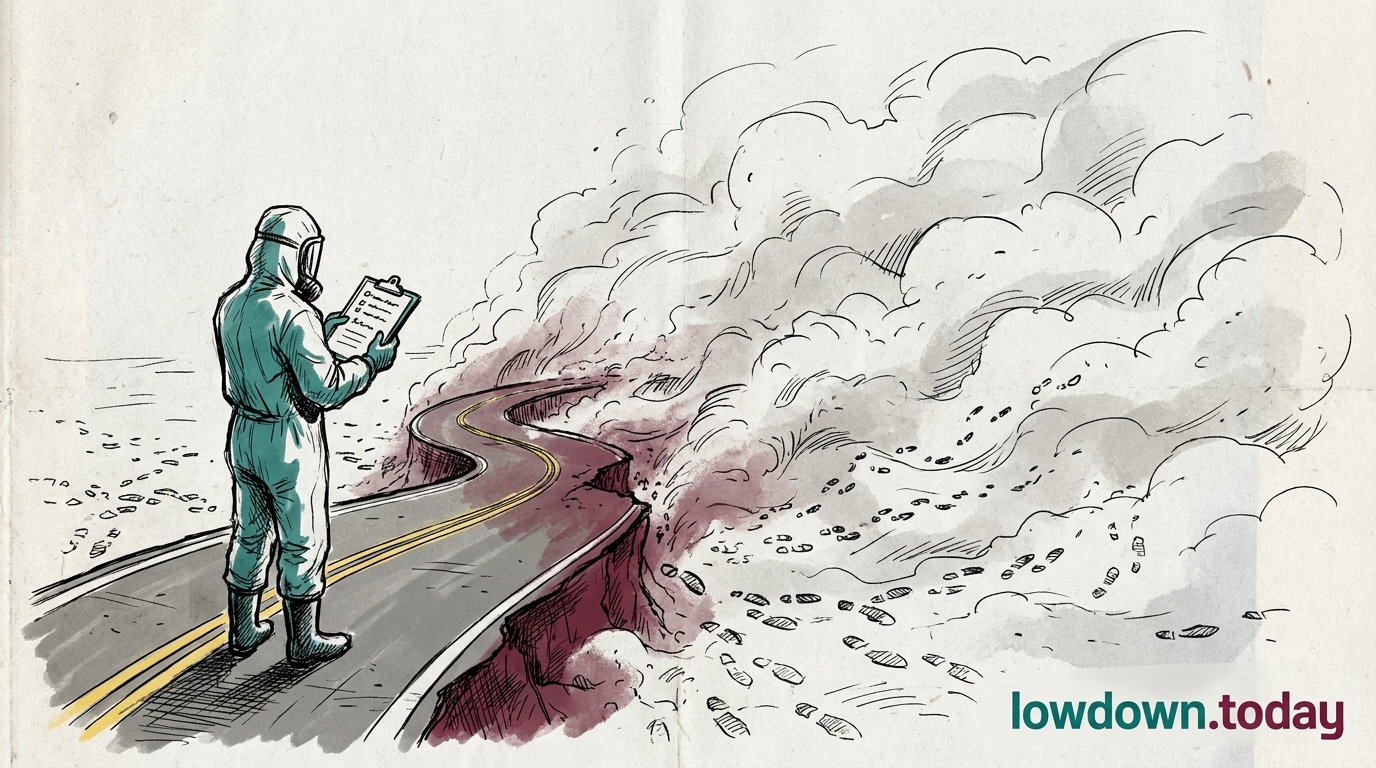
The fork in the model matters more than the R0. At the current patient isolation rate of roughly 20%, 65% of the model's simulation runs cross 20,000 cases by 22 August, approaching the scale of the 2014 to 2016 West Africa epidemic. Lift isolation to 70% and that worst case collapses to a 1% tail, with 90% of runs projecting fewer than 2,000 deaths. One controllable variable, the isolation rate, decides which of those two futures the outbreak follows.

That R0 of 2.51 sits below the 2014 Zaire-ebolavirus estimates of roughly 1.5 to 2.5 at peak, yet the projection runs worse, because isolation rather than intrinsic transmissibility is the binding control, and isolation is failing where the state apparatus is thin. The model was computed against a corrected baseline: WHO had carried 1,040 cases in late May before clearing its laboratory backlog and switching to confirmed-only figures. We lead on the projection and the correction rather than a raw count, because the counting method itself had inflated the earlier figure.

Deep Analysis

In plain English

Think of a disease's R0 number as how many people each infected person passes the illness to before they recover or die. An R0 of 2.51 means one person with this Ebola strain infects roughly two or three others, on average. For comparison, seasonal flu has an R0 around 1.3; measles is about 15. The CDC ran thousands of computer simulations of how this outbreak could play out. Right now, only about one in five patients is being isolated , kept away from others while infectious. At that rate, nearly two-thirds of the simulations ended with more than 20,000 cases by late August. But if isolation could be raised to seven in ten patients, almost none of the simulations got that bad. The hard problem is that two of the areas where the outbreak has spread are controlled by armed groups who block health workers from entering.

Deep Analysis
Root Causes

Bundibugyo's late-detected spillover around 19 February 2026 , estimated from the modelling's baseline , reflects a structural gap in DRC's zoonotic surveillance network. Ituri Province lacks the sentinel site density that would catch a haemorrhagic fever signal inside the 14-day window needed to initiate ring control before community amplification begins.

The 20% isolation rate is not primarily a capacity failure: treatment units exist in Bunia and Mongbwalu. It reflects a trust deficit built through years of contested Ebola responses in eastern DRC, where communities have torched treatment centres and attacked health workers. The CDC model treats isolation as a behavioural parameter, not an infrastructure one, making the gap a governance and community-engagement problem, not a beds problem.

What could happen next?
  • Risk

    At 20% isolation, CDC simulations give a 65% probability of 20,000+ cases by 22 August , an outcome that would place sustained pressure on global Ebola response capacity and increase the probability of exported cases beyond the current UAE-confirmed-clear incident.

    Short term · Assessed
  • Consequence

    The 70% isolation threshold required to collapse the worst-case is structurally blocked in IS-controlled Mambasa and M23-held South Kivu, meaning the model's best-case scenario requires a security intervention the health response cannot itself deliver.

    Immediate · Reported
  • Meaning

    The CDC's explicit comparison to the 2014 West Africa outbreak trajectory (also noted by Africa CDC) signals that the international community is framing this as a potential generational outbreak, not a contained regional event.

    Medium term · Assessed
First Reported In

Update #6 · Ebola outbreak gets an R0, and a fork

CDC MMWR· 9 Jun 2026
Read original
Different Perspectives
UK Government
UK Government
The Biological Security Strategy implementation report published 14 July commits the UK to deciding within twelve months whether to make DNA-synthesis screening mandatory, backed by GBP 1.83bn for biosecurity centres. It is a preemptive move on a threat that has not yet produced a UK incident.
Cambodia's Ministry of Health
Cambodia confirmed a nine-month-old girl in Phnom Penh as its fourth 2026 H5N1 case on 11 July, the country supplying four of the world's seven new human cases since February. The ministry's confirmed-case cadence is running well ahead of a US surveillance system that has recorded nothing new since March.
Knowledge Ecology International
KEI published proposed annex text on the day IGWG7 opened that would attach benefit-sharing duties to a product's market registration, regardless of whether the manufacturer used shared samples or only downloaded sequence data. It is the Africa Group's fallback position if the sample-based bargain fails to bind.
European Union
European Union
The EU and other industrialised states backed a hybrid model built on centralised infrastructure with more flexible access terms, the opposite design choice from the Africa Group's. Brussels wants conditions handled contractually once samples reach shared facilities, not attached to national custody of the material itself.
Africa Group / Algeria
Algeria, speaking for the Africa Group at IGWG7, backed distributed national and regional laboratories under binding access conditions, arguing that supplying states must keep legal control of samples rather than surrender them into shared infrastructure.
Uganda's Ministry of Health
Uganda discharged its last confirmed patient on 16 July and opened a 42-day countdown to declaring its own outbreak over, closing at 20 cases and 2 deaths with no new case since 21 June. This is a closing chapter running alongside DR Congo's still-worsening one, contingent on a border DRC can no longer see across.
