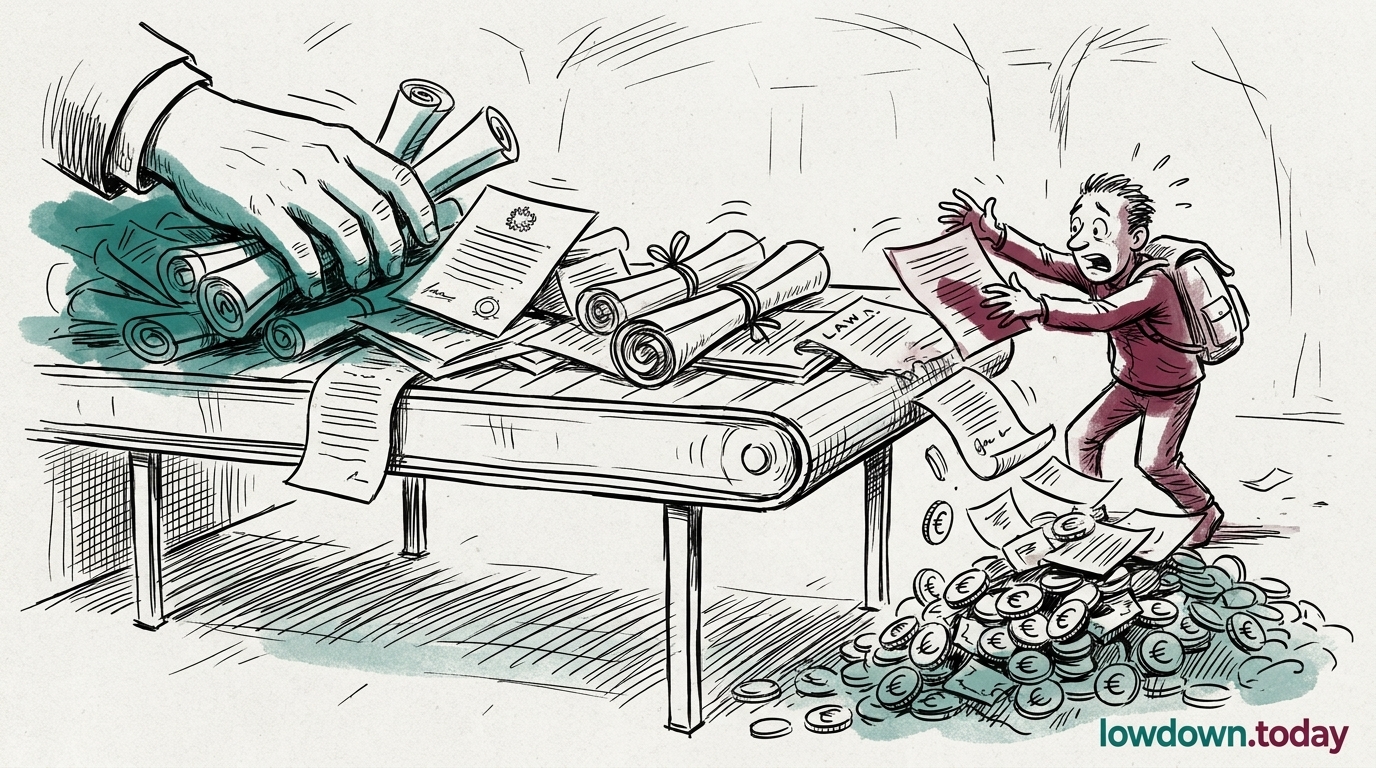
Georgia's second-reading labour migration law amendments took effect on 1 March 2026, establishing Ministry of Internal Affairs (MIA, the ministry handling police and domestic security) authority to conduct unannounced inspections of foreign nationals' homes and workplaces and imposing deportation and three-year entry bans on foreign nationals who participate in protests1. Remote workers employed by foreign companies fall, read narrowly, outside the law's explicit scope.
The law's phased implementation runs through next year: self-employed migrants have until 1 May 2026 to comply, and those on employment contracts have until 1 January 2027. Nika Simonishvili, former chair of the Georgian Young Lawyers Association, told OC Media, the independent South Caucasus outlet: "If you are performing work for Thailand, Georgia has no interest in regulating your participation in Thailand's labour market." On the text, he is right. The difficulty for nomads is that Georgian enforcement is not organised around the text.
Prime Minister Irakli Kobakhidze told Parliament on 13 February 2026 that Georgia would be "fully freed from illegal migrants", then added five days later that "without foreigners, many infrastructure projects could not be carried out". The contradiction is not accidental. The first line calibrates foreign nationals' self-assessment of personal risk. The second insulates the government from any domestic constituency that depends on foreign labour. Neither statement commits the government to a specific policy. No ministerial clarification has been issued on how either line applies to the roughly 7,200 remote workers based in Tbilisi.
The mechanism the rhetoric relies on is the MIA inspection authority. A narrow instrument paired with ministerial discretion is the pattern Hungary used between 2018 and 2020 to produce a foreign-resident chilling effect without a headline-generating restriction on any particular visa category. The protest-deportation clause in Georgia's text makes that effect tighter: any foreign national who participates in a street demonstration, including a housing or environmental one entirely unrelated to migration, can be removed and banned for three years. Remotely from Georgia, the country's bespoke nomad scheme, remains formally open at the $2,000-a-month income threshold. What has changed is the risk profile of actually using it. Georgia's posture on Russia's regional influence, which has drifted steadily away from EU alignment during 2024 and 2025, is the wider frame; the Georgian Dream government's broader anti-Western positioning is tracked in.


