Skip to content
Briefings are running a touch slower this week while we rebuild the foundations.See roadmap
Media's AI Pivot
10MAY

News Corp names $1.5bn Anthropic settlement

5 min read
16:44UTC

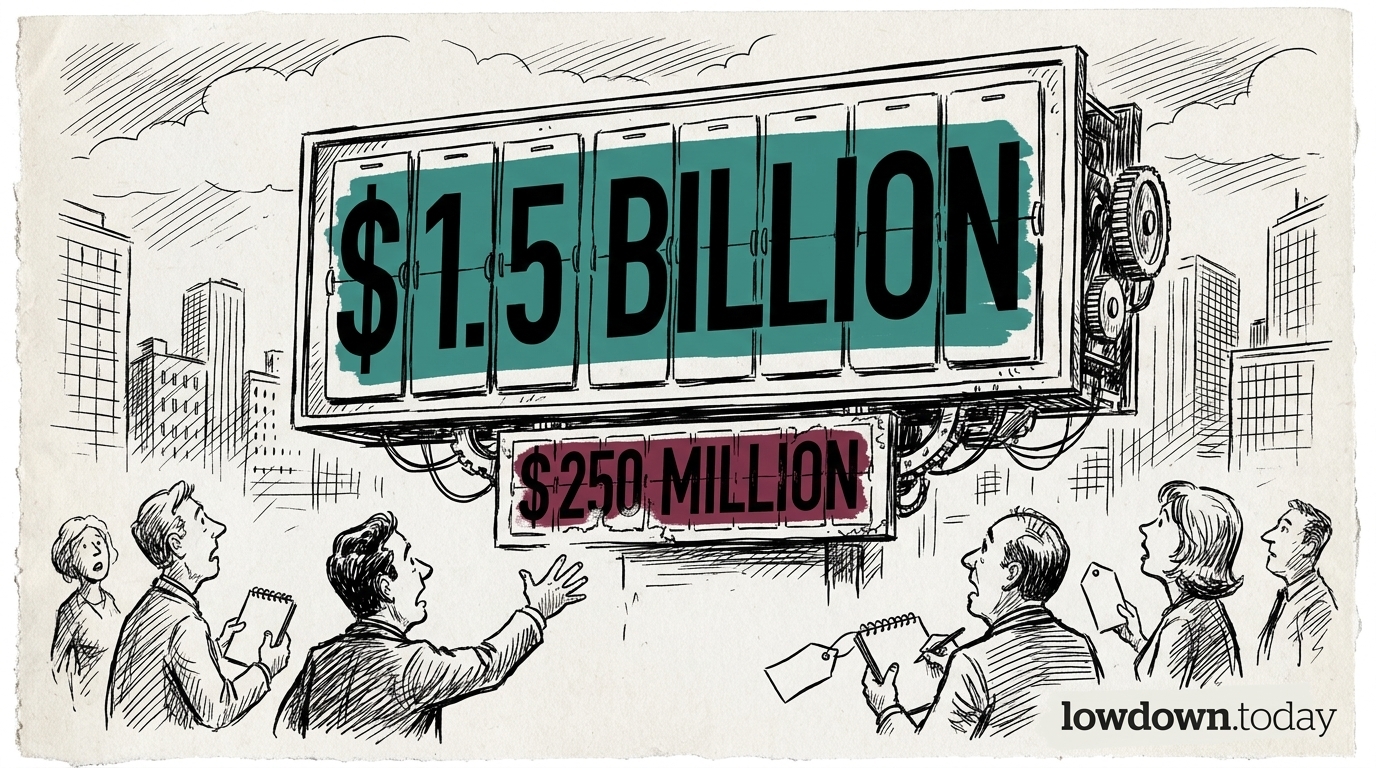
Robert Thomson told analysts on the Q3 FY2026 call that News Corp anticipates a $1.5 billion settlement with Anthropic, roughly six times its prior $250m OpenAI deal and the first publisher figure of this scale ever read into a SEC-filed transcript.

IndustryDeveloping
Key takeaway

News Corp's anticipated $1.5bn Anthropic settlement is the new benchmark for every tier-1 publisher's next AI licensing round.

News Corp chief executive Robert Thomson told analysts on the company's Q3 FY2026 earnings call on Friday 8 May 2026 that the publisher anticipates a $1.5 billion settlement with Anthropic, naming a specific dollar figure for an AI content arrangement at this scale in formal SEC-filed investor channels for the first time 1. Thomson called the figure "anticipated" rather than closed, and confirmed already-executed licensing deals with Meta and OpenAI alongside ongoing discussions with other AI companies 2.

The number re-prices an entire market. News Corp's previously reported deal with OpenAI sat at roughly $250 million over five years, identified in the Center for Journalism & Liberty's April 2026 report Same Gatekeepers, New Tollbooths 3. Thomson's $1.5bn is roughly six times the OpenAI benchmark. Every mid-tier publisher pursuing similar arrangements, from The Guardian to Le Monde to Axel Springer, will benchmark against $1.5bn rather than $250m in the next round. The negotiating asymmetry that favoured AI companies in closed bilateral talks has been partially closed by Thomson reading the number into a transcript that lands on the SEC's EDGAR filing system within hours of the call.

The scaling does not track crawler volume linearly. The same CJL report measured Anthropic's scrape ratio at 73,000 pages per human visitor returned, against OpenAI's 1,700:1 4. A 6x deal value against a 43x scrape-ratio gap suggests the figure is settling specific litigation exposure rather than pricing prospective licensing volume. Thomson's word choice carries the same signal: "anticipated" is the legal hedge a CEO uses when a number is read into the record before the ink dries on the agreement, leaving room for the figure to close at $1.5bn, restructure, or fall apart entirely.

Three commercial templates emerged in the same 30 days for how publishers extract revenue from AI platforms. News Corp anchors the lump-sum settlement model. The Reach plc / AWS pay-per-usage deal is the structural counter for publishers without comparable litigation exposure. Microsoft's Publisher Content Marketplace, launched February 2026, takes 15-50% as broker for the long tail. The templates encode different theories of who holds leverage, and they constrain who can participate at all: Reach cannot extract a $1.5bn figure, and News Corp does not need a marketplace's cut. Which template scales decides which publishers survive the AI traffic crash CJL mapped at minus 60% small-publisher referral over 2023-2025.


Deep Analysis

In plain English

When AI companies like Anthropic train their chatbots, they feed them billions of web pages, including articles from news organisations like the Wall Street Journal and The Sun. News Corp, which owns those titles, went to Anthropic and said: you used our content without paying for it, and now your chatbot can answer questions that our subscribers would otherwise pay to read. The $1.5 billion figure is what News Corp says it expects to receive as part of a settlement for that past use. The reason this matters beyond News Corp is that every other newspaper and broadcaster will now use $1.5 billion as their reference point in their own negotiations with AI companies. A publisher that was hoping for $50 million will argue that if News Corp got $1.5 billion, they deserve more too. It resets the price floor for an entire market.

Deep Analysis
Root Causes

Three structural drivers sit behind the $1.5bn figure. First, the DMCA's safe-harbour framework, written for web hosting in 1998, was never designed for AI training ingestion: AI companies occupied a regulatory gap that made litigation the only lever available to publishers, concentrating settlement capacity with those who could afford multi-year disputes.

Second, News Corp's content portfolio spans both the Wall Street Journal (premium financial content with measurable subscription value) and mass-market tabloid titles: the scrape ratio of 73,000 pages per human visitor returned by Anthropic generates a provable substitution claim on the Journal's paywall content, which a general news aggregator cannot make. That substitution argument is the litigation leverage that produced the figure.

Third, the timing reflects Anthropic's funding cycle: the company closed a $2.5bn Series E in March 2025. A settlement of this size is a balance-sheet decision, not a cash-flow one, made possible by Anthropic's capital position rather than its AI revenue.

What could happen next?
  • Precedent

    The $1.5bn figure sets the first publicly named benchmark for lump-sum AI content settlements, giving mid-tier publishers a cited anchor in bilateral negotiations with OpenAI, Google, and Meta.

    Immediate · 0.85
  • Risk

    If the settlement closes as a private commercial deal rather than through regulatory process, it produces no enforceable floor for publishers who cannot afford multi-year litigation, entrenching a two-tier market by litigation capacity.

    Medium term · 0.75
  • Opportunity

    European publishers with active competition-law or copyright-adjacent regulatory disputes (APIG in France, VG Media in Germany) may use the News Corp figure to quantify damages claims under the EU AI Act and the Copyright in the Digital Single Market Directive Article 4 opt-out framework.

    Short term · 0.7
  • Consequence

    AI companies will re-price their content acquisition strategies: future training data will be sourced from consented datasets and synthetic generation rather than open-web scraping, reducing future liability exposure at the cost of dataset quality for news-specific fine-tuning.

    Long term · 0.65
First Reported In

Update #1 · News Corp names $1.5bn AI settlement

The Motley Fool· 10 May 2026
Read original
Causes and effects
This Event
News Corp names $1.5bn Anthropic settlement
The figure becomes the public benchmark every tier-1 publisher will cite in its next AI licensing negotiation, re-pricing the lump-sum template that anchors one of three commercial models emerging in the same 30 days.
Different Perspectives
Sport rights holders (DAZN and Genius Sports)
DAZN's 30 April TikTok Serie A livestream and Genius Sports' Moment Engine launch mark the shift from social as the clip-reel to social as the live channel. Rights holders are ceding first-window distribution control in exchange for monetisation share and audience access, with DAZN's AI Delta Protocol reducing transport costs to make free livestreams viable on a P&L.
SMART STORIES consortium (IBC Accelerator)
Nine organisations including AP, BBC, NBCUniversal, Sky and ITV are building an open standard for story-context portability across agentic editing vendors. NBCUniversal VP Alex Bassett called the target 'something close to a minimum viable product rather than a simple proof of concept', with demonstrations due at IBC Amsterdam in September 2026.
EU regulators (AI Act Article 50)
Article 50 transparency obligations take effect 2 August 2026, with 84 days remaining and no major EU broadcaster publicly signed to the Code of Practice. The enforcement window coincides with the Q1 2026 earnings cycle, compressing the compliance decision horizon for RTL Group, M6 and ProSiebenSat.1.
Reach plc (UK mid-tier publisher)
Reach's April trading update disclosed a pay-per-usage AWS deal alongside Q1 group revenue down 6.9% and digital revenue down 8.1%. The framing treats usage-based licensing as a structural hedge against ad-revenue decline, with 'active discussions with several other tech platforms' signalling deliberate counterparty diversification.
News Corp (US tier-1 publisher)
Robert Thomson named the $1.5bn anticipated Anthropic settlement on the Q3 FY2026 earnings call, using 'anticipated' rather than 'agreed' as the settlement remains live. Reading a specific dollar figure into an SEC-filed transcript closes the information asymmetry that kept bilateral AI deal terms private across the industry.
