Skip to content
Briefings are running a touch slower this week while we rebuild the foundations.See roadmap
Iran Conflict 2026
16MAY

Commerce signs Nvidia clearance as summit's sole Iran-free deliverable

3 min read
12:41UTC

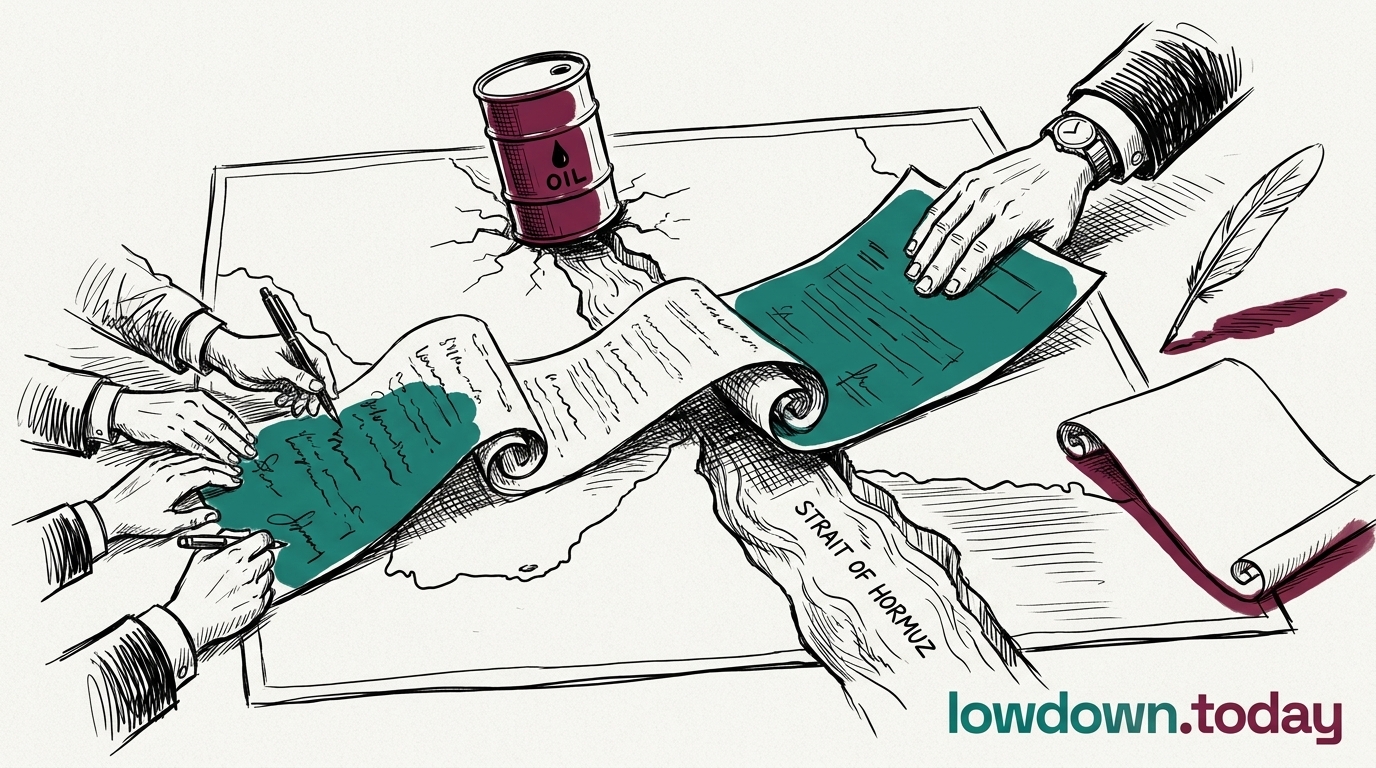
The only document Trump signed on Beijing summit Day 1 was a Commerce Department export clearance for 10 Chinese firms to buy Nvidia chips: a commercial concession timed to his arrival, with zero Iran instruments in 76 days of war behind it.

ConflictDeveloping
Key takeaway

Commerce signed chips for China on summit Day 1; the Iran instrument count stayed at zero.

The US Commerce Department signed export clearances on 14 May permitting 10 Chinese firms to purchase Nvidia chips, timing the announcement to the opening of the Trump-Xi Beijing summit. The White House presidential-actions index records zero Iran executive instruments across the entire 76-day war ; Trump arrived in Beijing having signed nothing on Iran since departing Washington . The chip clearance was the only signed deliverable on summit Day 1 and it was a commercial document, not an Iran instrument.

The pattern across 76 days is consistent: every Trump commercial action is signed; every Iran diplomatic move is verbal. Donald Trump offered China access to advanced American semiconductors on the day he most needed Chinese diplomatic weight on Iran, with no written quid pro quo on the nuclear file. A US commercial concession to Beijing was signed; a Chinese written commitment on Iran was not requested in any document 1.

The structural significance is not the chip clearance itself but what its sole occupancy of the signed-deliverable column reveals. Secretary of State Marco Rubio and Vice President JD Vance made public remarks on Iran at the same summit; those appear in the verbal register. Commerce signed paper. State signed nothing. The summit's opening day produced a technology trade concession dressed in the institutional register of a bilateral breakthrough.

Deep Analysis

In plain English

When Trump arrived in Beijing on 14 May to meet China's President Xi Jinping, the only document he actually signed was a Commerce Department clearance allowing ten Chinese companies to buy Nvidia computer chips. He signed nothing about Iran. That matters because the US had been fighting a war against Iran for 76 days without Trump ever signing a single Iran-related order. The chip clearance was a concrete gift to China; the Iran conversation remained verbal, with no written agreement to back it up.

Deep Analysis
Root Causes

The structural driver is the Trump administration's preference for bilateral commercial deliverables over multilateral institutional instruments. Commerce can sign export clearances under standing delegated authority without a presidential executive order. This lets the administration produce a signed document for the summit without producing a signed Iran document, maintaining the verbal-only Iran track while satisfying the summit's need for a tangible output.

The 76-day absence of a signed Iran instrument is the prior condition that makes this dynamic visible. Every signed US output in the conflict has been a Treasury or Commerce staff action under standing authority; every Iran-facing move has been a presidential verbal statement. The Nvidia clearance continues that institutional pattern at summit scale.

What could happen next?
  • Precedent

    Commercial export licences issued as summit-deliverables without a corresponding Iran written commitment establish a pattern where Beijing can expect technology concessions for facilitating verbal Iran conversations rather than written Iranian commitments.

    Medium term · 0.72
  • Risk

    If the Nvidia clearance exhausts US China-leverage before a written Iran instrument is secured, subsequent summits lose the commercial carrot that made Day 1 concession-making possible.

    Short term · 0.65
  • Consequence

    The asymmetry between Commerce-signed chip clearance and State-verbal Iran asks makes the summit's Iran output structurally contingent on future Chinese goodwill rather than any written obligation.

    Immediate · 0.78
First Reported In

Update #97 · Chips for Beijing, no paper for Iran

South China Morning Post· 14 May 2026
Read original
Different Perspectives
India (BRICS meeting host, grey-market beneficiary)
New Delhi hosted the BRICS foreign ministers' meeting on 14 May that Araghchi attended under the Minab168 designation, giving India a front-row seat to Iran's diplomatic positioning. India's state refiners have been absorbing discounted Iranian crude through grey-market routing since April; Brent at $109.30 means every barrel sourced outside the formal market generates a structural saving.
Hengaw / Kurdish human rights monitors
Hengaw's daily reports from Iran's Kurdish provinces remain the sole independent cross-check on Iran's judicial activity during the conflict. Two executions across Qom and Karaj Central prisons on 15 May and five Kurdish detentions on 15-16 May indicate the wartime judicial pipeline is operating independently of military tempo.
Pakistan (mediator and bilateral partner)
Islamabad spent its diplomatic capital as the US-Iran MOU carrier to secure LNG passage for two Qatari vessels through a bilateral Pakistan-Iran agreement, spending its mediation credit for direct economic gain. China's public endorsement of Pakistan's mediatory role on 13 May is the structural reward.
China and BRICS bloc
Beijing endorsed Pakistan's mediatory role on 13 May, one day after the BRICS foreign ministers' meeting in New Delhi. Chinese state banks are processing PGSA yuan toll payments; China has not commented on its vessels' continued Hormuz passage, but benefits structurally from a non-dollar toll system it did not design.
Iraq (bilateral passage partner)
Baghdad negotiated a 2-million-barrel VLCC transit without paying PGSA yuan tolls, offering political alignment in lieu of cash. Iraq's position inside Iran's adjacent bloc makes it the natural first bilateral partner and a template for how Tehran structures passage deals with states that cannot afford Western coalition membership.
Bahrain and Qatar (Gulf signatories)
Both signed the Western coalition paper while hosting US Fifth Fleet and CENTCOM's Al Udeid base, respectively. Qatar occupies the sharpest contradiction: it is on coalition paper while simultaneously receiving LNG passage through the bilateral Iran-Pakistan track, a position Doha has tacitly accepted from both sides.