Skip to content
Briefings are running a touch slower this week while we rebuild the foundations.See roadmap
Iran Conflict 2026
11MAY

Hormuz open in name; US ships targeted

4 min read
14:01UTC

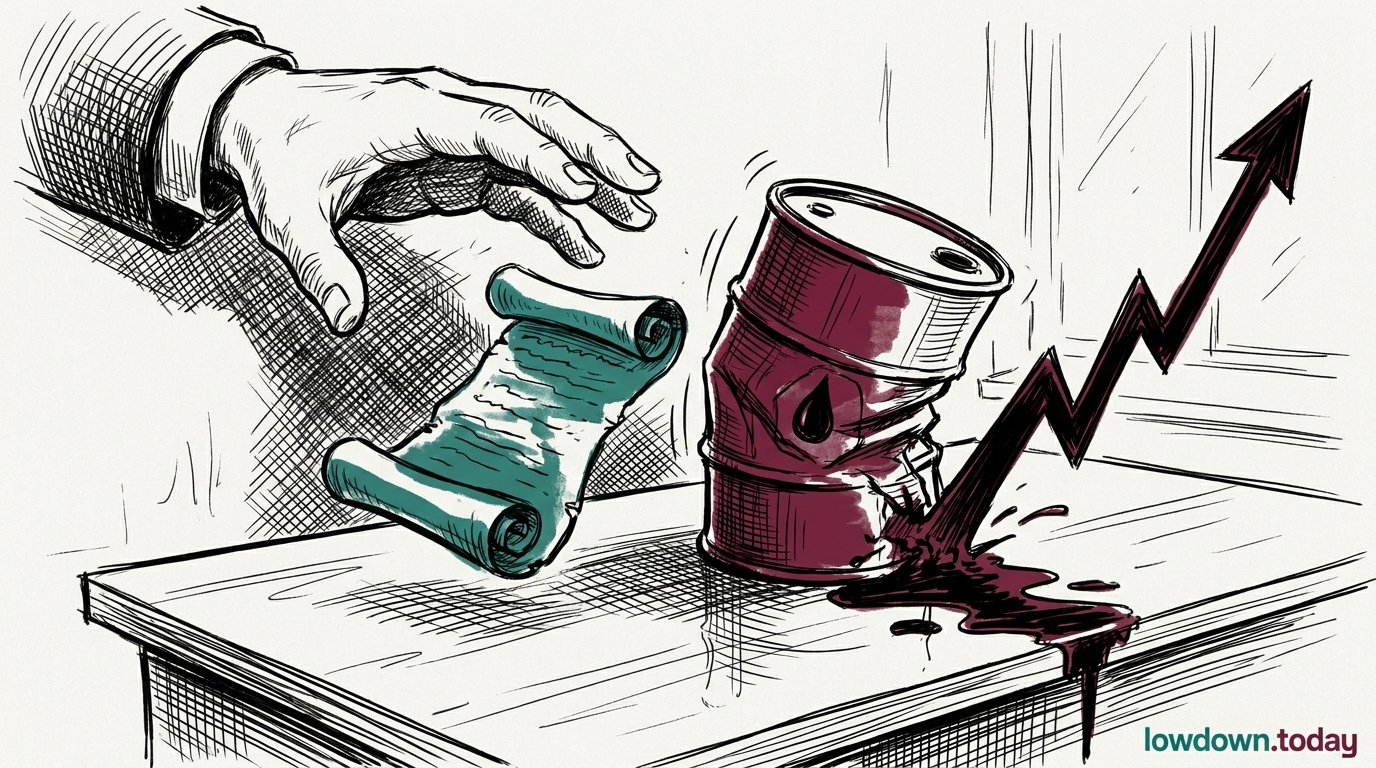
Iran declared the Strait of Hormuz officially open while designating US warships as legitimate targets — and not a single commercial vessel is transiting the waterway through which a fifth of the world's traded oil normally flows.

ConflictDeveloping
Key takeaway

Iran is engineering de facto closure of the Strait of Hormuz whilst maintaining deniability, shifting political responsibility for the economic disruption onto Washington.

Mohsen Rezai, secretary of Iran's Expediency Council, stated Saturday that the strait of Hormuz is "officially open" — but that US warships transiting the waterway are "legitimate targets." The IRGC's earlier VHF Channel 16 broadcast declaring that "no ships may pass" has not been rescinded. According to maritime tracking data, no commercial shipping is currently transiting the strait.

Rezai's statement is diplomatic repositioning, not an operational change. No commercial insurer will underwrite a Hormuz transit while the IRGC's closure broadcast remains active and US-Iranian naval forces are in combat. War-risk premiums, already prohibitive after the initial IRGC broadcast drove Hapag-Lloyd to suspend all transit and halted fourteen LNG tankers mid-voyage , would price out any remaining carrier. The practical result is a blockade without the legal declaration. Rezai's words are aimed at audiences in Beijing, New Delhi, Tokyo, and SeoulIran's own energy customers, the countries whose supplies are actually cut — to ensure that Tehran is seen as keeping the door open while Washington's military presence makes it impassable.

Approximately 21 million barrels of oil per day normally transit Hormuz — roughly a fifth of global supply. Oil tankers had begun avoiding the strait within hours of the first strikes . Brent Crude, trading at $73 per barrel before the operation began , is now in territory that makes every prior analyst forecast look conservative. Iran's own oil exports — between 1.3 and 1.8 million barrels per day — also flow through Hormuz. The interim council that assumed power hours ago needs that revenue. A prolonged closure damages Iran's remaining economic lifeline as surely as it damages its adversaries.

The deeper problem is that no one clearly controls the reopening. Even if the interim council wanted to resume normal shipping — and its need for oil revenue gives it reason to — the IRGC Navy operates with considerable autonomy. Its senior commanders are dead . Mid-ranking officers controlling fast-attack boats and anti-ship missile batteries along the strait's 34-nautical-mile chokepoint may not take direction from a civilian committee that has existed for less than 24 hours. The gap between Tehran's political statements and the IRGC's operational posture in the strait is where the global economy sits, waiting for someone with authority to give an order that sticks.

Deep Analysis

In plain English

The Strait of Hormuz is a narrow waterway between Iran and Oman through which roughly one-fifth of the world's oil supply passes every day. Iran's official says it is open, but the Iranian military's earlier broadcast declaring it closed has not been rescinded, and no tankers are actually moving through. This is a well-practised Iranian tactic: produce the disruption without formally owning it, so that when Japan or India complains about fuel shortages, Iran can point to US military presence as the cause rather than its own actions. The practical effect — a halt to approximately 20% of globally traded oil — is already in place regardless of what officials say.

Deep Analysis
Synthesis

The Hormuz situation crystallises the asymmetric logic of this conflict. Iran cannot match the US or Israel militarily, but it can impose costs on the global economy that are politically unbearable for Washington's allies. The de facto closure affects approximately 20% of globally traded oil — roughly 17 to 21 million barrels per day — and will ripple into energy prices, inflation, and growth forecasts across Asia, Europe, and the Americas within days. Iran is weaponising its geography at the precise moment when its military and political command structures are severely degraded: the IRGC has lost senior commanders, the constitutional apparatus is transitional, and yet the country retains the capacity to disrupt the global economy at scale. Rezai's statement signals that even a decapitated Iran can impose civilisational-scale economic disruption, which is itself a significant strategic message directed at Washington.

Root Causes

Iran's Hormuz leverage is structural: the country controls the northern shoreline and can threaten closure with relatively modest assets — mines, fast-attack boats, shore-based anti-ship missiles — that are difficult and expensive to neutralise. Rezai's statement is driven by two conflicting pressures: the domestic imperative to demonstrate the Islamic Republic retaliating meaningfully against the US and Israel, and the foreign-policy imperative to avoid alienating China, India, Japan, and South Korea, whose continued oil purchases are essential to Iran's economic survival under sanctions. The formula — officially open, but warships are targets — attempts to service both pressures simultaneously, directing consequences at Washington whilst preserving Iran's relationships with the Asian customers it cannot afford to punish.

Escalation

The situation is escalatory in a slow-burn rather than acute sense. The practical closure is already complete — no commercial shipping is transiting — so the immediate damage to global energy flows is occurring now. The critical question is duration: if the IRGC closure broadcast remains in force for weeks, the accumulating oil price shock will compound pressure on the US administration to either force the strait open militarily or absorb a significant economic cost. Trump's explicit threat to destroy Iran's navy (Event 10) creates a plausible pathway to direct naval confrontation in the Gulf, which would transform an indirect disruption into a hot naval war. Iran's framing of US warships as 'legitimate targets' simultaneously functions as a pre-authorisation of IRGC action if Washington moves to escort commercial vessels — a classic escalation ladder where each rung has been pre-announced.

What could happen next?
  • Consequence

    Global oil and LNG markets are absorbing a supply shock equivalent to approximately 20% of traded volumes; energy prices will rise materially within days unless commercial transit resumes.

    Immediate · Assessed
  • Risk

    If Iranian closure broadcasts remain in force and US naval escorts are deployed to protect commercial shipping, direct IRGC-USN engagement in the Gulf becomes a live operational risk.

    Short term · Assessed
  • Consequence

    Asian import-dependent economies — Japan, South Korea, India — face acute exposure to energy cost shocks and will come under domestic pressure to seek diplomatic off-ramps.

    Short term · Assessed
  • Precedent

    Iran's rhetorical formula — officially open, but warships are legitimate targets — may serve as a template for future coercive leverage that avoids the formal diplomatic costs of a declared blockade.

    Long term · Suggested
First Reported In

Update #4 · Interim council claims power; US troops die

EADaily· 1 Mar 2026
Read original
Causes and effects
This Event
Hormuz open in name; US ships targeted
The de facto closure of the Strait of Hormuz is the most consequential economic disruption of the conflict. Iran's rhetorical reframing shifts blame to Washington but changes nothing for the tankers sitting idle, the Asian economies dependent on Gulf energy, or an interim Iranian government that needs oil revenue to survive.
Different Perspectives
Israel
Israel
Israeli strikes on Hezbollah positions in Lebanon continued through the weekend, maintaining the secondary front. The IDF has publicly named Mojtaba Khamenei as an assassination target; his courier-governance mode complicates targeting but does not remove him from the order.
Russia
Russia
Putin told a Moscow press conference that Washington, not Tehran or Moscow, killed the Russia-custody uranium arrangement by demanding US-territory-only storage. Neither Tehran nor Washington has corroborated the account, which appeared in second-tier outlets only, consistent with a trial balloon rather than a formal position.
United Kingdom
United Kingdom
HMS Dragon was redeployed from the Eastern Mediterranean to the Middle East on 9 May, the first physical European platform commitment to the Gulf. The Ministry of Defence called it "prudent planning" while publishing no rules of engagement, no tasking order, and no vessel name, committing a named asset to a conflict zone before the political instrument authorising it exists.
United Arab Emirates
UAE air defences intercepted two Iranian drones over its territory on 10 May, a kinetic escalation six days after the Fujairah oil terminal strike that drew no formal protest. The three-state simultaneous operation, not the severity of individual strikes, appears to have crossed the threshold at which the GCC states collectively began responding.
Saudi Arabia
Saudi Arabia
Riyadh issued the first formal Gulf-state protest of the conflict on 10 May, demanding an "immediate halt to blatant attacks on territories and territorial waters of Gulf states", ending 10 weeks of channelling displeasure through OPEC+ quota discussions. The protest forecloses Saudi Arabia's preferred quiet-channel role and reduces the functioning back-channel architecture to Pakistan alone.
Qatar
Qatar
Doha is simultaneously a strike target, the site of the Safesea Neha attack 23 nautical miles offshore, and an active MOU mediator: Qatar's prime minister met Rubio and Vance in Washington the same weekend. Whether Qatar issues its own formal protest or maintains its dual role is the critical escalation indicator for the week of 11 May.