Skip to content
Briefings are running a touch slower this week while we rebuild the foundations.See roadmap
Iran Conflict 2026
1MAY

US strikes Kharg Island, spares the oil

4 min read
10:38UTC

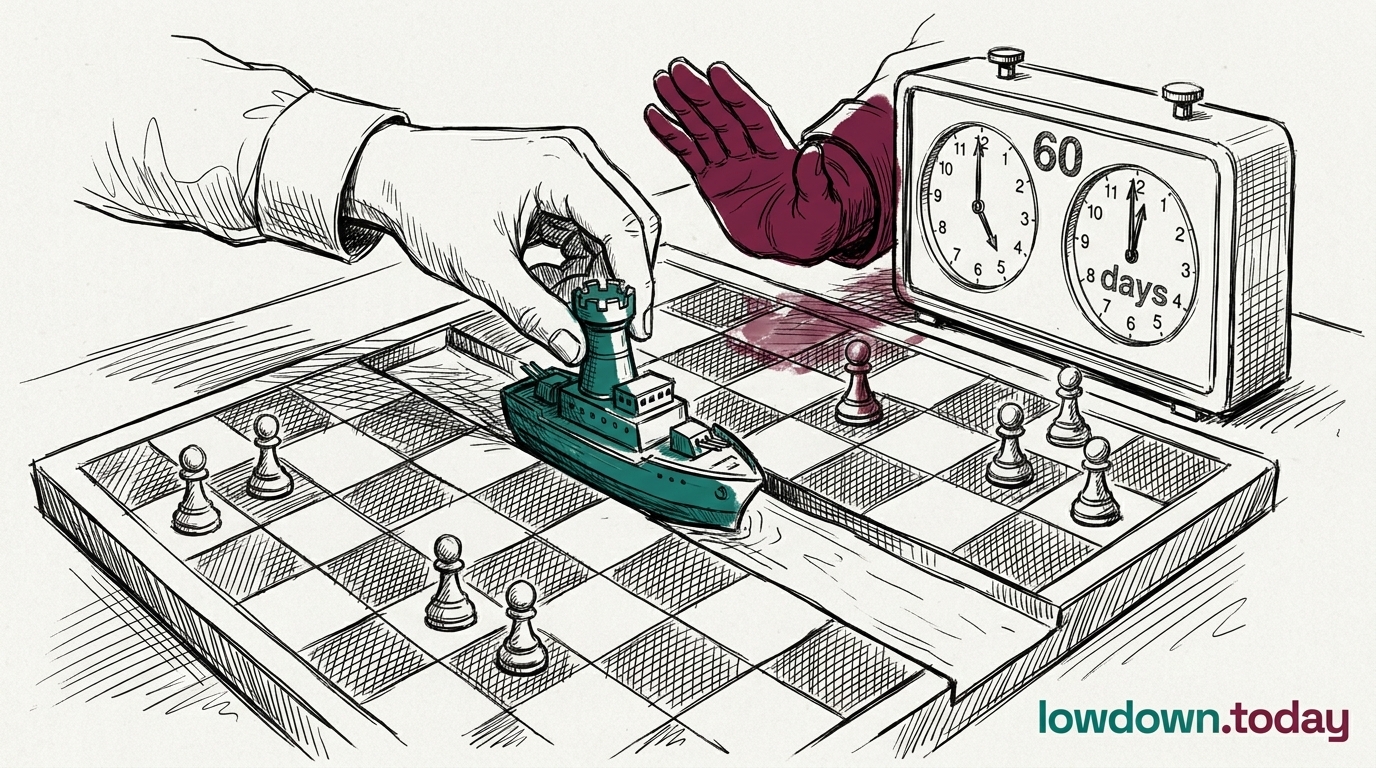
American forces hit military positions on the terminal through which 90% of Iran's crude exports flow — then left the oil infrastructure standing, converting it into a hostage.

ConflictDeveloping
Key takeaway

Striking military targets while sparing oil infrastructure converts Kharg into a hostage, not a target.

The United States struck military positions on Kharg Island on Friday — army defences, the Joshen Sea Base, an airport control tower, and a helicopter hangar, with more than 15 explosions reported. Trump stated forces had "totally obliterated every MILITARY target" on the island. Iran's government rejected the characterisation, describing the strikes as an attack on civilian economic infrastructure and sovereign territory. The distinction matters: Kharg handles roughly 90% of Iran's crude exports, and the line between military and economic infrastructure on a facility of that scale is not self-evident to the state losing it.

Kharg Island occupies a specific place in Iranian strategic memory. During the Iran-Iraq War, Iraqi aircraft attacked Kharg repeatedly between 1984 and 1988 as part of the Tanker War, attempting to cut Iran's revenue lifeline. Iran dispersed exports to Sirri and Larak islands and kept oil flowing. The island's defences have been rebuilt around the lesson that Kharg will always be a target. What is new is the scale of capability arrayed against it: the strikes that hit Tehran's Shahran refineries on Day 9 were Israeli; this was the US itself reaching Iran's economic centre of gravity.

The operational pattern is deliberate restraint as threat. By destroying military targets while leaving the terminal intact, the US demonstrated both reach and discretion — the former establishes capability, the latter creates a conditional. Iran's 11.7 million barrels of crude have continued transiting Hormuz to China since 28 February , and the shadow fleet that carries it docks at Kharg. The island is not just an export terminal; it is the physical chokepoint where Iran's remaining revenue meets the sea. Every barrel loaded there now loads under the implicit condition that the terminal's survival depends on decisions made in Tehran about Hormuz.

Iran's government has reason to contest the "exclusively military" framing. Kharg's military installations exist to defend the oil terminal. Destroying the defences while sparing the terminal does not leave the economic infrastructure untouched — it leaves it undefended. The strategic effect is to make Kharg's oil operations permanently vulnerable to a follow-up strike that requires no additional intelligence preparation or force positioning. The war's cost already exceeds $24 billion at $1.9 billion per day . The question of whether Kharg's oil terminal joins the target list is now the single most consequential economic decision of the conflict.

Deep Analysis

In plain English

Kharg Island is where nearly all of Iran's oil gets loaded onto tankers for export. The US destroyed military facilities there — a naval base, radar installations, an airport control tower — but deliberately left the oil loading equipment intact. Think of it as breaking the lock on the safe but leaving the money inside, while warning: 'Touch anything else and I return for the money.' Iran argues the distinction between military and civilian infrastructure on an active commercial export terminal is legally and practically artificial.

Deep Analysis
Synthesis

The US has executed a graduated coercive demonstration: sufficient destruction to prove capability, insufficient to trigger Iran's stated retaliation threshold. This is signalling through restraint. The strategic risk is that Iran reads the same evidence as proof of US hesitancy — that the withheld escalation will remain withheld regardless of Iranian actions.

Root Causes

Iran's 90% dependence on Kharg reflects a structural export concentration that decades of sanctions pressure did not successfully diversify. The Jask terminal, completed in 2021 specifically to bypass Hormuz, handles only a fraction of Kharg's capacity — the vulnerability was known, partially mitigated, but not resolved.

Escalation

The strike's deliberate restraint is itself escalatory in a non-linear way: it proves US precision-strike capability against Kharg while leaving the conditional threat credible. Iran cannot now dismiss the threat as bluster after witnessing the demonstration.

What could happen next?
  • Precedent

    The first direct US strike on Iranian sovereign territory in this conflict establishes a new threshold for direct military engagement, separate from proxy or proxy-adjacent operations.

    Immediate · Assessed
  • Risk

    Gulf shipping insurers may reclassify Kharg Island vicinity as an active war zone, raising underwriting costs for tankers calling at Iranian terminals even without further strikes.

    Immediate · Suggested
  • Consequence

    Iran may accelerate investment in Jask terminal capacity to reduce its strategic dependence on Kharg, diminishing US leverage over time.

    Medium term · Suggested
  • Meaning

    Selective destruction of military-only targets creates a legible signal hierarchy: the US is communicating restraint as much as capability, which structures the next escalation choice.

    Immediate · Assessed
First Reported In

Update #35 · Kharg Island struck; oil terminal spared

CNBC· 14 Mar 2026
Read original
Different Perspectives
Oil markets
Oil markets
Brent fell $1.05 to $106.0 on summit Day 1 but remains $5-7 above the post-ceasefire equilibrium analysts modelled in March; the market is pricing a holding pattern, not a breakthrough. OilPrice.com and Aramco CEO Nasser converge on buffer-exhaustion before Hormuz reopens if the blockade extends past mid-June.
Iranian dissidents and human rights monitors
Hengaw documented a five-prison simultaneous execution cluster on 13 May, with Gorgan appearing for the first time in the wartime register. Espionage charges framed as Israel-linked moharebeh now extend across Mashhad, Karaj, and Gorgan, using the war as judicial cover for protest-era detainees.
BRICS / Global South
Araghchi's Delhi appearance positioned Iran as a victim of US aggression before non-Western foreign ministers, with Deputy FM Bagheri Kani calling on BRICS to act against US aggression. India, as the largest non-Chinese user of Iranian-routed crude, faces pressure to balance bloc solidarity against its own shipping and sanctions exposure.
China
China
Beijing accepted the Nvidia chip clearance on summit Day 1 and gave Rubio verbal acknowledgement of Iran as an Asian stability concern, having already put Pakistan on paper as the mediatory channel on 13 May (ID:3253), deflecting the US ask for direct Chinese action without refusing it.
Iran (government and civilian diplomatic track)
Araghchi denied any Hormuz obstruction at BRICS Delhi on 14 May while Iran's SNSC had finalised a Hormuz security plan the day before. Israel Hayom's single-sourced 15-year freeze offer gives Tehran a deployable figure in non-Western forums regardless of corroboration; the state attributed 3,468 wartime deaths with no independent verification.
United States (Trump administration and Senate moderates)
Trump signed a chip clearance for 10 Chinese firms on summit Day 1 and zero Iran instruments across 76 days; Rubio and Vance made verbal Iran asks without paper. Murkowski voted yes on the 49-50 war-powers resolution after Hegseth told the Senate that Article 2 makes an AUMF unnecessary.