Skip to content
Briefings are running a touch slower this week while we rebuild the foundations.See roadmap
Iran Conflict 2026
1MAY

GL-U expiry nears with no renewal

2 min read
10:38UTC

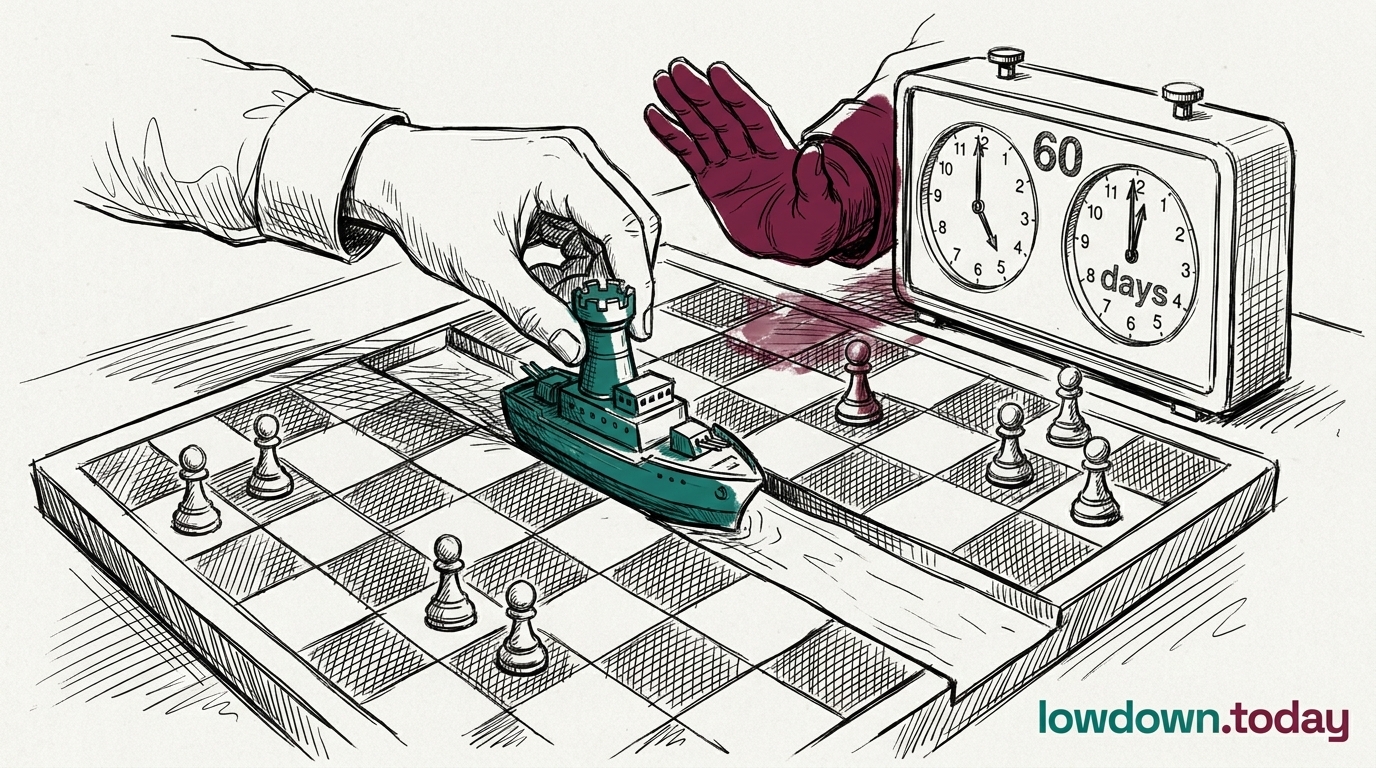
OFAC's General License U expires 19 April with no Treasury signal, after 23 days of silence on Iran sanctions.

ConflictDeveloping
Key takeaway

Treasury silence on GL-U renewal leaves stranded tankers in legal uncertainty.

OFAC (Office of Foreign Assets Control) General License U, which authorises the sale and delivery of Iranian-origin crude oil loaded before 20 March, expires on 19 April. No renewal, extension, or replacement licence has been issued as of 12 April. Seven days remain.

OFAC has not published a single Iran-related action since 20 March, 23 days of silence during an active war. It amended general licences for Russia and Venezuela in the same window, making the Iran silence conspicuous.

The licence's scope is narrow. It covers crude and petroleum products loaded on vessels on or before 20 March. It does not authorise new purchases, new loadings, or any transaction after its expiry. The oil tankers stranded in the Gulf are already in legal limbo; GL-U expiry would recriminalise any remaining deliveries.

GL-U expires three days before the ceasefire's own expiry around 22 April, creating back-to-back deadlines. A renewal would signal US willingness to keep a back-channel open despite the talks breakdown. Non-renewal would be read in Tehran as confirmation that the US is tightening pressure rather than extending space. Neither outcome has been signalled, which in itself is a signal: The Administration has not decided, or has decided not to show its hand.

Deep Analysis

In plain English

OFAC is the US Treasury office that enforces sanctions. When the US struck a deal to pause hostilities, it issued a special permit called General License U, which temporarily allowed oil that had already been loaded onto ships before 20 March to be delivered and sold legally. That permit expires on 19 April. With talks now collapsed, the US has not signalled any intent to renew it. If it expires without renewal, every Iranian oil delivery currently in transit becomes illegal under US sanctions, meaning any bank or company involved in processing that payment faces US penalties. For the 325 tankers stranded in the Gulf, this creates a legal cliff: even if they get through the strait, their cargo may become unsellable under US sanctions three days before the ceasefire itself expires. It is a tightening vice with two jaws closing simultaneously.

What could happen next?
  • Consequence

    GL-U non-renewal on 19 April would tighten the sanctions regime three days before the ceasefire expires on approximately 22 April, creating a legal and commercial cliff that compounds the diplomatic vacuum from the Islamabad collapse.

  • Opportunity

    A targeted GL-U renewal, possibly extended to cover additional Iranian oil deliveries, could serve as a back-channel signal to Tehran that the US is not yet escalating sanctions, potentially creating space for Pakistan to arrange a further round of talks.

First Reported In

Update #66 · Islamabad collapses: 10 days to expiry

Al Jazeera· 12 Apr 2026
Read original
Different Perspectives
Oil markets
Oil markets
Brent fell $1.05 to $106.0 on summit Day 1 but remains $5-7 above the post-ceasefire equilibrium analysts modelled in March; the market is pricing a holding pattern, not a breakthrough. OilPrice.com and Aramco CEO Nasser converge on buffer-exhaustion before Hormuz reopens if the blockade extends past mid-June.
Iranian dissidents and human rights monitors
Hengaw documented a five-prison simultaneous execution cluster on 13 May, with Gorgan appearing for the first time in the wartime register. Espionage charges framed as Israel-linked moharebeh now extend across Mashhad, Karaj, and Gorgan, using the war as judicial cover for protest-era detainees.
BRICS / Global South
Araghchi's Delhi appearance positioned Iran as a victim of US aggression before non-Western foreign ministers, with Deputy FM Bagheri Kani calling on BRICS to act against US aggression. India, as the largest non-Chinese user of Iranian-routed crude, faces pressure to balance bloc solidarity against its own shipping and sanctions exposure.
China
China
Beijing accepted the Nvidia chip clearance on summit Day 1 and gave Rubio verbal acknowledgement of Iran as an Asian stability concern, having already put Pakistan on paper as the mediatory channel on 13 May (ID:3253), deflecting the US ask for direct Chinese action without refusing it.
Iran (government and civilian diplomatic track)
Araghchi denied any Hormuz obstruction at BRICS Delhi on 14 May while Iran's SNSC had finalised a Hormuz security plan the day before. Israel Hayom's single-sourced 15-year freeze offer gives Tehran a deployable figure in non-Western forums regardless of corroboration; the state attributed 3,468 wartime deaths with no independent verification.
United States (Trump administration and Senate moderates)
Trump signed a chip clearance for 10 Chinese firms on summit Day 1 and zero Iran instruments across 76 days; Rubio and Vance made verbal Iran asks without paper. Murkowski voted yes on the 49-50 war-powers resolution after Hegseth told the Senate that Article 2 makes an AUMF unnecessary.