Skip to content
Briefings are running a touch slower this week while we rebuild the foundations.See roadmap
Iran Conflict 2026
21APR

One ship through Hormuz in 24 hours

3 min read
10:51UTC

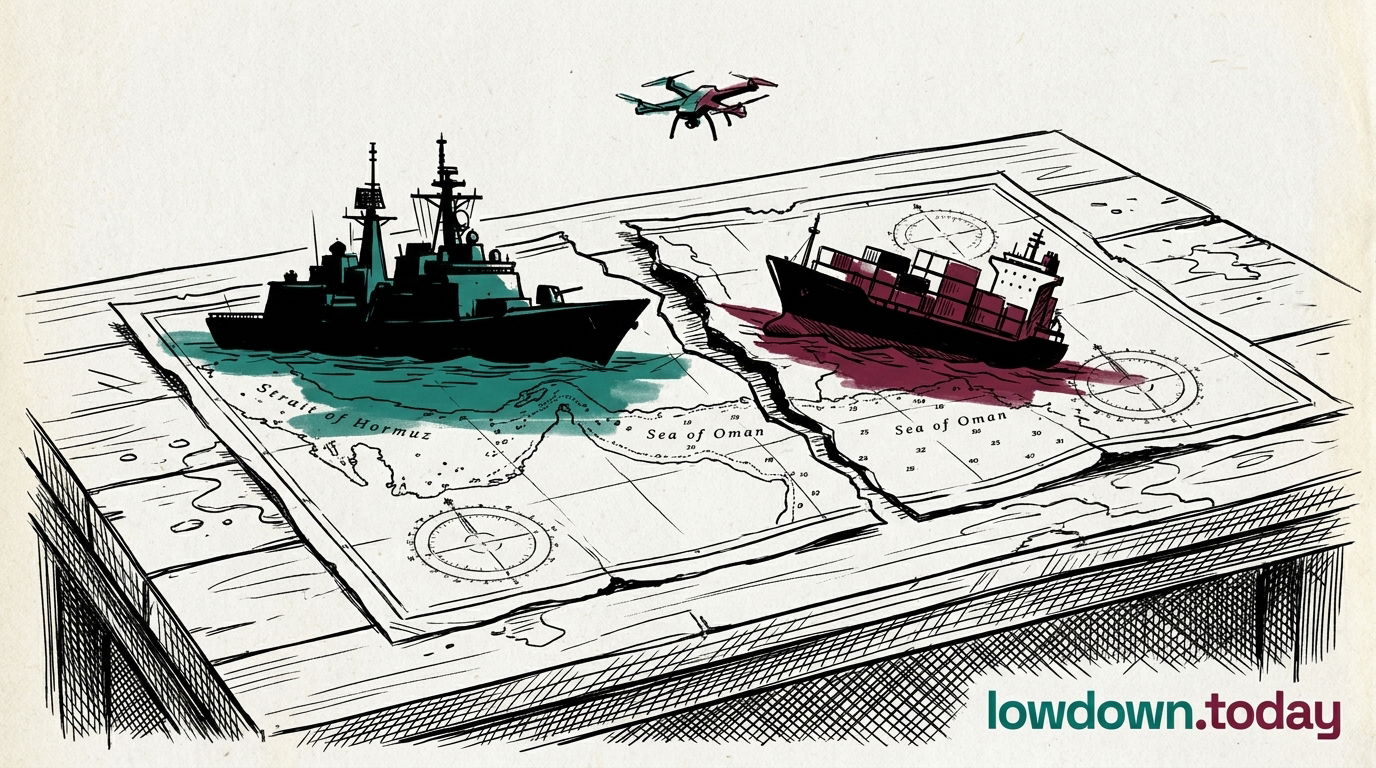
AIS vessel tracking data confirms what diplomatic language obscures: the Strait of Hormuz is effectively shut, with a single commercial transit recorded in a full day.

ConflictDeveloping
Key takeaway

Primary AIS data shows Hormuz is effectively closed; diplomatic framing overstates passage.

AIS (Automatic Identification System) monitoring data recorded one commercial cargo transit through the strait of Hormuz in the past 24 hours 1. The pre-war baseline was 30 to 50 daily transits carrying roughly 20 million barrels per day of crude and product exports. The diplomatic narrative of ships getting through collapses against this primary data.

Pakistan secured a second bilateral deal with Iran: 20 more vessels at two per day, bringing the total to approximately 40 Pakistani-flagged ships 2. Iran's state media framed it as a bilateral arrangement, not a concession on Hormuz sovereignty. Iran drew this distinction deliberately. Iran's five conditions for ending the war include permanent sovereignty over the strait; the Pakistan deal costs Tehran nothing on that legal question.

The IEA March report confirms nearly 20 million barrels per day of crude and product exports disrupted through Hormuz, substantially higher than the 8 mb/d production disruption commonly cited 3. Buried in the same report: demand growth revised down 210,000 barrels per day, an early recession signal. The Majlis toll bill is expected to be finalised this week. Passage would embed Hormuz control in Iranian domestic law, converting de facto IRGC control into a constitutional fact that no negotiator could concede.

Deep Analysis

In plain English

The Strait of Hormuz is a 33-kilometre-wide bottleneck in the Persian Gulf through which roughly 20% of the world's oil passes every day. In peacetime, 30 to 50 ships transit it daily. In the past 24 hours, one ship went through. Iran controls the strait because the narrow shipping channel runs through its territorial waters. It has been charging ships a toll of up to $2 million per vessel to pass. Most ships are not paying, and most are not transiting. The practical effect: oil, gas, and petrochemical supply chains are broken across Asia, Europe, and beyond. The IEA has released emergency reserves, but those cover about 20 days of the disruption at most.

Deep Analysis
Root Causes

Iran's control of Hormuz is not a wartime improvisation; it reflects decades of deliberate naval investment in asymmetric chokepoint denial capability. The IRGC Navy developed the toll system precisely because it understood Hormuz passage was its most durable strategic leverage.

The legal architecture underlying the closure combines de facto IRGC enforcement with Iran's domestic Majlis legislation and IMO notification. Each layer reinforces the others: IRGC control is enforceable, the Majlis bill makes it domestic law, and the IMO notification creates international legal precedent.

What could happen next?
  • Risk

    The IEA's 400 million barrel emergency reserve covers roughly 20 days of disruption; sustained closure beyond that point exhausts the buffer and triggers rationing.

    Short term · 0.75
  • Consequence

    Dow CEO's 250-275 day supply chain unwinding estimate means structural damage is locked in regardless of when the war ends.

    Medium term · 0.8
  • Risk

    Recession demand destruction already visible in IEA's -210,000 b/d revision may accelerate, masking the true supply shock until Hormuz reopens.

    Short term · 0.65
First Reported In

Update #51 · Iran hits aluminium plants; Hormuz emptying

International Maritime Organisation / UKMTO· 29 Mar 2026
Read original
Different Perspectives
Israel
Israel
The IDF struck a Lebanese army unit on 6 June, killing a colonel, and privately told Moscow that shelling near Bushehr was accidental, per Putin's SPIEF disclosure. Israel is advancing in Lebanon past an unenforced ceasefire text while maintaining a back-channel to Russia on nuclear-site deconfliction.
Lebanon
Lebanon
President Aoun told CNN on 5 June that Iran uses Lebanon as a bargaining chip and urged Hezbollah toward diplomacy; on 6 June an IDF strike killed a Lebanese army colonel on the Khardali-Nabatieh road. The Lebanese state is publicly rejecting Iranian tutelage while the army sustains casualties from Israeli fire and the Washington framework remains unenforced.
Bahrain
Bahrain
Bahrain's US Fifth Fleet headquarters was among the targets in the 5-6 June two-country salvo; its PAC-3 magazine stands at 87 per cent depletion with an 18-month resupply gap and no comparable arms sale has been announced. The state is defending a critical US regional command on a thinning interceptor stock.
Kuwait
Kuwait
Kuwait received a $1.98bn US counter-drone sale approval on the same day IRGC missiles targeted its bases; it expelled two Iranian diplomats on 4 June and filed a formal protest. The arms approval gives Kuwait a future capability but leaves a 6-18 month delivery gap that the salvo tempo is already pressing.
Russia
Russia
Putin reaffirmed Russia's offer to hold Iran's 440.9 kg HEU at SPIEF on 6 June, said Russia is not arming Iran, and disclosed that both the US and Israel privately told Moscow that shelling near Bushehr was accidental. The restatement casts Moscow as the only remaining mediator both sides call, a position serving Russian interests whatever the nuclear file produces.
Iran
Iran
The IRGC, per Iranian state media, fired seven ballistic missiles at US bases in Kuwait and Bahrain, the largest two-country salvo of the war, and framed the launches as lawful retaliation; Foreign Minister Araghchi rejected Aoun's bargaining-chip accusation and Velayati warned Beirut against diplomatic naivety. Tehran has sent no HEU counter-proposal since Araghchi confirmed no progress on 4 June.