Skip to content
Briefings are running a touch slower this week while we rebuild the foundations.See roadmap
Iran Conflict 2026
17APR

Iran airs AI Khamenei footage confirming gap

2 min read
09:52UTC

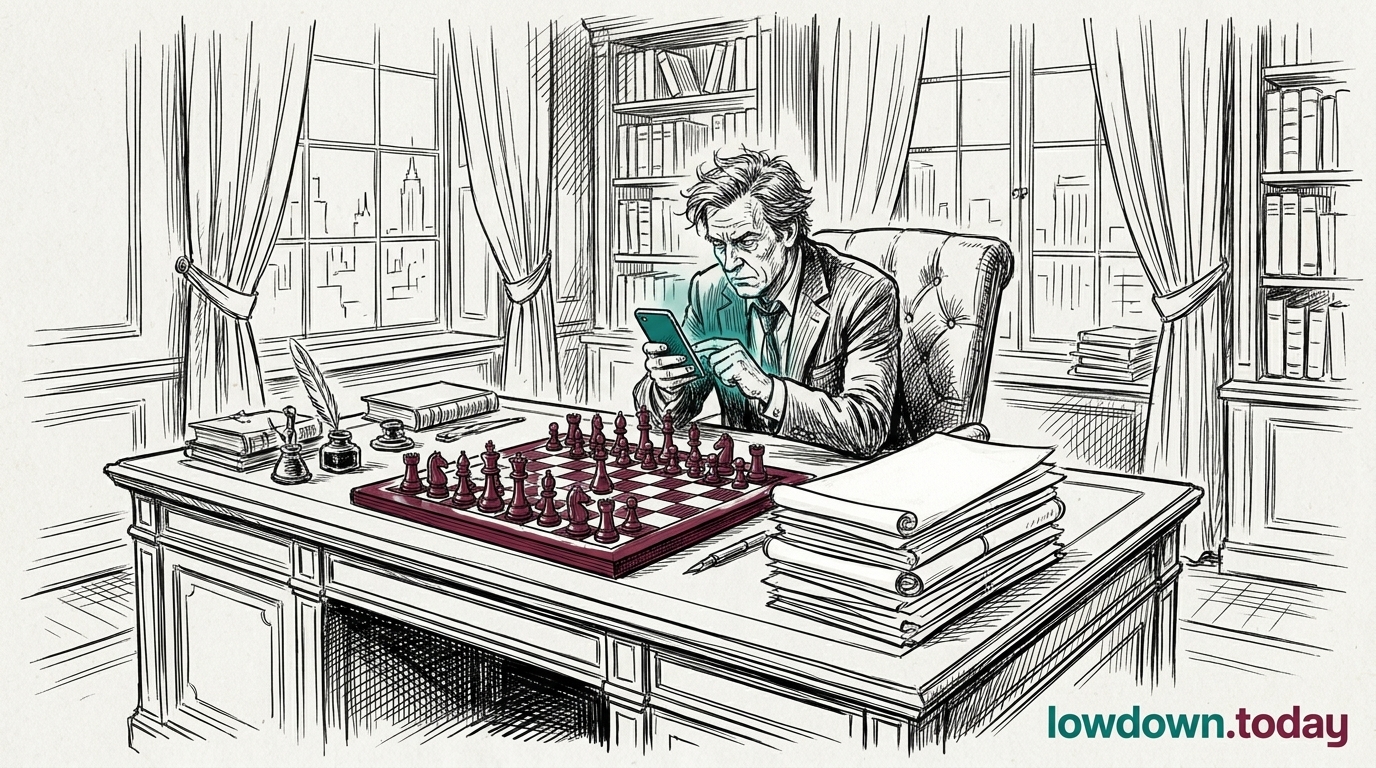
Iran's state broadcaster aired AI-generated footage of Mojtaba Khamenei in a war room because no authentic footage exists, a production choice that confirms rather than closes the gap.

ConflictDeveloping
Key takeaway

A state broadcasting AI footage of its leader confirms the footage gap, not fills it.

Iran state television broadcast an AI-generated video on Sunday showing Mojtaba Khamenei, Iran's Supreme Leader, entering a war room and surveying a map of Israel's Dimona nuclear research facility 1. No audio accompanied the footage.

If authentic footage existed, Tehran would use it. The production confirms the gap reported by the Soufan Center , which assessed that Khamenei is unconscious and unable to participate in decision-making, citing US and Israeli intelligence. The Times of Israel reported a competing assessment: disfigured but mentally sharp, taking part in meetings via audio conferencing. The Times of London described him as "incapacitated and receiving medical treatment in Qom." No in-person appearance has occurred since the 28 February strikes that killed his father, mother, wife, and son.

The operational consequences matter more than the health debate. Khamenei publicly authorised the ceasefire . If he cannot govern, the IRGC's 31 separate commands operate under the "Mosaic Defence Architecture" without centralised authority above them. Individual commanders can interpret ceasefire terms differently, refuse compliance, or escalate without authorisation.

Deep Analysis

In plain English

Iran's top leader is called the Supreme Leader. The current holder of that role is a man named Mojtaba Khamenei, who took the position in March 2026 after his father was killed in strikes. Think of the Supreme Leader as Iran's combination of head of state, commander-in-chief, and religious authority all in one. The problem is that Khamenei appears to have been seriously injured or incapacitated. There has been no verified footage of him since late February. When Iran's state television needed to show him, they used AI-generated video rather than real footage. There was no audio. Using a fake video of your own leader is significant because it tells you the real thing does not exist. If they had genuine footage of him looking healthy and in charge, they would use it. The AI video is a confirmation that they do not.

Deep Analysis
Root Causes

The AI video reflects a structural condition Iran's system was not designed to handle: a Supreme Leader incapacitated during active wartime. The 1979 constitution vests all armed forces command authority in the Supreme Leader personally; the Guardian Council's emergency provisions do not address a leader who is alive but non-functional.

The IRGC's mosaic defence architecture, comprising 31 semi-autonomous commands designed to survive decapitation, means the system can operate without central direction. It cannot, however, negotiate, authorise ceasefire terms, or make political commitments without a functioning Supreme Leader. The AI video is the regime's attempt to paper over a constitutional gap that has no formal resolution mechanism.

Escalation

The Khamenei incapacitation creates a diffuse escalation risk distinct from deliberate decision-making. The IRGC's 31 commands can interpret the ceasefire, the blockade, and Israeli actions in Lebanon through local command judgment rather than centralised authority. The risk is uncoordinated local responses that collectively breach the ceasefire without any single actor ordering it.

What could happen next?
  • Risk

    IRGC commands operating without centralised authority may breach ceasefire terms through uncoordinated local responses, producing escalation without a political decision behind it.

    Immediate · Medium
  • Consequence

    Any diplomatic commitment made by Iran, including the ceasefire Khamenei authorised, lacks verified executive authority, making it legally and politically contestable.

    Short term · Medium
  • Precedent

    Iran's use of AI-generated state media for a sitting head of state sets a precedent for synthetic political communication in authoritarian systems under wartime duress.

    Long term · Assessed
First Reported In

Update #67 · Trump blockades Iran on a tweet

Jerusalem Post· 13 Apr 2026
Read original
Different Perspectives
Human rights monitors (Hengaw, Amnesty International, Iran HRM)
Monitors documented a second death sentence for Zahra Tabari, 68, reported cemetery record deletions at Behesht-e Zahra, and a poll showing 81.5% of medical residents want to emigrate, against a background of 200+ confirmed executions since February. Iran's security courts operate at uninterrupted wartime tempo regardless of the diplomatic track.
Pakistan (mediator)
Pakistan (mediator)
Islamabad carried Trump's revised MOU demanding HEU destruction to Iranian negotiators, formally inheriting the role of sole active mediator after Oman's forced withdrawal. Pakistan lacks Oman's banking infrastructure for frozen-asset routing and carries its own regional stakes, making it a less structurally neutral broker.
Kuwait
Kuwait
Kuwait intercepted Iranian missiles and drones for a second time in days on 1 June, with air-raid sirens sounding nationwide, after invoking Article 51 self-defence on 28 May following the Ali Al Salem ballistic-missile strike. The repeated interceptions test whether Kuwait's domestic politics can sustain hosting US forces as a de facto co-belligerent.
China (PRC)
China (PRC)
Beijing sent scholars to Shangri-La rather than its defence minister and addressed Taiwan without mentioning Iran, maintaining bilateral energy corridor protection with Tehran while refusing diplomatic exposure at multilateral forums. Trump barred China as an HEU custodian on 27 May, removing Beijing from the deal architecture while China continues supplying DPI hardware that caps Iran's internet.
Lloyd's of London / war-risk underwriters
Lloyd's held its Hormuz war-risk designation at $10-14 million per voyage while Brent recovered to $93.91, maintaining the structural divergence from futures pricing that has persisted since late May. Underwriters require a UN Security Council resolution or government certification letter, not diplomatic optimism.
Gulf Cooperation Council states (Saudi Arabia, UAE, Bahrain, Qatar)
Five Gulf states wrote to the IMO on 21 May rejecting Iran's PGSA transit authority over international waters; Saudi Arabia and the UAE have not confirmed participation in the European Hormuz mission. The GCC is navigating between US security guarantees and exposure to Iranian fire, with no Gulf state formally co-belligerent except Kuwait.