Skip to content
Briefings are running a touch slower this week while we rebuild the foundations.See roadmap
Iran Conflict 2026
23MAR

Russia oil revenue -38% as Q1 deficit hits ceiling

4 min read
05:40UTC

Russia's Finance Ministry published data on 8 May showing oil and gas revenues fell 38.3% year-on-year in January-April 2026 to 2.3 trillion roubles, while federal spending rose 15.7% and the Q1 deficit alone exceeded the full-year target.

ConflictDeveloping
Key takeaway

Russia's Q1 deficit already exceeded its full-year target; Brent at $107 maximises the cost of every blocked cargo.

Russia's Finance Ministry published quarterly data on 8 May 2026 showing oil and gas budget revenues fell 38.3% year-on-year in January-April to 2.3 trillion roubles ($30.77bn) 1. The government's baseline assumption was 2.8 trillion roubles, at an implied $59/barrel Urals; the actual figure suggests Urals averaged closer to $45-50/barrel once volume losses are factored in, not the headline Brent figure.

The spending side moved the other way. Federal expenditure rose 15.7% year-on-year to 17.6 trillion roubles over the same period, driven by defence allocations. The Q1 budget deficit alone exceeded the full-year target, a figure the Finance Ministry published without editorial comment 2. Russia's National Wealth Fund (NWF) held $49.1 billion in liquid assets on 1 May; the Finance Ministry is purchasing 110 billion roubles in NWF assets in May to recapitalise. That is a balance-sheet transfer that moves liquid cover from one government account to another, making the NWF position look healthier while draining the underlying buffer.

Economic Development Minister Maxim Reshetnikov warned in late April that the NWF's liquid share could fall to roughly $12.5 billion by year-end . The 8 May data confirms the trajectory that warning implied. Ukraine's strikes had reduced Russian refinery throughput to a 16-year low in early May , compounding the structural volume loss from shadow fleet SDN exposure and the Druzhba Kazakh transit halt.

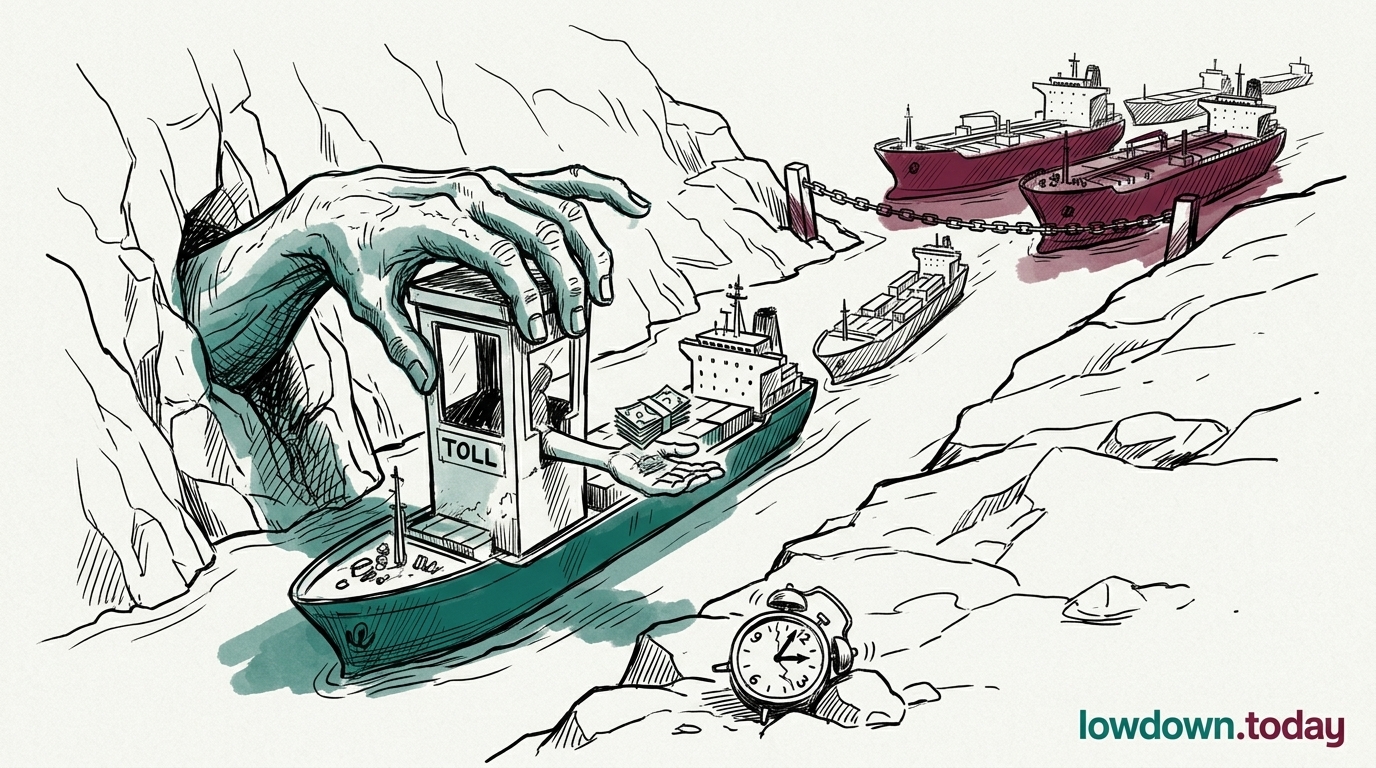
Brent at $107/barrel, elevated partly by the Iran ceasefire wobble, sits at the heart of the paradox. Each Russian barrel that cannot leave legally earns nothing while a barrel that can leave earns roughly $82-87 at the Urals discount. High oil prices make blocked volume maximally costly; Russia earns more per barrel precisely as the volume constraint tightens. The second half of 2026, against a military budget growing at 15.7% on a 38.3%-smaller oil revenue base, runs the arithmetic in one direction.

Deep Analysis

In plain English

Russia funds its war partly through money it earns selling oil and gas. In the first four months of 2026, those earnings fell by 38% compared to the year before, largely because Ukraine has been hitting Russian export infrastructure and Western countries have been blocking Russian oil shipments. Russia has a savings account called the National Wealth Fund, used when revenues drop. That fund stood at about $49 billion at the start of May. But the government is spending far more than it earns, and the savings are being drawn down faster than expected. One of Russia's own ministers warned the liquid part of the fund could be nearly empty by the end of 2026. That would not end the war immediately, but it would force Moscow to make difficult choices about what it can afford.

What could happen next?
  • Consequence

    NWF depletion to the $12.5 billion projected year-end level would trigger a structural spending debate inside Moscow, with potential cuts to social programmes, military procurement, or both, creating domestic political pressure Putin has not faced since 2022.

  • Risk

    If oil prices fall from their Iran-war premium as sanctions stabilise, Russia's revenue shortfall deepens, making the fiscal constraint binding sooner than the year-end projection.

First Reported In

Update #16 · 800 drones, three ceasefires, one cliff

TASS / Russian Finance Ministry· 13 May 2026
Read original
Different Perspectives
Gulf shipping and insurance markets
With Hormuz and Bab el-Mandeb both hostile at once, war-risk underwriters face their first dual-chokepoint pricing problem; the rerouting hedge that absorbed one closure is gone for Israeli-linked hulls. Any deal that reopens Hormuz without a Houthi stand-down clause delivers only partial shipping relief.
Russia and China
Russia and China
Russia and China met IAEA chief Grossi jointly in Geneva on 5 June to coordinate an advance blocking position against Washington's censure resolution, the first documented instance of proactive pre-session obstruction rather than reactive post-vote dissent. Beijing's move came four days after OFAC designated Shanghai Qianye Energy under Iran energy sanctions.
Saudi Arabia
Saudi Arabia
Saudi Arabia was left out of the emergency $4.01 billion Patriot waiver Qatar received on 2 May as its own PAC-3 stocks ran near-empty from intercepting Iranian salvoes over Aramco facilities. Riyadh is on a standard 18-month FMS queue behind a production line booked through 2030, with no equivalent priority to Qatar's Al Udeid basing role.
Houthis (Ansar Allah)
The Houthis declared a complete ban on Israeli Red Sea navigation on 8 June and struck Jaffa, their first attack on Israeli territory since April, seven days after the Tasnim authorisation to activate other fronts including Bab el-Mandeb. The declaration put both chokepoints under hostile authority simultaneously.
Iran
Iran
Iran agreed the 9 June mutual halt after the Mahshahr exchange and coordinated with Russia and China to block Washington's IAEA censure resolution, using the Board as a second front while the bilateral pause held on the military one. Tehran's acceptance of the Lebanon carve-out contradicts the linkage position it stated on 1 June.
Benjamin Netanyahu and the IDF
Israel struck the Karun Petrochemical plant at Mahshahr on 8 June over Trump's explicit objection, then agreed a halt with Iran the following day scoped on Israeli terms with Lebanon carved out. Netanyahu's posture is that the IDF will not accept Iranian missile factories as off-limits regardless of US diplomatic timelines.