Skip to content
Briefings are running a touch slower this week while we rebuild the foundations.See roadmap
Iran Conflict 2026
14MAR

Three counts of Iran's dead; all differ

4 min read
06:20UTC

Iran's government reports 1,444 killed after 18 days of war. An independent Kurdish human rights organisation counts at least 5,300 — a gap that mirrors the government's documented record of undercounting its own dead.

ConflictDeveloping
Key takeaway

Hengaw's 9:1 military-to-civilian ratio, if accurate, would represent unusually high precision for an 18-day urban air campaign.

After 18 days of war, three organisations report vastly different death tolls from Iran. Iran's Health Ministry: 1,444 killed, 18,551 injured. The Human Rights Activists News Agency (HRANA): 3,099 killed. Hengaw, a Kurdish human rights organisation with correspondents across Iran's provinces: at least 5,300 killed 1.

Hengaw's fifth report breaks this into 4,789 military and 511 civilian deaths — the latter including 120 minors and 160 women. Strikes have hit 178 cities across 25 of Iran's 31 provinces. The earlier Hengaw count of 4,300 dead as of Day 10 has risen by 1,000 in eight days — a pace consistent with continued strikes across western and central Iran even as Defence Secretary Hegseth claimed a 90% drop in Iran's missile output . The 91% military share of Hengaw's total suggests strikes are primarily hitting military targets, but 511 civilian dead in 18 days — in a country where AP reported that Tehran's 14 million residents have no air raid sirens, no warning systems, and no bomb shelters — reflects the toll of sustained aerial bombardment across populated areas.

The threefold gap between government and independent figures follows a documented pattern. During the 2022 Mahsa Amini protests, Iran's official count of those killed by security forces consistently ran at one-quarter to one-third of figures compiled by HRANA and Hengaw. Both organisations rely on hospital contacts, family networks, and provincial correspondents rather than government data. Iran's Health Ministry has institutional reasons to undercount: acknowledging military losses weakens domestic morale and contradicts the IRGC's narrative of effective defence; acknowledging civilian losses invites scrutiny under international humanitarian law. None of the three figures can be independently verified by international bodies — the lack of foreign media access inside Iran since 28 February makes external corroboration impossible.

Hengaw separately documented Iranian military forces relocating into schools, dormitories, and mosques — using civilian infrastructure for concealment 2. This violates the principle of distinction under international humanitarian law, which requires parties to separate military objects from civilian populations. Senior Iranian commanders have already dispersed from headquarters to makeshift tent encampments — as evidenced by the location where Basij commander Gholamreza Soleimani was killed. The dispersal reduces the effectiveness of strikes against command nodes but pushes military personnel into civilian spaces, compounding risks for non-combatants caught between sustained bombardment from above and their own armed forces sheltering among them.

Deep Analysis

In plain English

Three organisations are counting the dead in Iran and producing figures two to four times apart. The government has strong incentives to report lower numbers — high casualties undermine domestic morale and the narrative that Iran can absorb Israeli strikes. Independent monitors face the opposite problem: they rely on local networks that may over-report in heavily targeted or monitored areas. Hengaw specifically monitors Kurdish-majority provinces in western Iran — Kermanshah, Kurdistan, Ilam, and West Azerbaijan. These provinces contain major IRGC bases and have historically been strike priorities. If Israeli strikes concentrated on western Iran, Hengaw's regional focus would produce higher counts than national averages without being wrong about what it can observe. The 4,789 military versus 511 civilian breakdown is the most analytically significant detail in the entire casualty picture. A ratio of nearly 9 military deaths for every civilian death would be remarkable — most modern air campaigns in urban environments struggle to keep that ratio below 1:1.

Deep Analysis
Synthesis

The 4,789 military to 511 civilian breakdown has a significance the body does not draw out: if accurate, it implies a 9:1 military-to-civilian kill ratio across 178 cities after 18 days. That would represent a degree of targeting precision with few modern parallels in sustained urban air campaigns. It would also substantially complicate Iranian information operations, which rely on civilian casualty narratives to generate international sympathy and pressure for ceasefire — an adversary demonstrating 90% military targeting has a materially stronger IHL position.

Root Causes

The body explains the government-versus-independent gap but does not address the equally significant divergence between Hengaw (5,300) and HRANA (3,099). The structural reason: Hengaw's Kurdish-region geographic focus encompasses provinces where IRGC fixed installations are densest and where Israeli strikes appear most concentrated. HRANA covers all 31 provinces but has thinner local networks in western Iran. The two-count divergence may therefore reflect genuine geographic concentration of casualties rather than simple counting error.

Escalation

The casualty-count divergence does not drive tactical escalation directly, but if Hengaw's figures gain international acceptance — particularly with UN human rights bodies — political pressure for a humanitarian pause or formal investigation intensifies. Iranian domestic tolerance for casualties is a key variable: if Iranians come to understand the true scale via independent monitors rather than state media, internal pressure on both the IRGC and Pezeshkian's civilian government could affect Iran's willingness to sustain the conflict.

What could happen next?
  • Meaning

    Hengaw's 9:1 military-to-civilian kill ratio, if validated, would rank among the most precise targeting records of any air campaign in modern urban warfare.

    Medium term · Suggested
  • Consequence

    International humanitarian law accountability processes — ICC referrals, UN commissions of inquiry — will use the casualty-figure divergence as primary grounds for investigation once the conflict ends.

    Long term · Assessed
  • Risk

    If Hengaw's figures become the international reference point, domestic Iranian political tolerance for continued conflict may erode faster than IRGC hardliners anticipate.

    Short term · Suggested
  • Meaning

    Hengaw's geographic concentration in Kurdish provinces may yield a non-representative national figure — overstating casualties where strikes concentrated, or understating them where local monitoring is thin.

    Immediate · Suggested
First Reported In

Update #40 · Larijani dead; Israel hunts the new leader

Hengaw· 18 Mar 2026
Read original
Causes and effects
This Event
Three counts of Iran's dead; all differ
The threefold discrepancy between official and independent casualty counts follows the same pattern seen during the 2022 Mahsa Amini protests, where government figures consistently ran at one-quarter to one-third of independent tallies. Documented military relocation into civilian spaces compounds the risk to non-combatants from both sides of the conflict.
Different Perspectives
Gulf shipping and insurance markets
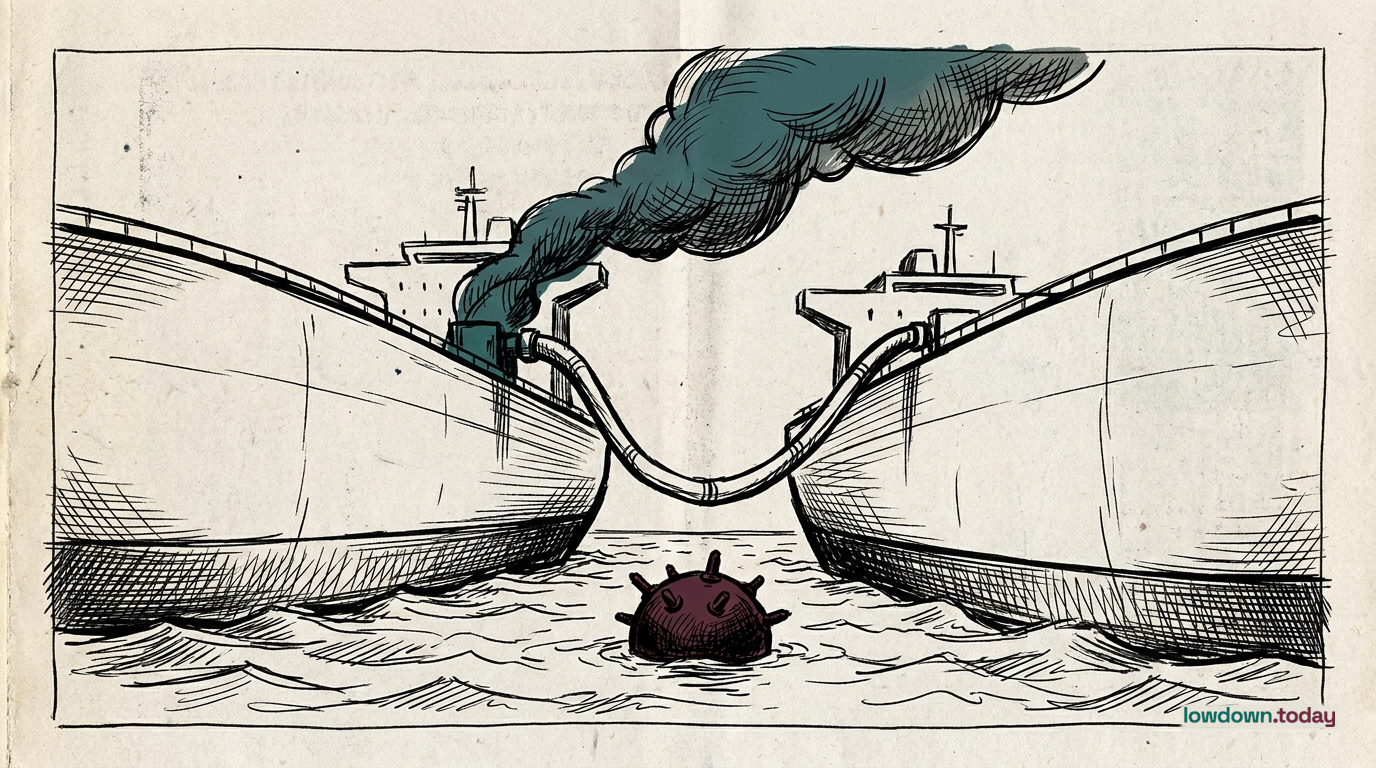
With Hormuz and Bab el-Mandeb both hostile at once, war-risk underwriters face their first dual-chokepoint pricing problem; the rerouting hedge that absorbed one closure is gone for Israeli-linked hulls. Any deal that reopens Hormuz without a Houthi stand-down clause delivers only partial shipping relief.
Russia and China
Russia and China
Russia and China met IAEA chief Grossi jointly in Geneva on 5 June to coordinate an advance blocking position against Washington's censure resolution, the first documented instance of proactive pre-session obstruction rather than reactive post-vote dissent. Beijing's move came four days after OFAC designated Shanghai Qianye Energy under Iran energy sanctions.
Saudi Arabia
Saudi Arabia
Saudi Arabia was left out of the emergency $4.01 billion Patriot waiver Qatar received on 2 May as its own PAC-3 stocks ran near-empty from intercepting Iranian salvoes over Aramco facilities. Riyadh is on a standard 18-month FMS queue behind a production line booked through 2030, with no equivalent priority to Qatar's Al Udeid basing role.
Houthis (Ansar Allah)
The Houthis declared a complete ban on Israeli Red Sea navigation on 8 June and struck Jaffa, their first attack on Israeli territory since April, seven days after the Tasnim authorisation to activate other fronts including Bab el-Mandeb. The declaration put both chokepoints under hostile authority simultaneously.
Iran
Iran
Iran agreed the 9 June mutual halt after the Mahshahr exchange and coordinated with Russia and China to block Washington's IAEA censure resolution, using the Board as a second front while the bilateral pause held on the military one. Tehran's acceptance of the Lebanon carve-out contradicts the linkage position it stated on 1 June.
Benjamin Netanyahu and the IDF
Israel struck the Karun Petrochemical plant at Mahshahr on 8 June over Trump's explicit objection, then agreed a halt with Iran the following day scoped on Israeli terms with Lebanon carved out. Netanyahu's posture is that the IDF will not accept Iranian missile factories as off-limits regardless of US diplomatic timelines.