Skip to content
You can now search across every topic, entity and event.What's new
Iran Conflict 2026
23AUG

Trump letter declares the war over

3 min read
19:02UTC

Donald Trump signed his first Iran paper in 65 days on Friday 1 May, telling Speaker Mike Johnson and Senate President pro tempore Chuck Grassley that 'hostilities have terminated'.

ConflictDeveloping
Key takeaway

Trump's first signed Iran paper in 65 days declares the war ended, not authorised.

Donald Trump sent near-identical letters to Speaker Mike Johnson and Senate President pro tempore Chuck Grassley on Friday 1 May, stating 'The hostilities that began on February 28, 2026 have terminated' and 'There has been no exchange of fire between United States Forces and Iran since April 7, 2026' 1. Both letters were filed under the War Powers Resolution (WPR), the 1973 statute that gives a president 60 days to wind down unauthorised military action.

The paper is Trump's first signed Iran instrument since 28 February. For 65 days the verbal claim that the war was 'Militarily WON' sat on White House transcripts without a corresponding signature; on 1 May the signature finally arrived, and what it certified is that the war is over rather than that it should continue. The instrument asserts an end-state rather than authorising any further action.

The legal architecture underneath came from Defense Secretary Pete Hegseth, who told the Senate Armed Services Committee on 30 April that the ceasefire 'pauses or stops' the 60-day clock . Senator Tim Kaine rejected that reading on the floor: 'I do not believe the statute would support that.' War powers expert Katherine Yon Ebright at the Brennan Center for Justice was blunter: nothing in the text or design of the WPR suggests the clock can be paused or terminated by ceasefire 2. Trump separately told reporters that the 1973 statute is itself unconstitutional, leaving The Administration running three mutually weakening positions in parallel: hostilities have ended, the clock has paused, and the statute is void. No Office of Legal Counsel opinion has endorsed any of them.

The practical effect is that any federal-court challenge to the war's legality now has a written instrument to cite, beyond a verbal claim from a podium. The contradiction with OFAC's same-day enforcement package, dispatched hours later, lands in the next event: two signed US government documents dated 1 May that argue with each other about whether there is still a war.

Deep Analysis

In plain English

In 1973, Congress passed a law called the War Powers Resolution to limit presidents' ability to wage war without approval. It says the president must tell Congress in writing soon after sending troops into combat, and then Congress has 60 days to either authorise the war or the troops must come home. Trump sent a letter on 1 May saying the fighting is over, which is his way of closing out the clock. Legal experts say the law does not work that way: the 60 days started automatically when the bombs fell in February, and no clause in the statute allows a president to extinguish that clock by letter.

Deep Analysis
Root Causes

The Trump administration's legal architecture around the Iran campaign has never produced a signed executive instrument: zero Iran-related executive orders across the 62-day period. Without a presidential instrument establishing the legal basis, there is no OLC opinion, no statutory framework, and no coherent theory of authority to which lawyers inside the executive branch can anchor compliance decisions.

This produces the clock problem structurally. The WPR clock runs from introduction of forces into hostilities, not from a signed presidential declaration. Every day the administration operated without an instrument, it allowed the clock to run while simultaneously developing theories (clock-pause, not-at-war, WPR unconstitutional) that would retroactively deny the clock ever started. The 1 May termination letter is the administration choosing the least costly of three losing arguments.

What could happen next?
  • Risk

    Without an OLC opinion supporting the termination-letter theory, federal agencies including OFAC, the Pentagon, and the intelligence community each apply their own compliance readings, creating parallel legal realities inside the executive branch that courts or Congress may eventually be asked to resolve.

    Short term · 0.82
  • Precedent

    If the termination-letter mechanism goes unchallenged, it establishes that any future president can close a WPR clock by unilateral notification, effectively gutting the statute's automatic-clock provision.

    Long term · 0.75
  • Consequence

    The 1 June operative legal cliff under Section 1544(b) (the 30-day withdrawal window that follows the 60-day engagement limit) still runs regardless of the termination letter's legal validity; if courts hold the letter void, the administration faces a statutory withdrawal obligation it has already publicly disclaimed.

    Short term · 0.71
First Reported In

Update #86 · Trump signs paper. The paper ends the war.

CBS News· 2 May 2026
Read original
Different Perspectives
Hizballah
Hizballah
Has not commented on the US Treasury's 20 August designation of ten people, including named couriers, over a cash network Treasury says moved money to it from the IRGC-Qods Force. ACLED recorded a sharp rise in attacks around it the same day.
Kuwait
Kuwait
Kuwait's Chief of the General Staff, Lieutenant General Khaled al-Shriaan, co-chaired the 16th US-Kuwait Joint Military Commission at the Pentagon on 21 August. Kuwait has not published what was agreed; only a summary of the meeting's existence and attendees is sourced.
Qatar
Qatar
Has not commented publicly on the $4.5bn KC-46A tanker Foreign Military Sale notification the State Department approved on 20 August. The notification opens a sale process; Doha has not confirmed whether it will proceed to a signed transfer.
Mohammad Bagher Ghalibaf
Told a Baghdad business meeting on 20 August that Iran will not endure a hungry population regardless of its military strength, against 87.9% point-to-point inflation and 128.1% food inflation for Tir. His fellow Majlis Economic Committee member Samsami separately warned a petrol price rise would ignite unrest.
US Navy
US Navy
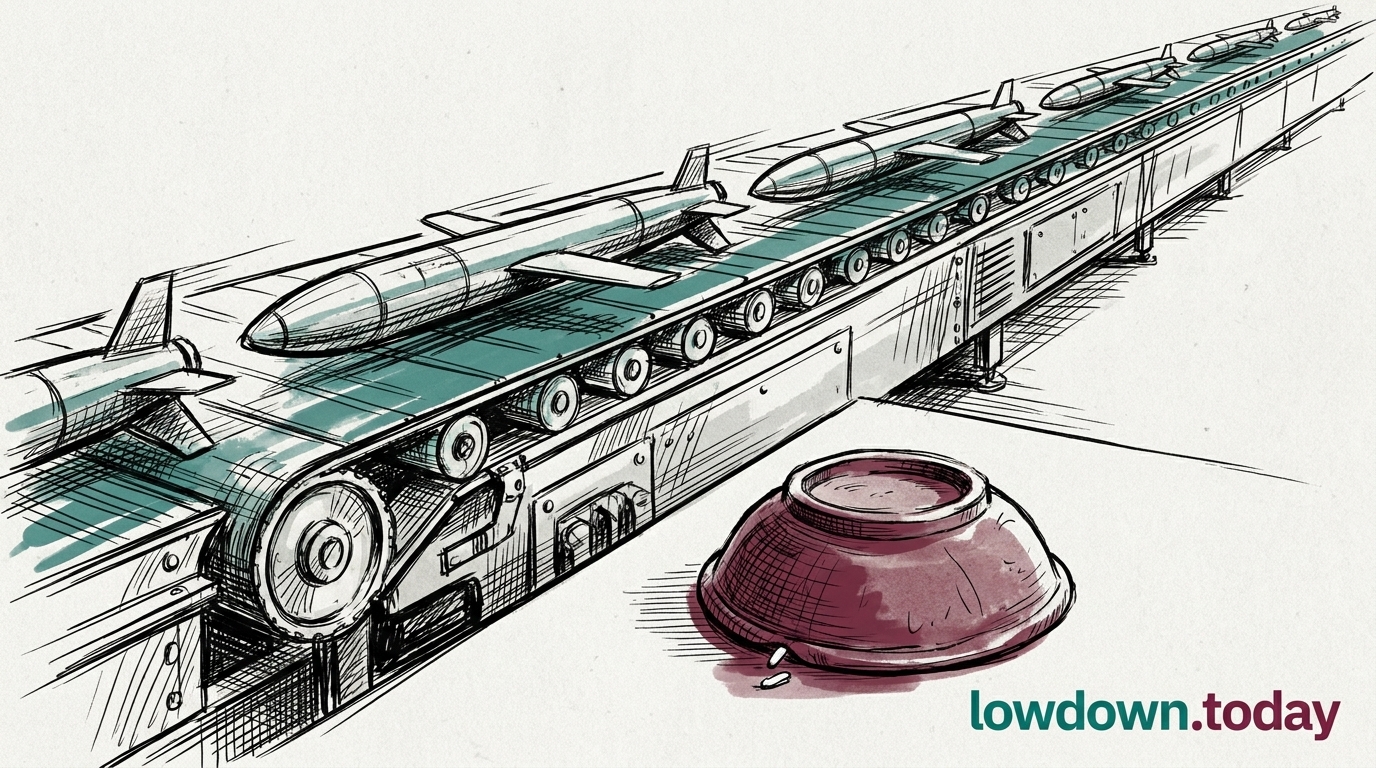
Signed a $22.9bn, seven-year contract with Raytheon on 17 August to raise Tomahawk output from about 60 a year to more than 1,000. The Acting Navy Secretary, quoted via an X post, framed it as the "Arsenal of Freedom" initiative; it replaces the 850 missiles fired by 1 April in about ten months at the new rate.
UK Maritime Trade Operations
UKMTO logged six armed men boarding a tanker 136 nautical miles east of Al Mukalla on 20 August and redirecting it toward Somalia. A vessel steered toward the Somali coast reads as an attempted seizure, a distinct hazard from the stand-off strikes the same lane has seen before.