Skip to content
You can now search across every topic, entity and event.What's new
Iran Conflict 2026
23AUG

Saudi jets hit Houthi sites at Hodeidah

3 min read
19:02UTC

Saudi Arabia bombed Houthi-held military sites around Hodeidah on 24 July. Coalition spokesman Turki al-Maliki said the port itself was untouched and three Red Sea harbours remain open.

ConflictDeveloping
Key takeaway

Saudi Arabia bombed sites around Hodeidah while insisting the port and two others stay open to shipping.

Saudi Arabia flew air strikes against Houthi-held military sites around Hodeidah, the Yemeni Red Sea port city, on 24 July 1. Coalition spokesman Turki al-Maliki said the targets were sites used to threaten commercial shipping, that Hodeidah port itself was not hit, and that "Hodeidah, Ras Issa and Salif remain open to navigation" 2. Houthi-affiliated Al Masirah said the strikes hit telecommunications facilities and Kamaran Island, with a woman injured; the Coalition disputes those specifics 3.

Riyadh spent years bombing Yemen and then largely stopped, and these raids follow the missile strike the Houthis claimed against the Saudi tanker Layla two days earlier . Hodeidah is the entry point for most of the food and fuel reaching Yemen's north, where the population depends on imports for the great majority of its calories. Bombing near it without hitting it is a distinction al-Maliki went out of his way to draw.

That distinction has a history. Coalition strikes on Hodeidah's cranes and berths in earlier phases of the Yemen war drew censure from UN agencies and slowed aid throughput for months afterwards. Naming Ras Issa and Salif alongside Hodeidah tells insurers, charterers and the World Food Programme that the corridor is meant to keep functioning, which is a commitment the Coalition can be held to if the next round goes closer.

The two accounts of what was struck cannot both be right, and neither side has published imagery. A woman injured is the only human cost either party has put on the record from these strikes.

Deep Analysis

In plain English

The Houthis are an armed group that controls most of northern Yemen and has Iranian backing. Saudi Arabia leads a military coalition that has fought them for years. After the Houthis hit a Saudi oil tanker, Saudi Arabia struck back at Houthi military sites near Hodeidah, a Yemeni port city the Houthis control. The Saudi military says it avoided hitting the port itself, which matters because that port is how most food and fuel reaches ordinary people in Yemen. Houthi-linked media gave a different account, saying the strikes hit communications facilities and an island, and that one woman was hurt. Saudi and Houthi-linked media disagree on exactly what was hit near Hodeidah.

Deep Analysis
Root Causes

The Houthis operate without a navy or air force but have built a missile and drone arsenal, developed with Iranian technical support, capable of threatening Red Sea shipping from fixed positions on Yemen's coast, which is what makes Hodeidah's surrounding military sites, rather than the group's negligible conventional forces elsewhere, the logical target for any Saudi response to a tanker strike.

Saudi Arabia's coalition faces a structural constraint the Houthis do not: Hodeidah port supplies most of the food and fuel reaching a Yemeni population already short of both, so any strike that damages port operations directly risks a humanitarian crisis that would cost Riyadh more in international standing than the military value of hitting it, explaining the coalition's repeated public assurances the port itself was untouched.

Escalation

Direction: escalatory but bounded. Saudi Arabia responded to a tanker strike within the same day rather than absorbing it, but both sides' public statements suggest an effort to keep the exchange contained to military targets rather than widen it toward the port infrastructure both sides depend on being left alone.

What could happen next?
  • Consequence

    A same-day Saudi response to the NCC Masa strike establishes that Riyadh will retaliate for tanker attacks rather than treat them as isolated incidents to absorb.

  • Risk

    Disputed claims over what was actually hit near Hodeidah, military sites versus telecommunications infrastructure, could become a point of escalation if Houthi-aligned media's account gains traction internationally.

First Reported In

Update #161 · Bahrain and Kuwait struck Iran, WSJ reports

Al Jazeera· 25 Jul 2026
Read original
Different Perspectives
Hizballah
Hizballah
Has not commented on the US Treasury's 20 August designation of ten people, including named couriers, over a cash network Treasury says moved money to it from the IRGC-Qods Force. ACLED recorded a sharp rise in attacks around it the same day.
Kuwait
Kuwait
Kuwait's Chief of the General Staff, Lieutenant General Khaled al-Shriaan, co-chaired the 16th US-Kuwait Joint Military Commission at the Pentagon on 21 August. Kuwait has not published what was agreed; only a summary of the meeting's existence and attendees is sourced.
Qatar
Qatar
Has not commented publicly on the $4.5bn KC-46A tanker Foreign Military Sale notification the State Department approved on 20 August. The notification opens a sale process; Doha has not confirmed whether it will proceed to a signed transfer.
Mohammad Bagher Ghalibaf
Told a Baghdad business meeting on 20 August that Iran will not endure a hungry population regardless of its military strength, against 87.9% point-to-point inflation and 128.1% food inflation for Tir. His fellow Majlis Economic Committee member Samsami separately warned a petrol price rise would ignite unrest.
US Navy
US Navy
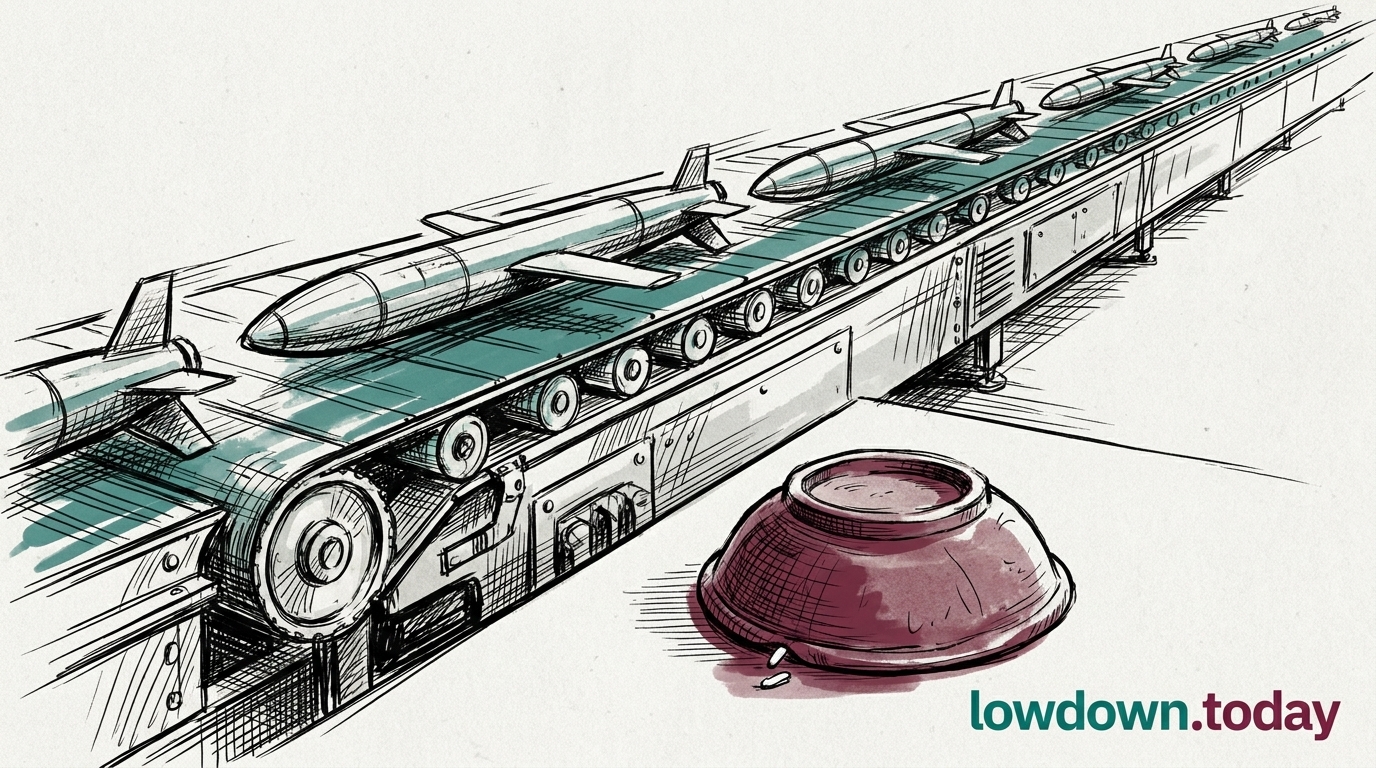
Signed a $22.9bn, seven-year contract with Raytheon on 17 August to raise Tomahawk output from about 60 a year to more than 1,000. The Acting Navy Secretary, quoted via an X post, framed it as the "Arsenal of Freedom" initiative; it replaces the 850 missiles fired by 1 April in about ten months at the new rate.
UK Maritime Trade Operations
UKMTO logged six armed men boarding a tanker 136 nautical miles east of Al Mukalla on 20 August and redirecting it toward Somalia. A vessel steered toward the Somali coast reads as an attempted seizure, a distinct hazard from the stand-off strikes the same lane has seen before.