Skip to content
You can now search across every topic, entity and event.What's new
Iran Conflict 2026
23AUG

Iran: six more months; trust level zero

2 min read
19:02UTC

Tehran's foreign minister told Al Jazeera Iran is ready for at least six months of conflict and that no negotiations exist in any form, as the IRGC declared Iran alone would decide when the war ends. The gap between Washington's two-to-three-week withdrawal timeline and Iran's six-month posture is the single most important number in this conflict.

ConflictAssessed
Key takeaway

Iran's six-month war posture makes the $14-18 oil risk premium dramatically understated if Tehran holds.

Iranian Foreign Minister Abbas Araghchi told Al Jazeera on 1 April that Iran is prepared for at least six months of war and stated the trust level is zero, with no negotiations existing in any form. Pakistan had confirmed indirect US-Iran talks were underway just days earlier ; Araghchi's statement effectively closed that channel publicly.

Araghchi's six-month declaration is not bluster. It is a formal statement of strategic intent, broadcast internationally, with institutional backing from both the IRGC and the Armed Forces. The IRGC spokesman said Iran will determine when the war ends. The Armed Forces spokesman called Trump delusional. These are not hedged diplomatic formulations; they mirror the language Ghalibaf used when he simultaneously rejected indirect talks while Pakistan was announcing them .

The oil market is pricing Trump's version of events. Brent at $107.72 reflects partial belief in near-term resolution. Goldman Sachs estimates the geopolitical risk premium at $14-18 per barrel. Brent had crashed from $126 to $97 on Trump's first deadline extension, then recovered sharply when Iran rejected the terms. The same pattern now repeats: markets price the American announcement; Iran's response prices reality.

If Tehran holds for six months, the $14-18 premium is not structural floor but structural ceiling. Iran has already demonstrated it can sustain this pace: the Islamabad Four talks broke without a statement , the Hormuz toll legislation is advancing to full parliament vote, and the NPT withdrawal bill moves on the same track. Iran is building the legal and military architecture for a prolonged conflict, not preparing an exit.

Deep Analysis

In plain English

Iran's foreign minister said publicly that Iran is ready to fight for at least six months and has zero trust in negotiations with the US. He said no talks are happening, not even informal ones. This matters because the US says the war will be over in two to three weeks. Both sides cannot be right. The oil market currently believes the Americans. If Iran is right, the disruption to global oil supply ; about one in five barrels in the world ; continues for months, not weeks. That means higher petrol prices and higher costs for almost everything transported by lorry or ship.

Deep Analysis
Root Causes

Iran's zero-trust posture stems from the US withdrawal from the JCPOA in 2018 under Trump's first term. Araghchi's reference to yielding no results is a direct callback to the experience of negotiating the deal and watching it abandoned unilaterally.

The IRGC's institutional interest in the war also differs from the foreign ministry's: the Guards have consolidated power over state functions during Khamenei's absence and have no political incentive to end a conflict that has elevated their authority.

Escalation

Iran's institutional declarations ; the Hormuz toll law, the NPT withdrawal bill, the six-month war posture ; are each individually reversible but collectively suggest a government that has made a strategic decision to contest rather than accommodate the US campaign.

What could happen next?
  • Risk

    Oil markets are mispricing the conflict duration; a six-month war implies structural rather than temporary supply disruption.

    Short term · Assessed
  • Consequence

    Iran's institutional war-making apparatus ; Hormuz toll law, NPT withdrawal bill ; becomes entrenched and harder to reverse with each week of conflict.

    Medium term · Assessed
  • Risk

    Zero-trust posture means no back-channel exists to de-escalate if either side reaches a threshold requiring emergency communication.

    Immediate · Reported
First Reported In

Update #54 · Trump declares victory and withdrawal

RTX· 1 Apr 2026
Read original
Different Perspectives
Hizballah
Hizballah
Has not commented on the US Treasury's 20 August designation of ten people, including named couriers, over a cash network Treasury says moved money to it from the IRGC-Qods Force. ACLED recorded a sharp rise in attacks around it the same day.
Kuwait
Kuwait
Kuwait's Chief of the General Staff, Lieutenant General Khaled al-Shriaan, co-chaired the 16th US-Kuwait Joint Military Commission at the Pentagon on 21 August. Kuwait has not published what was agreed; only a summary of the meeting's existence and attendees is sourced.
Qatar
Qatar
Has not commented publicly on the $4.5bn KC-46A tanker Foreign Military Sale notification the State Department approved on 20 August. The notification opens a sale process; Doha has not confirmed whether it will proceed to a signed transfer.
Mohammad Bagher Ghalibaf
Told a Baghdad business meeting on 20 August that Iran will not endure a hungry population regardless of its military strength, against 87.9% point-to-point inflation and 128.1% food inflation for Tir. His fellow Majlis Economic Committee member Samsami separately warned a petrol price rise would ignite unrest.
US Navy
US Navy
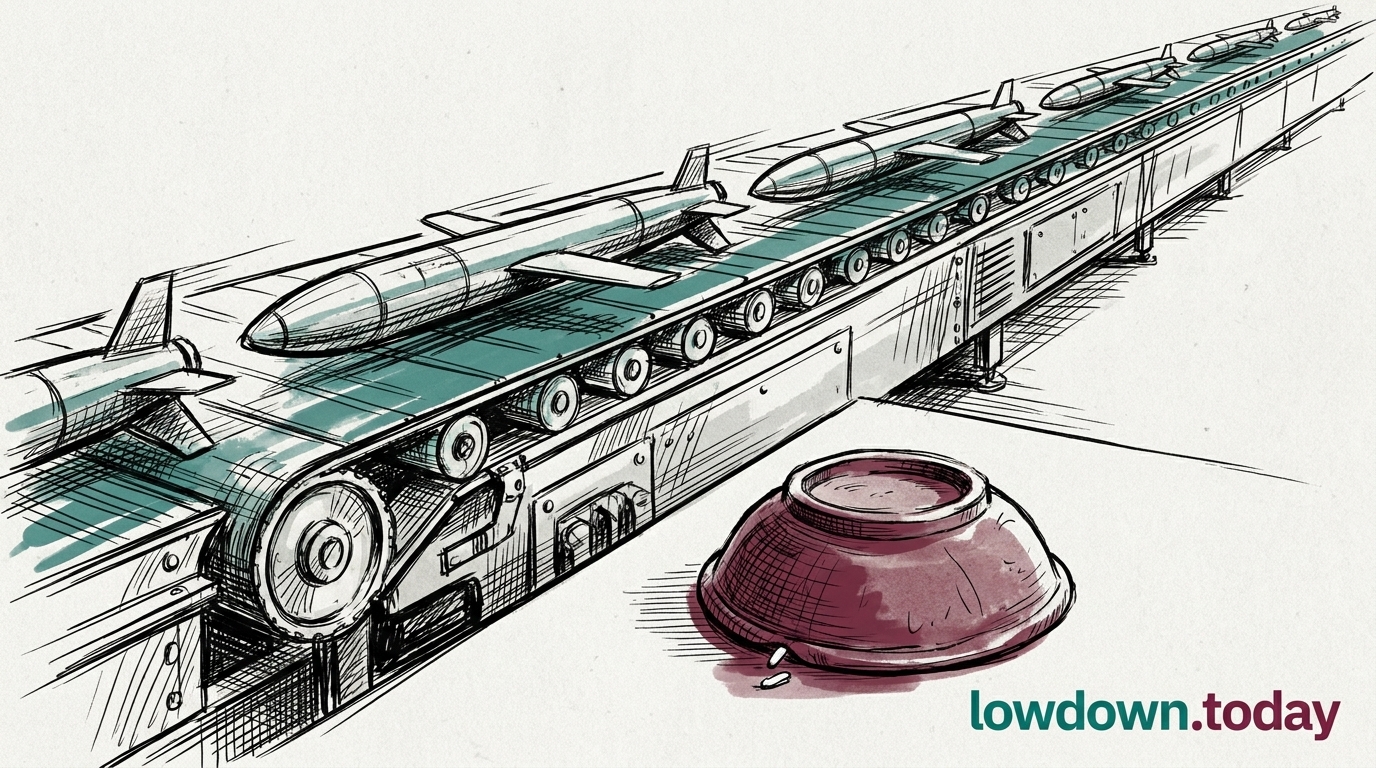
Signed a $22.9bn, seven-year contract with Raytheon on 17 August to raise Tomahawk output from about 60 a year to more than 1,000. The Acting Navy Secretary, quoted via an X post, framed it as the "Arsenal of Freedom" initiative; it replaces the 850 missiles fired by 1 April in about ten months at the new rate.
UK Maritime Trade Operations
UKMTO logged six armed men boarding a tanker 136 nautical miles east of Al Mukalla on 20 August and redirecting it toward Somalia. A vessel steered toward the Somali coast reads as an attempted seizure, a distinct hazard from the stand-off strikes the same lane has seen before.