Skip to content
You can now search across every topic, entity and event.What's new
Iran Conflict 2026
31JUL

Forty days of war, zero new executive instruments

2 min read
09:24UTC

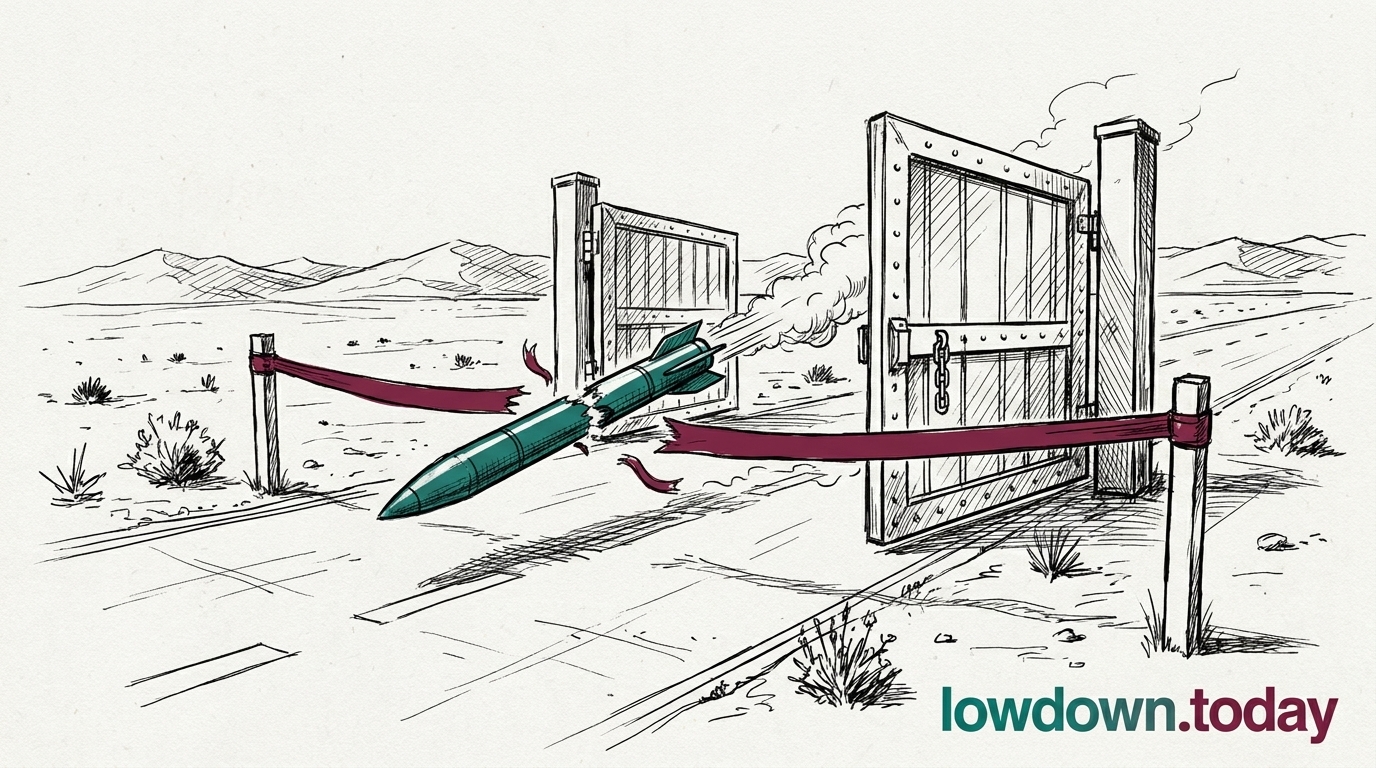
The White House paper trail under six weeks of escalation contains college sports and steel tariffs, not a single Iran filing.

ConflictAssessed
Key takeaway

The war had a rhetorical ceiling that touched civilization-ending threats and a paper trail that contained college sports.

The presidential-actions index was scanned directly on 8 April. The nine most recent items contain no Iran content. Across 40 days of war, no new Defense Production Act invocation to surge munitions, no reserve mobilisation order to backfill the 50,000 troops in theatre, no new emergency economic authority. The war has been prosecuted entirely on pre-existing authorities tested against an interceptor stockpile that RUSI documented reaching critical thresholds the same week .

The gap matters because the rhetorical ceiling above it has touched extremes. On Monday afternoon Trump posted that 'A whole civilization will die tonight, never to be brought back again'. Roughly twelve hours later, after midnight Wednesday Eastern Time, he posted 'Iran can start the reconstruction process ... this could be the Golden Age of the Middle East'. Civilization-ending to Golden Age in twelve hours, with no intervening executive action. The pattern recurs at every previous deadline cycle .


Deep Analysis

In plain English

Trump has been threatening to do enormous things to Iran for six weeks. In that same six weeks, his administration has not filed a single new executive order, proclamation, or memorandum about Iran. The White House paper trail contains things like college sports rules and steel tariffs. That is the gap between his words and his actions in one data point.

Deep Analysis
Synthesis

The war's most reliable signal was always what was not being signed.

Root Causes

Pre-existing authorities were stretched to their limit by Day 40. New instruments would have required Congressional engagement the administration appears to have judged politically unavailable.

Escalation

The flat operational ceiling has been the war's most consistent feature. Today's ceasefire is its logical endpoint.

What could happen next?
  • Meaning

    The administration's military reach is constrained by the existing authorities and stockpiles, not expanded by new ones.

  • Consequence

    Any future escalation would likely have to be preceded by new executive instruments that have not yet been filed.

First Reported In

Update #62 · Two victories, two different lists

White House· 8 Apr 2026
Read original
Different Perspectives
Shipping and insurance underwriters
Underwriters can price Houthi strikes because the group announces its targets, but an unclaimed drone at Damietta and a mandatory Iranian insurance scheme both deny them a pattern to price against. War-risk premiums are increasingly being set by the absence of a claimant, not the scale of the damage.
Jordan
Jordan
Azraq absorbed its fourth Iranian strike in seven weeks, again drawing no direct Jordanian retaliation, only an American one. Amman's exposure, hosting US basing without the Patriot density of Gulf allies, has not changed even as the war around it widens.
Houthi movement
Houthi movement
The Houthis' 20 July blockade of Saudi-linked shipping is the injury Riyadh's new 43-nation coalition directly answers, yet the group itself was never asked to join and remains outside every proposal on the table. Sanaa-aligned commentators call the coalition a paper reassurance for insurers rather than a deployable force.
Egypt's Cabinet
Egypt's Cabinet
Egypt confirmed the Damietta blaze was an attack, not an accident, on soil the war had never touched before. Cairo now faces an unclaimed threat to a facility supplying roughly 7% of its domestic gas, with no author to hold accountable and no pattern yet to defend against.
Oman
Oman
Muscat is running the only channel Iran will use, a voluntary Hormuz fee modelled on Malacca, but stayed out of Saudi Arabia's new naval coalition entirely. Oman's mediating leverage depends on treating Hormuz as shared and non-exclusive, the opposite of what Tehran is now demanding of it.
Iraq's Prime Minister
Al-Zaidi cancelled his first official Riyadh visit and convened the Coordination Framework, the coalition that keeps him in power and whose factions sit inside the PMF that Saudi jets just struck. He is caught between a five-year Saudi investment relationship and armed groups inside his own state he does not fully control.



