Skip to content
You can now search across every topic, entity and event.What's new
Iran Conflict 2026
23JUN

Two US carriers stay, blockade runs on

3 min read
11:42UTC

The USS Abraham Lincoln and the USS George H.W. Bush remained on station in the Gulf as of 18 June, the blockade still redirecting vessels, despite the memorandum's clause that it be removed immediately.

ConflictDeveloping
Key takeaway

Two carriers on station are the proof the order to lift the blockade never reached the fleet.

Two US carrier strike groups, built around the USS Abraham Lincoln and the USS George H.W. Bush, remained on station in The Gulf region as of 17-18 June 1. CENTCOM (US Central Command), the US military command for the Middle East, has issued no drawdown order, and the naval blockade continues to redirect vessels, despite the Islamabad Memorandum of Understanding (MoU) clause that the blockade be "removed immediately."

The blockade is the apparatus that has throttled Iranian seaborne trade through the war, turning the strait into a corridor ships transit only on US sufferance. Trump signed the MOU and ordered the blockade lifted on 16 June , but CENTCOM kept it running pending a signed instrument it has not received. The carriers on station are the physical evidence that the order has not reached the water.

The shipping industry reads operations, not press releases. Insurers, mine-clearance crews and tanker owners need an on-water change before commercial transits resume; a memorandum does not move a hull. Hormuz logged zero new tanker transits the day after Trump signed . The Geneva signing ceremony was scrapped, and Baghaei confirmed the text was finalised electronically, the presidents' signatures applied digitally rather than at any podium.


Deep Analysis

In plain English

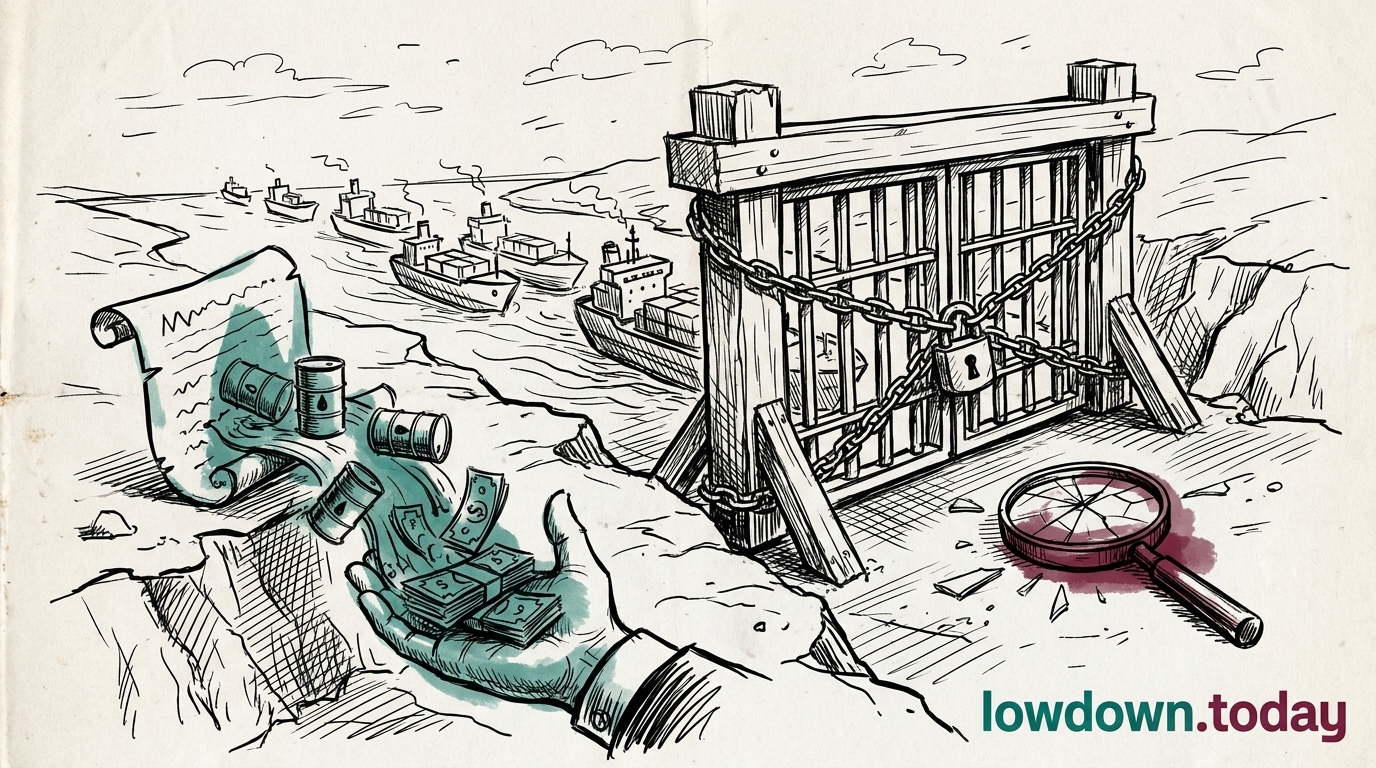
Think of the naval blockade as a lock on a gate that is run by one department and the key as a different document held by another department. When the US President signed the Islamabad MOU, he was handing over a promise to unlock the gate. But the military commanders operating the lock need a separate written order from the Defence Department before they can actually turn the key. As of 18 June, that order had not arrived. So both aircraft carriers, the Abraham Lincoln and the George H.W. Bush, stayed in position, redirecting ships just as before. The gate remained locked. Separately, the sea still has live floating mines in it. Even if the lock were opened, no commercial ship would sail through a minefield without a guarantee that the mines had been removed.

Deep Analysis
Root Causes

The blockade-stays problem has a structural cause independent of politics: the CENTCOM enforcement mechanism runs on a separate chain of command from the diplomatic track that produced the MOU. Trump signed the MOU as the US executive; the blockade is operationalised by CENTCOM via the Secretary of Defense chain. Without a National Security Council decision memo, a SecDef order, and a CENTCOM operational directive, the blockade runs by default.

Mine-clearance progress also blocks the blockade lift. Hormuz was still seeded with active mines on 18 June. BIMCO and the International Chamber of Shipping have stated publicly that commercial vessels will not transit an uncleared minefield regardless of what a ceasefire agreement says. The operational prerequisite for the blockade lift, cleared lanes, does not yet exist.

What could happen next?
  • Risk

    An incident between an on-station carrier and an IRGC vessel, as happened on 15 June with the 'last warning' radio transmission, could escalate to an exchange of fire that voids the MOU before the 19 June ceremony.

    Immediate · Reported
  • Consequence

    The carrier stay gives Iran a public talking point: the US blockade continues despite the signed MOU, symmetrically matching Iran's own non-compliance on Lebanon.

    Short term · Assessed
  • Precedent

    If the blockade does not begin to lift within seven days of signing, insurers will treat the MOU as a rhetorical instrument rather than an operational change, maintaining war-risk exclusions and keeping effective transit near zero.

    Short term · Assessed
First Reported In

Update #131 · Iran deal's first death tests the text

Al Jazeera· 18 Jun 2026
Read original
Different Perspectives
Shipping and insurance industry
UKMTO counted about 20 US-facilitated Hormuz transits a day to 11 September against only 6 visible on AIS, with traffic still around 90% below the 138-a-day pre-war baseline. War-risk underwriters cannot price hulls they cannot see, or resolve whether the tanker El Gaia hit a mine, as Iran claims, or a missile and drone, as CENTCOM says.
European refiners
European refiners
European refiners, including Poland's Orlen, absorbed a roughly $26 gap between Dated Brent at $130.80 on 15 September and ICE Brent futures settling at $103.87 on 18 September, a spread that widened from $13.45 on 9 September rather than newly opening. Their futures hedges no longer cover what they now pay for physical barrels.
Saudi Arabia
Saudi Arabia
Saudi Aramco zeroed European term customers' October allocations and rerouted roughly 60 million barrels to Asia through Ras Tanura and Sohar, using Red Sea and Gulf terminal capacity built years ago to cut Hormuz exposure. Riyadh reallocated existing supply rather than negotiating a shortfall with Europe.
Qatar
Qatar
Qatar's energy minister Saad al-Kaabi told Bloomberg at the Qatar Economic Forum on 20 September that Bessent's two-year Hormuz-obsolescence forecast is wrong, and that Doha has deliberately built no bypass pipeline. Qatar's gas exports run through one waterway by choice, not oversight.
Iran (foreign ministry and Majlis)
Iran's foreign ministry and 130 Majlis deputies moved toward NPT withdrawal this week, with lawmaker Hossein-Ali Haji Deligani filing a triple-urgency bill on 20 September that Speaker Qalibaf has not yet scheduled. Tehran treats treaty membership as leverage still on the table, not yet spent.
Russia and China
Russia and China
Moscow and Beijing vetoed the Panel of Experts' renewal, maintaining Resolution 2231 lapsed in October 2025 and the 2025 snapback was never validly triggered, so the sanctions architecture the Panel enforces has no current legal standing. Both governments frame the veto as upholding law, not shielding Tehran.



