Skip to content
You can now search across every topic, entity and event.What's new
Iran Conflict 2026
21JUN

CENTCOM: 43 ships sunk, 3,000 targets

3 min read
17:51UTC

CENTCOM's tally has crossed 3,000 targets struck and 43 warships destroyed in eight days. Iran entered this conflict with 65 operational vessels — two-thirds now sit on the seabed.

ConflictDeveloping
Key takeaway

The strategic significance of Iran losing two-thirds of its surface fleet depends entirely on whether IRGC Navy fast-attack assets — Iran's actual asymmetric maritime deterrent — are included in the 43-vessel count.

CENTCOM's cumulative tally now stands at more than 3,000 targets struck and 43 naval vessels destroyed since operations began on 28 February. Iran's pre-war surface fleet comprised approximately 65 operational vessels. Two-thirds are gone in eight days.

The destruction has accelerated. By Day 4, half the fleet had been sunk or destroyed . The four days since eliminated another quarter — including a second drone carrier roughly the size of a Second World War aircraft carrier, still burning when CENTCOM Commander Admiral Brad Cooper confirmed its loss . A verification gap persists: of 43 vessels claimed destroyed, three have been independently confirmed by name or class through satellite imagery and released video — the IRIS Dena, the IRIS Shahid Sayyad Shirazi, and an unnamed Jamaran-class corvette . Iran has publicly acknowledged only the Dena .

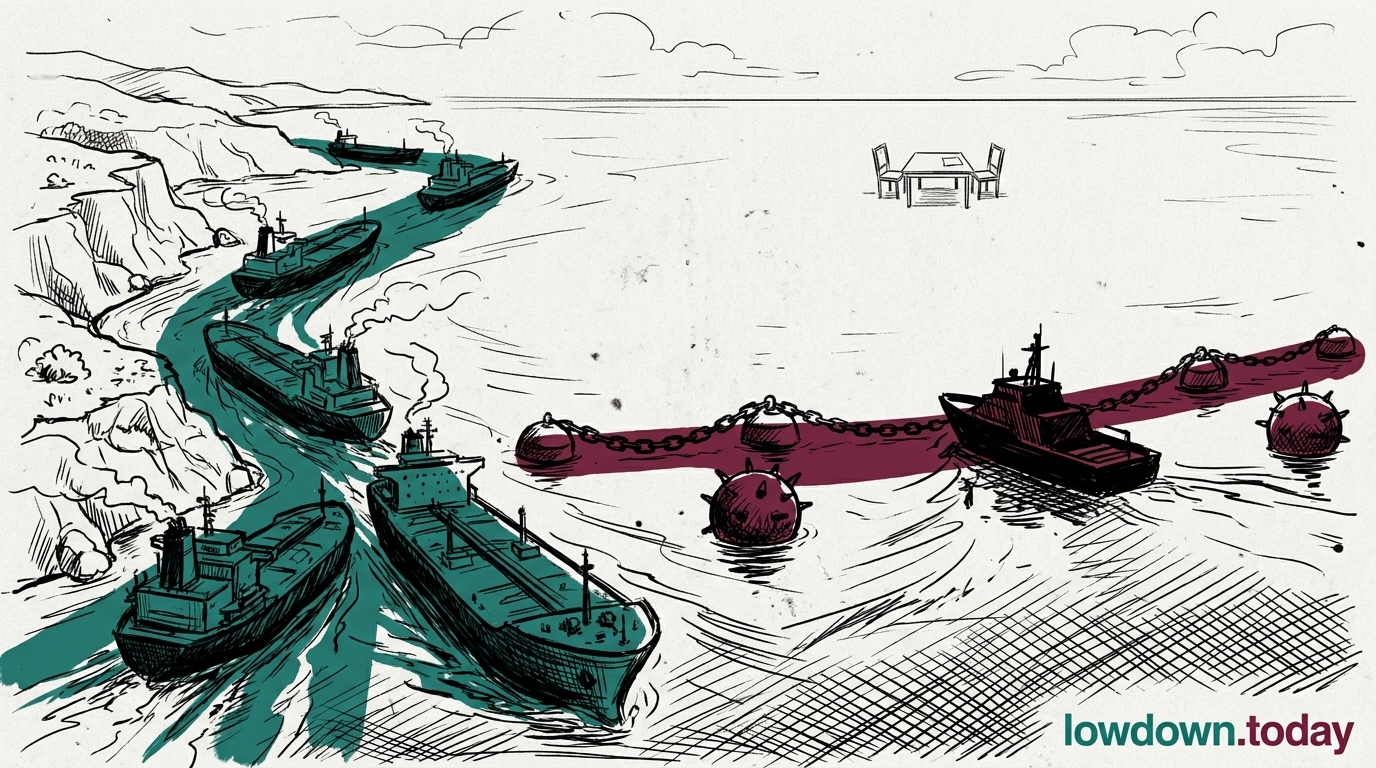
The surface fleet's destruction eliminates Iran as a conventional naval power for a generation — these are warships Iran's sanctioned shipyards cannot replace. But Iran's primary maritime threat was never the blue-water fleet. Shore-based anti-ship missiles, naval mines, and the thousands of small IRGC Navy craft in coastal waters remain intact, operated by the same decentralised provincial units now sustaining drone and missile operations on land. During the Tanker War of 1984–88, Iran threatened Gulf shipping for four years with far fewer naval assets — because the weapons that close the strait of Hormuz sit on shore, not on decks.


Deep Analysis

In plain English

Iran runs two parallel navies: the regular navy with larger warships, and the IRGC Navy with small, fast speedboats designed to swarm shipping lanes and lay mines. The larger ships are easier to find and destroy; the smaller IRGC craft are the real threat to oil tankers and far harder to eliminate. If the 43 destroyed vessels are predominantly conventional navy, Iran's asymmetric maritime capability may be largely intact — meaning the fleet destruction statistics tell an incomplete story about how much the maritime threat has actually been degraded.

Deep Analysis
Synthesis

The simultaneous destruction of Iran's surface fleet and the sustained high-volume drone and missile barrage contradicts the logic of attrition warfare against a mosaic defence: conventional naval attrition has no measurable effect on distributed offensive capacity, while eliminating the very forces Iran would need for post-war maritime governance and deterrence. The US may be creating a surface-domain security vacuum in the Gulf without a plan to fill it.

Escalation

With Iran's surface fleet near elimination, the remaining maritime threat vectors are mines, shore-based anti-ship missiles, and IRGC fast-attack craft — all dispersed, mobile, and harder to target than naval vessels. The campaign may have destroyed Iran's conventional deterrent without materially reducing its ability to threaten commercial shipping, shifting the locus of maritime risk rather than eliminating it.

What could happen next?
  • Consequence

    Iran's surface fleet will not recover to pre-war levels for a decade or more, permanently altering the naval balance in the Persian Gulf and eliminating Iran's conventional maritime deterrent against GCC states.

    Long term · Assessed
  • Risk

    If IRGC Navy fast-attack and mine-laying assets remain largely intact, the Strait of Hormuz threat persists beyond any ceasefire — making the 43-vessel figure a misleading indicator of maritime threat reduction.

    Short term · Assessed
  • Meaning

    CENTCOM's 3,000-target figure represents one of the highest-tempo sustained air campaigns since Desert Storm, but cumulative counts in modern air campaigns typically include re-strikes and supporting infrastructure — unique degraded capabilities will be a materially lower number.

    Immediate · Suggested
First Reported In

Update #25 · Russia shares targeting data on US forces

Reuters· 7 Mar 2026
Read original
Causes and effects
This Event
CENTCOM: 43 ships sunk, 3,000 targets
The destruction of two-thirds of Iran's surface fleet eliminates conventional naval power for a generation, but leaves intact the asymmetric maritime capabilities — shore-based missiles, mines, fast attack craft — that historically posed the greater threat to Gulf shipping and that can close the Strait of Hormuz from land.
Different Perspectives
Shipping and insurance industry
UKMTO counted about 20 US-facilitated Hormuz transits a day to 11 September against only 6 visible on AIS, with traffic still around 90% below the 138-a-day pre-war baseline. War-risk underwriters cannot price hulls they cannot see, or resolve whether the tanker El Gaia hit a mine, as Iran claims, or a missile and drone, as CENTCOM says.
European refiners
European refiners
European refiners, including Poland's Orlen, absorbed a roughly $26 gap between Dated Brent at $130.80 on 15 September and ICE Brent futures settling at $103.87 on 18 September, a spread that widened from $13.45 on 9 September rather than newly opening. Their futures hedges no longer cover what they now pay for physical barrels.
Saudi Arabia
Saudi Arabia
Saudi Aramco zeroed European term customers' October allocations and rerouted roughly 60 million barrels to Asia through Ras Tanura and Sohar, using Red Sea and Gulf terminal capacity built years ago to cut Hormuz exposure. Riyadh reallocated existing supply rather than negotiating a shortfall with Europe.
Qatar
Qatar
Qatar's energy minister Saad al-Kaabi told Bloomberg at the Qatar Economic Forum on 20 September that Bessent's two-year Hormuz-obsolescence forecast is wrong, and that Doha has deliberately built no bypass pipeline. Qatar's gas exports run through one waterway by choice, not oversight.
Iran (foreign ministry and Majlis)
Iran's foreign ministry and 130 Majlis deputies moved toward NPT withdrawal this week, with lawmaker Hossein-Ali Haji Deligani filing a triple-urgency bill on 20 September that Speaker Qalibaf has not yet scheduled. Tehran treats treaty membership as leverage still on the table, not yet spent.
Russia and China
Russia and China
Moscow and Beijing vetoed the Panel of Experts' renewal, maintaining Resolution 2231 lapsed in October 2025 and the 2025 snapback was never validly triggered, so the sanctions architecture the Panel enforces has no current legal standing. Both governments frame the veto as upholding law, not shielding Tehran.



