Skip to content
Briefings are running a touch slower this week while we rebuild the foundations.See roadmap
Iran Conflict 2026
6MAR

US destroys second Iranian drone carrier

2 min read
04:48UTC

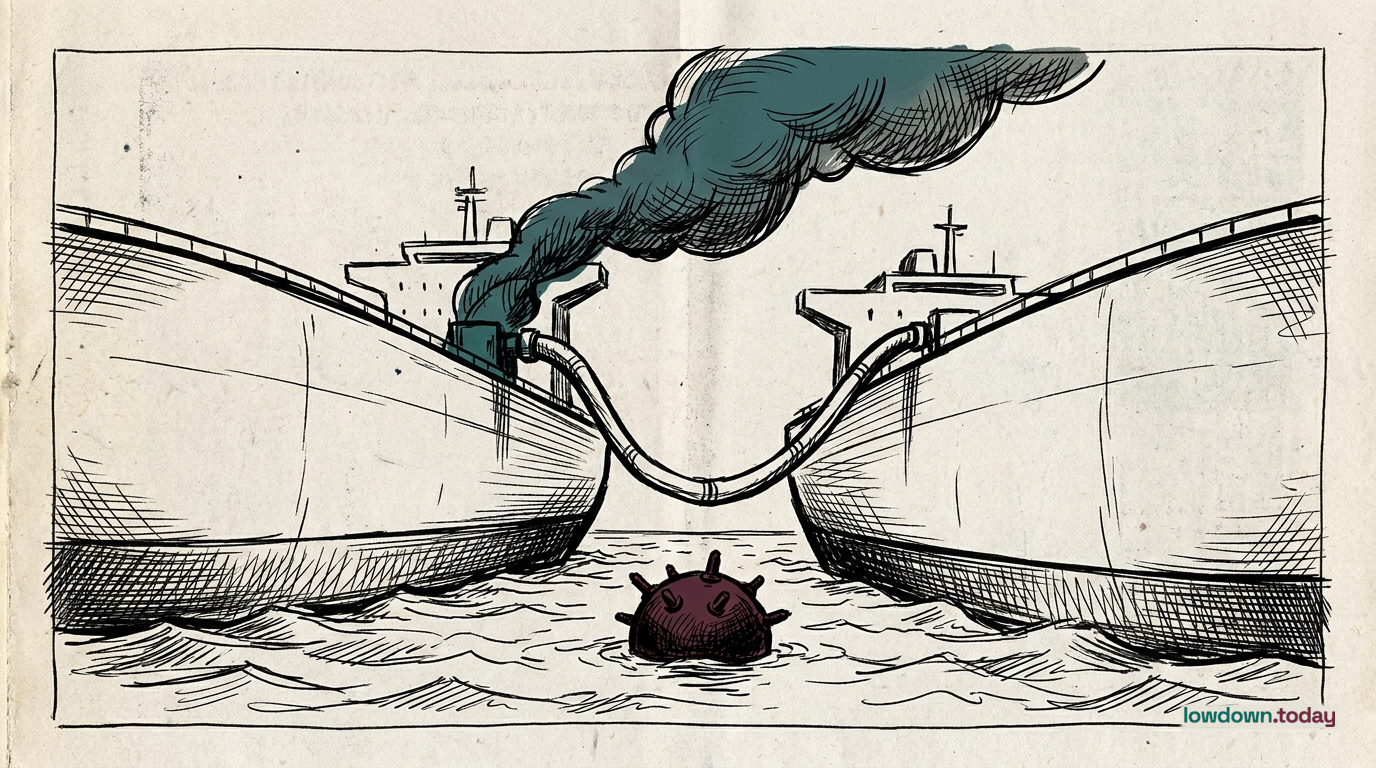
Admiral Cooper confirmed the destruction of a vessel the size of a Second World War carrier — still ablaze when he spoke. Iran's first drone carrier lasted less than a day.

ConflictDeveloping
Key takeaway

The destruction of both Iranian drone carriers in one week eliminates an entire force-projection capability class Iran developed specifically to threaten Gulf targets beyond land-based drone range.

CENTCOM Commander Admiral Brad Cooper confirmed on Thursday that US forces destroyed a second Iranian drone carrier, which he described as roughly the size of a Second World War aircraft carrier. The vessel was still burning when Cooper spoke. Iran's first drone carrier, the IRIS Shahid Bagheri, was destroyed on Day 1 of operations, 28 February.

Iran's drone carriers are converted commercial hulls — large cargo vessels retrofitted with launch rails and control systems to deploy waves of one-way attack drones from offshore positions. They represent Iran's answer to a problem its navy has faced since the 1979 revolution: how to project airborne striking power at sea without the multi-billion-dollar carrier programmes that only a handful of states can sustain. The conversion programme, developed by the IRGC Navy, gave Iran the ability to saturate targets with drones launched from positions beyond the immediate reach of land-based air defences.

Both confirmed platforms are now destroyed. The first lasted hours; the second, days. The speed of their elimination reflects a basic vulnerability: a converted cargo hull broadcasting radar and thermal signatures consistent with a large vessel has no survivability against a force with satellite surveillance and precision-guided munitions. Iran invested in the concept as an asymmetric equaliser; the asymmetry ran the other direction.

Deep Analysis

In plain English

Iran converted large civilian ships into floating launch platforms for drones — improvised aircraft carriers for unmanned weapons — giving it the ability to threaten targets far from its coastline without building expensive conventional warships. With both destroyed within a week, that capability no longer exists. The loss matters not just for what is gone but for what Iran tried to build it to replace: a surface navy it already knew it could not defend.

Deep Analysis
Synthesis

With both drone carriers destroyed, Iran has lost its only tool for extending drone strike range into the southern Gulf without transiting the Strait — a capability specifically designed to threaten Aramco offshore infrastructure and create a threat axis outside the Strait chokepoint. Iran's residual drone threat is now geometrically constrained to land-launched systems whose range arcs can be mapped and defended against.

Root Causes

Iran's drone carrier programme emerged from a doctrinal shift following the 2019 Strait of Hormuz tanker harassment campaign: Tehran needed a mobile, harder-to-pre-empt launch platform that could avoid the vulnerability of fixed coastal infrastructure to precision cruise missile strikes. The programme was a creative response to a known structural weakness, not an extension of existing naval strength.

Escalation

Losing both carriers consolidates US sea control of the Gulf and narrows Iran's remaining offensive options to land-launched missiles with predictable range arcs and proxy maritime harassment — the latter carrying different escalation dynamics and less Iranian state control over timing and targeting.

What could happen next?
  • Consequence

    Iran's ability to threaten southern Gulf energy infrastructure with drones beyond land-based range is eliminated for the conflict's duration.

    Immediate · Assessed
  • Risk

    Losing both drone carriers may pressure Iran to accelerate land-based ballistic missile use, shifting remaining strike capacity toward higher-yield, harder-to-intercept systems.

    Short term · Suggested
  • Precedent

    The rapid neutralisation of converted civilian vessels as military strike platforms will inform future naval doctrine on the survivability of asymmetric maritime innovation against peer-adversary air power.

    Long term · Assessed
First Reported In

Update #23 · Iran loses half its navy; China eyes Hormuz

USNI News· 6 Mar 2026
Read original
Different Perspectives
Gulf shipping and insurance markets
With Hormuz and Bab el-Mandeb both hostile at once, war-risk underwriters face their first dual-chokepoint pricing problem; the rerouting hedge that absorbed one closure is gone for Israeli-linked hulls. Any deal that reopens Hormuz without a Houthi stand-down clause delivers only partial shipping relief.
Russia and China
Russia and China
Russia and China met IAEA chief Grossi jointly in Geneva on 5 June to coordinate an advance blocking position against Washington's censure resolution, the first documented instance of proactive pre-session obstruction rather than reactive post-vote dissent. Beijing's move came four days after OFAC designated Shanghai Qianye Energy under Iran energy sanctions.
Saudi Arabia
Saudi Arabia
Saudi Arabia was left out of the emergency $4.01 billion Patriot waiver Qatar received on 2 May as its own PAC-3 stocks ran near-empty from intercepting Iranian salvoes over Aramco facilities. Riyadh is on a standard 18-month FMS queue behind a production line booked through 2030, with no equivalent priority to Qatar's Al Udeid basing role.
Houthis (Ansar Allah)
The Houthis declared a complete ban on Israeli Red Sea navigation on 8 June and struck Jaffa, their first attack on Israeli territory since April, seven days after the Tasnim authorisation to activate other fronts including Bab el-Mandeb. The declaration put both chokepoints under hostile authority simultaneously.
Iran
Iran
Iran agreed the 9 June mutual halt after the Mahshahr exchange and coordinated with Russia and China to block Washington's IAEA censure resolution, using the Board as a second front while the bilateral pause held on the military one. Tehran's acceptance of the Lebanon carve-out contradicts the linkage position it stated on 1 June.
Benjamin Netanyahu and the IDF
Israel struck the Karun Petrochemical plant at Mahshahr on 8 June over Trump's explicit objection, then agreed a halt with Iran the following day scoped on Israeli terms with Lebanon carved out. Netanyahu's posture is that the IDF will not accept Iranian missile factories as off-limits regardless of US diplomatic timelines.