Skip to content
You can now search across every topic, entity and event.What's new
Iran Conflict 2026
17JUN

Brent loses $14 in four sessions

3 min read
09:37UTC

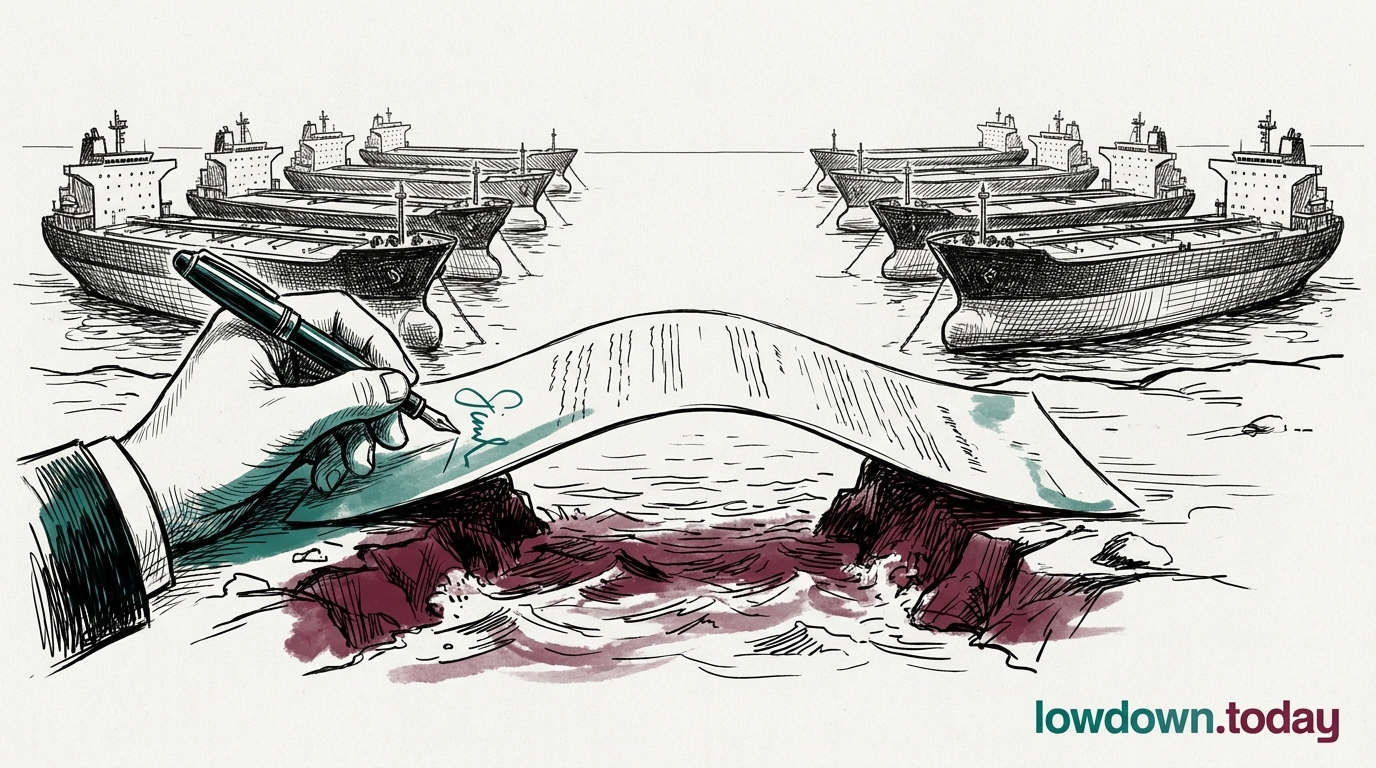
Brent fell from $110.34 on Wednesday 20 May to $96.14 on Sunday 24 May after Trump called the Iran deal 'largely negotiated', deflating the Hormuz war premium that the light-sweet complex had carried.

ConflictDeveloping
Key takeaway

Brent shed $14 on the Iran MOU; the war premium is discounted, not gone, with uranium still outside the deal.

Brent fell from $110.34 on Wednesday 20 May to $96.14 on Sunday 24 May, a $14 week, with WTI shedding over 6% to $90.30 1. The driver sat next door in the diplomacy: Donald Trump called the Iran deal "largely negotiated" on Saturday 23 May, framing a Memorandum of Understanding as phase one with the Hormuz-reopening narrative doing the rest 2. The diplomacy sits in the Iran file; the spreads it knocked sit with us.

The Brent-Dubai EFS is narrowing from the $6-plus peak it held in early May , because the light-sweet Hormuz bid deflates faster than sour Dubai, which never carried the same war premium. Brent-WTI is compressing toward $1-2 from the old $4-5 band as WTI catches up. That spread is the one that pays for the trade: above roughly $4 the round-trip economics justify hauling Atlantic barrels east on VLCCs, and below it they stop working. We will not put a precise current EFS print on the page because the assessment is paywalled, but the direction is not in doubt.

the MOU is phase one of a 30-60 day process and leaves the highly-enriched-uranium stockpile untouched 3, so the war premium is discounted, not dead, and a single failed-flow headline re-arms the EFS. The market that ran the long-Brent, short-WTI trade against has watched the Atlantic-basin premium that funded it evaporate inside a week, and the freight complex still reads a war it no longer fully believes in.


Deep Analysis

In plain English

Oil prices fell sharply in the last week of May after US President Trump announced an early-stage deal with Iran that could reopen the Strait of Hormuz ; the narrow sea passage through which roughly a fifth of the world's oil flows. Brent crude, the main international price benchmark, dropped from about $110 to $96 in four days. The move reflects markets pricing in the possibility of cheaper Iranian oil returning. However, the deal is not final: Iran's nuclear stockpile was left out, and broader talks are expected to take 30-60 days. Diesel prices across Europe may ease slightly on the news, but the underlying shortage of middle distillates means any relief could be temporary.

Deep Analysis
Root Causes

The EFS blowout above $6 reflected two compounding effects: (1) Asian refiners bidding aggressively for Atlantic light-sweet crudes as Hormuz-sourced barrels (mostly medium-sour Gulf grades) were unavailable; (2) European refiners simultaneously short of Middle East sourcing (695kbd import gap, BP outage), driving NWE gasoil and Atlantic crude basis higher.

Trump's 23 May MOU announcement deflated only the geopolitical risk premium in flat Brent. The structural distillate deficit in Europe (9% below US 5yr average, 38% import collapse) is supply-side, not geopolitical ; it persists regardless of diplomatic signal. This is why the ICE Gasoil crack held near $54/bbl even as Brent fell $14: the crack spread widens mechanically when flat price falls faster than physical distillate premiums.

What could happen next?
  • Risk

    If Hormuz mine clearance stalls within the 30-60 day MOU window, Brent will spike back above $100 and the EFS will re-widen toward the $6+ peak, punishing any long position built on the Iran deal narrative.

    Short term · Assessed
  • Consequence

    The EFS narrowing removes the primary economic incentive for Atlantic-basin crude to route east on VLCCs; TD3C spot freight will soften from the WS458.75 peak as the light-sweet bid deflates.

    Short term · Reported
  • Opportunity

    The ICE Gasoil crack is structurally wider relative to flat price as Brent falls; refiners with Mediterranean and NWE crude intake locked at pre-MOU prices and gasoil sold at current forward prices capture asymmetric margin.

    Short term · Assessed
First Reported In

Update #2 · GL 134C reverses the cliff, Brent -$14

CNBC· 26 May 2026
Read original
Different Perspectives
Lloyd's Market Association
War-risk underwriters price the Houthis' Red Sea attacks because the group announces its targets in advance, but the unclaimed Damietta drone gives insurers a hit with no author to price against. An attack nobody claims costs shipping more than one that is claimed, since premiums are set against a known pattern, not raw damage.
US Central Command
US Central Command
CENTCOM has announced no strike on Iran since resuming bombing on 30 July within hours of an IRGC salvo on Jordan, and centcom.mil did not respond to requests to confirm any pause. The command has gone quiet before while a larger operation was being weighed, so silence alone proves nothing about what it has or has not done.
Hengaw
Hengaw
Hengaw recorded at least 67 executions in Iran during July, of which the state acknowledged only eight, and reported the 1 August execution of protest detainee Arvin Kheirkhahan at Shahrud with no advance notice to his family. A family's first notice of a death sentence is now usually the instruction to collect a body.
Egypt
Egypt
Egypt's government asked media on 2 August to report the Damietta attack accurately, named no author, and said no findings will be published before its own investigation concludes. Cairo holds the debris and jurisdiction over an attack on its own soil, and naming a culprit now would pull it into a dispute it has avoided for five months.
Iran's Foreign Ministry
Araghchi called the Hormuz talks with Oman final-stage on 2 August, four days after his own deputy rejected Oman's lane proposal, and denied the Damietta drone strike as an Israeli false flag while two Iranian officials privately claimed it for Tehran. Iran's public position now contradicts itself on both files at once.
Bahrain and Kuwait
Bahrain and Kuwait
Bahraini and Kuwaiti aircraft flew their own strikes on Iranian depots in July with Emirati air cover behind them, and Ynetnews reports some Gulf capitals wanted the 2 August strike to proceed rather than stop. States that have already taken fire see a closing window on Iranian weakness, not a reason to pause.



