Skip to content
You can now search across every topic, entity and event.What's new
Iran Conflict 2026
14JUN

Senate war-powers vote falls ten short

3 min read
11:42UTC

The House passed its war-powers measure 215-208 on 3 June; in the Senate it sits roughly ten votes short of cloture, with only four Republicans crossed and the 8 June floor reserved for a judicial nomination.

ConflictDeveloping
Key takeaway

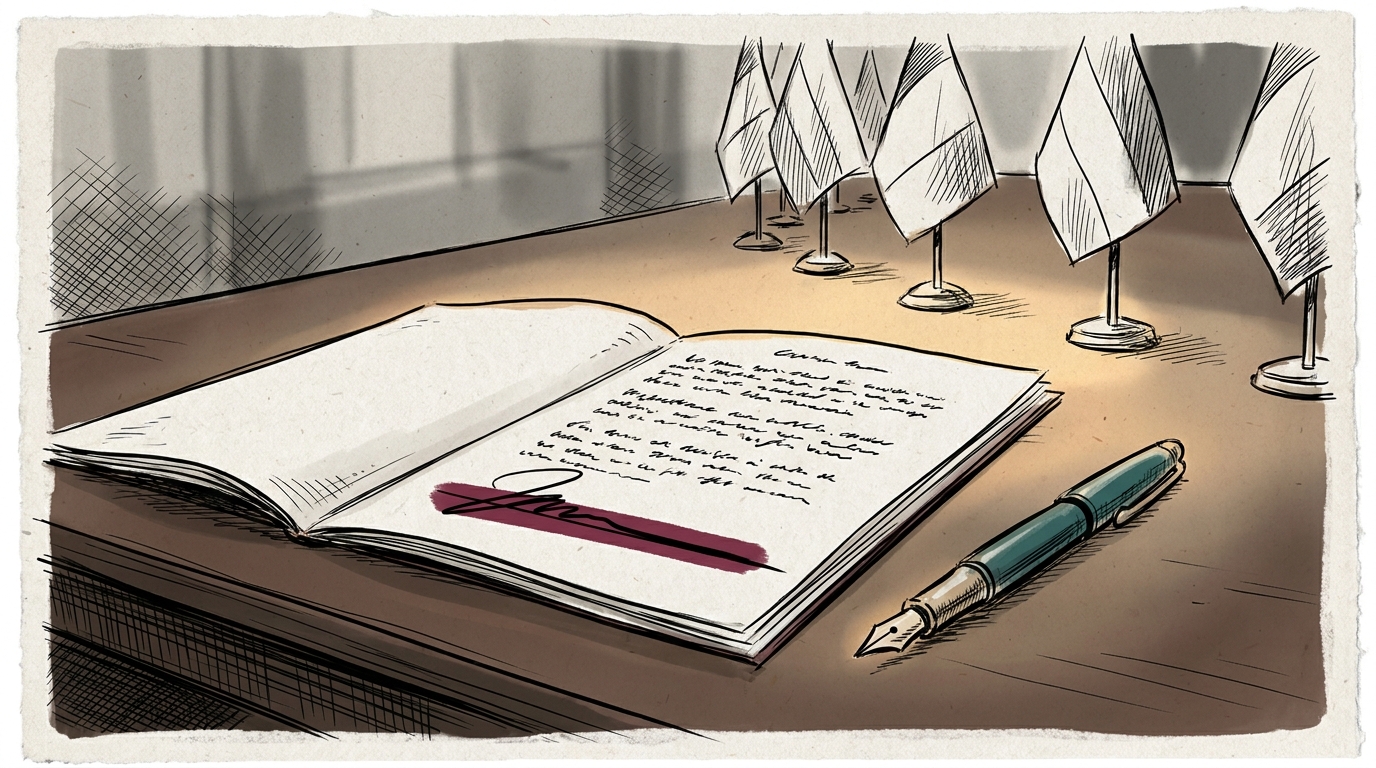
Congress has its first war position but cannot force the signed instrument the executive withholds.

The House passed its war-powers measure 215-208 on 3 June and sent it to the Senate, where ending debate requires 60 votes 1. The vote was the first recorded congressional position of the war, inverting the 14 May tie. Only four Republicans have crossed: Susan Collins, Lisa Murkowski, Rand Paul and Bill Cassidy, leaving the resolution roughly ten votes short of cloture. The Senate's floor time for 8 June is set for a judicial nomination, not Iran.

The War Powers Resolution (WPR), the 1973 statute that caps undeclared hostilities at 60 days and requires the President to seek authorisation, has now lapsed three times in this war, on Days 60, 72 and 93 , with no enforcement. The statute creates leverage for a floor vote but cannot compel one, and it carries no mechanism to force the executive to produce a signed instrument. So at the 100-day milestone the legislature can register a position yet neither chamber can compel the paper The Administration declines to sign. Foreign Minister Abbas Araghchi has coupled any movement to the unsigned memorandum of understanding, tying Lebanon's fate to the same absent signature, which keeps every clock running against a document nobody has signed.


Deep Analysis

In plain English

The War Powers Resolution is a US law passed in 1973, after Congress felt it had been shut out of decisions to send troops to Vietnam. The law says that if the President deploys forces into combat without a formal declaration of war from Congress, he must report it within 48 hours and then stop within 60 days unless Congress approves. In this conflict, that 60-day clock has now run and lapsed three separate times, on Days 60, 72 and 93, with no enforcement action from Congress. On 3 June the House of Representatives passed a resolution 215-208 instructing the President to wind down US involvement. But that resolution still has to pass the Senate too, and to bring it to a full Senate vote requires 60 senators to agree to end the debate. Currently only 50 senators have crossed in favour, and four of those are Republicans who broke with their own party: Susan Collins, Lisa Murkowski, Rand Paul and Bill Cassidy. With the Senate's next floor session on 8 June set for a judicial confirmation vote rather than Iran, the war-powers measure sits ten votes short of its threshold. This means the President continues the conflict without a signed legal authorisation from Congress, and Congress has so far been unable to force one.

Deep Analysis
Root Causes

Two structural failures generate the ten-vote gap. First, the Republican Senate caucus holds institutional loyalty to executive war-making authority as a party norm, rooted in the doctrine of unitary executive theory which asserts that foreign-policy and military command powers belong constitutionally to the President, not Congress. Breaking that norm carries primary-election risk for most Republican senators in states where Trump's approval remains above 60%.

Second, the WPR's cloture threshold of 60 votes was never realistic given the Senate's current 53-47 composition. The 50-47 discharge vote of 20 May was itself a procedural advance that bypassed the 60-vote bar; the full floor vote reintroduces that bar. The measure was always designed to produce a recorded position, not legislative enforcement, given the arithmetic.

What could happen next?
  • Precedent

    Three WPR lapses without enforcement in a single conflict will be cited by future administrations as evidence that the statute's 60-day clock has no operative enforcement mechanism, weakening its deterrent value in future undeclared conflicts.

    Long term · Assessed
  • Consequence

    The House 215-208 vote creates a documented congressional record that future courts, Government Accountability Office reviews, or appropriations riders can cite as evidence that the legislature formally opposed the executive's conduct of hostilities.

    Medium term · Assessed
  • Risk

    Without a signed war authorisation, any future escalation that results in significant US casualties would face immediate judicial and legislative challenge using the existing House vote as standing evidence of opposition.

    Short term · Suggested
First Reported In

Update #120 · The deal's last 5% is uranium nobody can find

Congress.gov· 7 Jun 2026
Read original
Different Perspectives
Qatar (mediator)
Qatar (mediator)
Qatari negotiators flew to Tehran on Sunday morning to close remaining gaps between the parties, operating as the primary shuttle channel. Qatar's role is to bridge the civilian-track gap the IRGC veto has left.
IAEA / Rafael Grossi
Grossi replied to Araghchi's 13 June protection-of-materials letter the same day, citing Iran's NPT Safeguards Agreement obligation to declare any nuclear material transfer. With 97 days of lost inspector access and approximately 240 kg unaccounted, Grossi has treaty text and no inspectors on the ground to enforce it.
United Arab Emirates
The UAE state oil company assessed full Hormuz flows will not resume until 2027 even with a fast deal, citing demining, inspection, and insurance timelines. The UAE ambassador to Washington said a simple ceasefire is not enough.
Islamic Revolutionary Guard Corps (IRGC)
The IRGC ran naval exercises in Hormuz during Geneva talks and its political deputy declared Iran was negotiating from a position of strength. The corps has not endorsed the MoU; by amplifying Mashhad protests through Fars, it is framing any deal as conditions it imposed rather than a concession it accepted.
Iran Foreign Ministry / Araghchi
Araghchi's dilute-in-Iran red line was met by the US concession, but his foreign ministry spokesman said Tehran had not taken a final decision and a signing might come in days, not Sunday. Araghchi separately wrote to the IAEA pledging to protect nuclear materials as dilution negotiations advanced.
White House / US negotiating team
Washington accepted dilution inside Iran rather than ship-out, its first substantive material concession in 106 days, the New York Times reported. With the White House register blank and the ceremony slipped a third weekend, the administration has moved its negotiating position without yet producing a document.



