Skip to content
You can now search across every topic, entity and event.What's new
Iran Conflict 2026
13JUN

Trump's 100% tariff threat on digital taxes

3 min read
10:52UTC

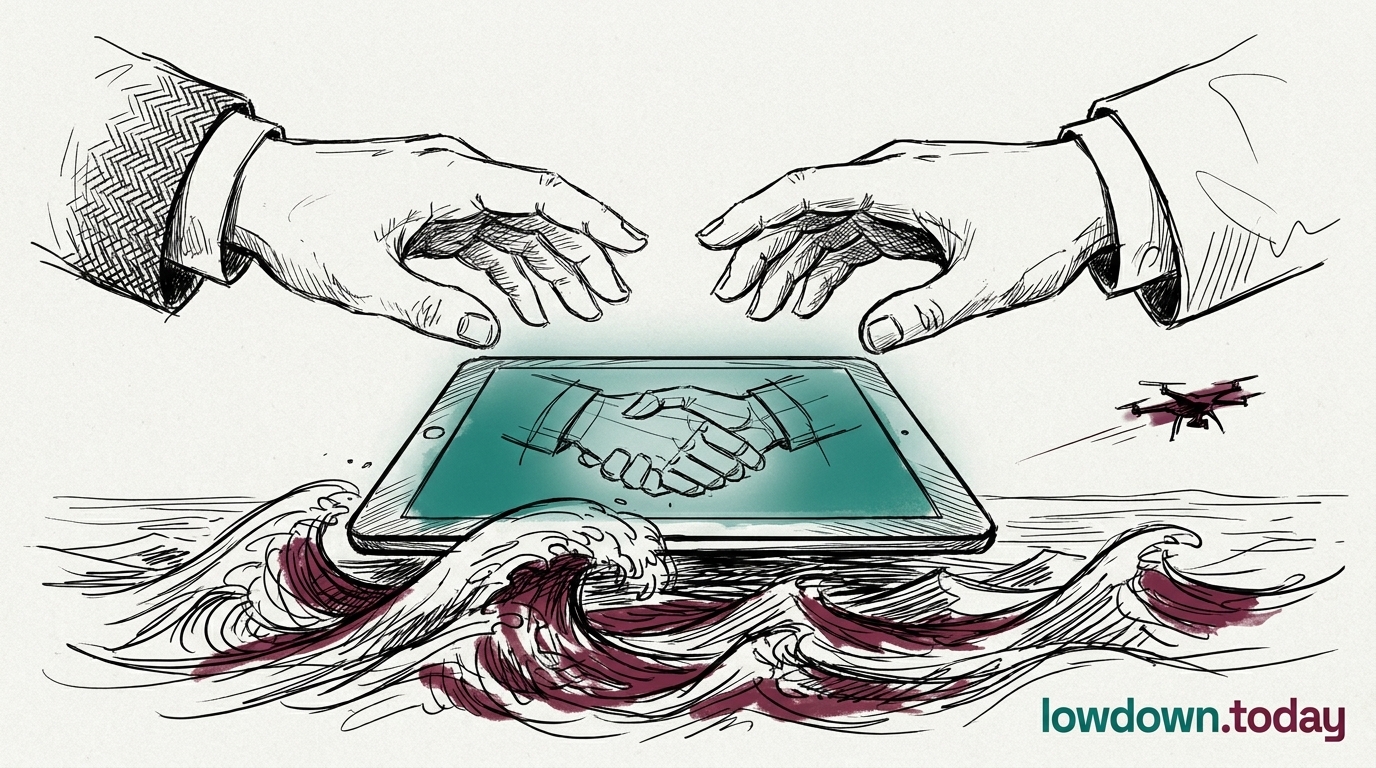
A day after an EU-US trade deal capped most European tariffs at 15% but spared digital services taxes, Donald Trump threatened 100% tariffs on any country taxing US technology firms.

ConflictDeveloping
Key takeaway

Trump threatened 100% tariffs on digital-tax states, and the EU calls its own retaliation toolkit depleted.

The EU and US ratified a trade deal on 25 June that caps most European export tariffs at 15% but pointedly leaves digital services taxes untouched. A day later, Donald Trump threatened 100% tariffs on any country that taxes American technology firms. Digital services taxes are levies several European states apply to the local revenues of large US technology companies, designed to capture value from firms headquartered elsewhere.

Trump's threat landed one day after the deal, exposing the tariff cap as leverage rather than a settled bargain. A European Commission spokesperson said the bloc would respond "swiftly and decisively" to defend its regulatory autonomy, yet officials privately describe the EU's retaliation toolkit as "depleted" after the June concessions. The bloc's Anti-Coercion Instrument runs a roughly twelve-month investigation before it can impose a single countermeasure.

The same leverage hangs over The Commission's completed Google self-preferencing fine, the penalty for ranking its own services above rivals', which still sits unsigned on Ursula von der Leyen's desk . Civil-society groups allege the delay is meant to avoid handing Washington a fresh grievance before a 24 July US trade determination lands. Washington's case is that these taxes are written to fall on American firms; Brussels' case is that a market may tax the business done inside it as it chooses.

Deep Analysis

In plain English

Several EU countries charge American technology companies a tax on their local revenues, separate from normal corporate tax. France, Italy and Spain each run their own version. The US has long objected to these taxes, arguing they unfairly target American firms. On 25 June, the EU and US agreed a trade deal that capped tariffs on most European goods entering America, but specifically did not resolve the digital tax question. The next day, Trump threatened to put 100% tariffs on any country that runs such a tax. For comparison, the deal that was just signed caps tariffs at 15%. The Commission said it would respond strongly, but its main retaliation tool takes 12 months to activate, which is too slow for a threat with a near-term deadline. The EU also has a completed Google fine sitting unsigned, which many observers believe is being held back to avoid annoying Washington before a key trade decision on 24 July.

Deep Analysis
Root Causes

Europe's retaliation deficit has two structural sources. First, the Anti-Coercion Instrument, designed precisely for this scenario, requires the Commission to demonstrate that a foreign measure constitutes economic coercion, then complete a 12-month investigation before imposing countermeasures: the instrument is structurally too slow for a threat timed to resolve in weeks.

Second, the June trade deal itself traded away the negotiating capital that backed European leverage: with tariffs at 15% rather than 20-25%, US exporters have already been granted concessions that cannot be recalled to pressure Washington on a separate digital-tax dispute.

The Commission's inability to sign the Google DMA fine illustrates the deeper problem: regulatory enforcement and trade negotiation are running on separate institutional tracks, each constraining the other, without a single point of decision authority that can trade enforcement delay against trade concessions in a transparent way. Von der Leyen's personal hold on the fine has removed the Commission's trade team's ability to credibly deny the link.

Escalation

Direction is toward further confrontation: three overlapping deadlines land within five weeks of the tariff threat (24 July trade determination, 27 July Google DMA ruling, 2 August GPAI enforcement), and the EU's stated retaliation capacity does not match the speed at which any of these could escalate.

What could happen next?
  • Risk

    If the Commission signs the Google DMA fine before the 24 July trade determination, it triggers the US tariff threat on digital-tax countries, affecting EU exporters across sectors unrelated to technology.

    Immediate · Reported
  • Consequence

    The unsigned Google fine has now been publicly linked to trade leverage, permanently damaging the Commission's ability to claim enforcement independence from political interference on future DMA cases.

    Medium term · Assessed
  • Risk

    A completed trade deal that excludes digital services taxes leaves the EU with no agreed framework for resolving the underlying dispute, making recurring tariff threats the default negotiating posture.

    Long term · Reported
First Reported In

Update #10 · Digital euro to trilogue; Senate bars CBDC

TechTimes· 30 Jun 2026
Read original
Different Perspectives
Iran's Supreme Leader's office and Iranian households
A letter published through state media named Lebanon's territorial integrity and an end to Israeli operations there as the war's ending condition; the same week, spokesperson Mohajerani cut the subsidised petrol ration from 70 to 50 litres a month. Iranian agencies still disagree on who inside the office signed the letter.
Oman
Oman
Muscat proposed a voluntary-funded coalition to police Hormuz, the corridor its own coastline gives it standing to manage, while Iran wants control and toll rights over shipping and Washington insists on free navigation. Oman's remit stops at the strait; it has no comparable claim over Iraq, the Caspian, or Lebanon.
Kyiv
Kyiv
President Volodymyr Zelenskyy confirmed the Caspian strike on an Iranian vessel carrying military cargo from Russia's Astrakhan region, opening a front that ties Iran's war to its supply relationship with Moscow rather than to anything the Gulf mediators are discussing.
Riyadh
Riyadh
Maj Gen Turki Al Malki named Iraq as the launch point for drones intercepted over the Eastern Province and Riyadh, the first time this war has reached Saudi Arabia from that direction rather than from Yemen. Nothing landed, but a second launch geography aimed at Saudi oil now exists alongside the Houthi front.
Baghdad
Baghdad
Iraq's Foreign Ministry summoned its own ambassador in Riyadh after Saudi Arabia's Defence Ministry said the drones came from Iraqi territory, while the same day drones struck Iranian-Kurdish opposition camps inside Iraq. Baghdad is disowning attacks it did not launch from territory it does not fully control.
The Pentagon and Congress
Acting press secretary Joel Valdez attributed the toll's reversal to site anomalies, the same explanation the department gave for the opposite cut on 24 July; Representative Thomas Massie called the category change an absurd ruse designed to reset the war's legal clock. Neither side agrees on which explanation, or which war, is real.