Skip to content
Briefings are running a touch slower this week while we rebuild the foundations.See roadmap
Iran Conflict 2026
3MAR

Hegseth and Rubio split on regime change

3 min read
04:37UTC

The defence secretary says this is not regime change. The secretary of state says Washington would welcome the end of Iran's governing system. Both spoke on day three of the war.

ConflictDeveloping
Key takeaway

Rubio's regime-change statement directly contradicts the self-defence legal argument he himself made for the pre-emptive strikes, because a war fought to welcome the enemy government's overthrow cannot simultaneously be a war of necessity.

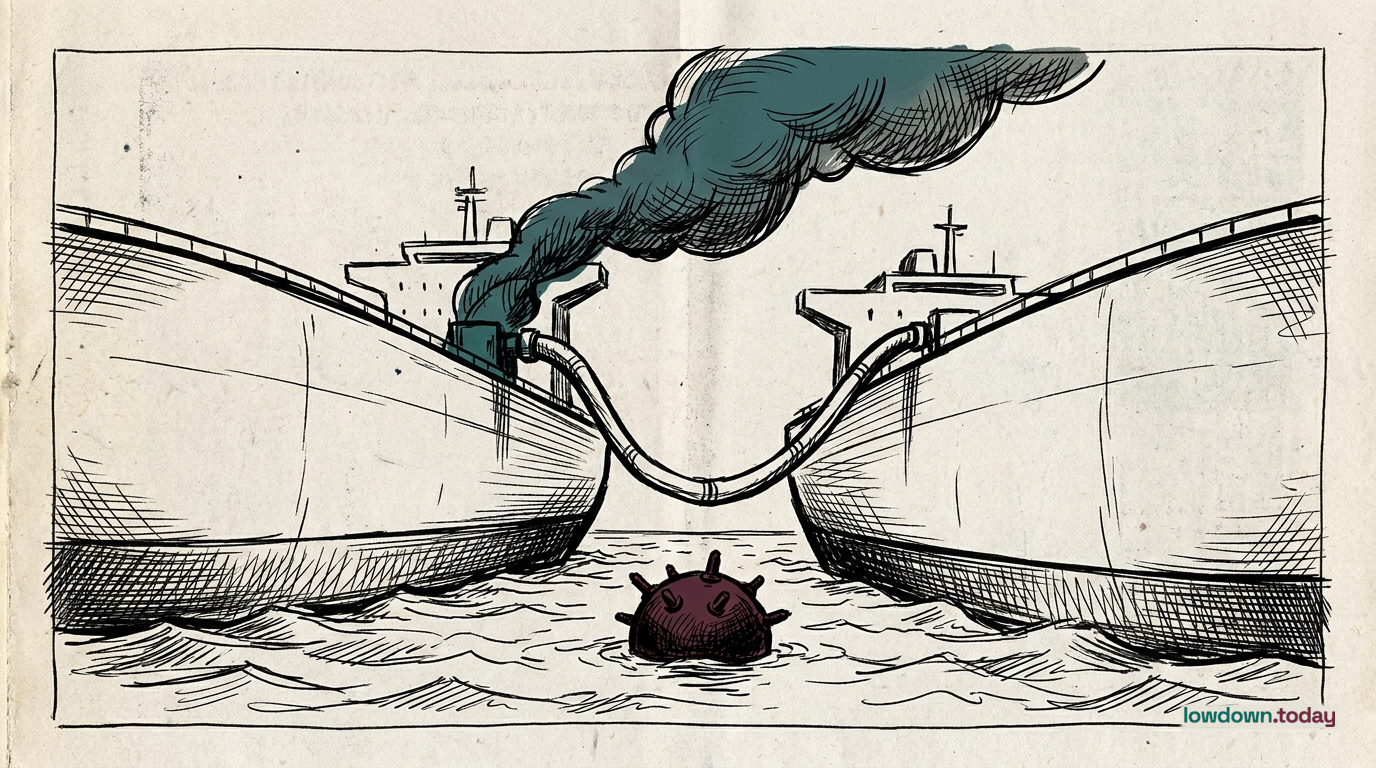
Defence Secretary Pete Hegseth, from the Pentagon: "This is not a Regime change war." Secretary of State Marco Rubio, from the State Department: "The US would welcome ending the governing system in Tehran." Both statements were made within hours of each other on day three of a campaign that has killed six American service members, effectively closed the Strait of Hormuz to commercial shipping , shut Ben Gurion Airport, and displaced hundreds of thousands across Lebanon. Hegseth's earlier Pentagon briefing had introduced nuclear capability as justification — the first time the administration invoked it from that podium . Rubio's statement goes further than any prior administration comment on the campaign's purpose.

The contradiction matters because war aims determine targeting, diplomatic off-ramps, and alliance cohesion. But the target list is already answering the question the two officials cannot agree on. US and Israeli strikes have hit the IRGC's Sarallah Headquarters, the Assembly of Experts in Tehran, Iran's state broadcaster IRIB, and killed up to 40 senior officials . The systematic destruction of military, political, religious, and informational institutions is the operational signature of Regime change, regardless of what it is called from a podium. Iran's foreign minister has stated that military units are operating outside central government direction — if the chain of command is already severed, the distinction between degrading a military and collapsing a state becomes academic.

The last American war that began with one stated aim and migrated to another was Iraq. In March 2003, the objective was eliminating weapons of mass destruction; by April, it was Regime change; by May, nation-building. Each expansion extended the war by years. President Trump projected "four weeks or less" and told CNBC the operation was "ahead of schedule" . Seventy-two hours later, he declined to rule out ground troops . Whether the gap between Hegseth and Rubio reflects genuine disagreement, evolving objectives, or deliberate ambiguity, it leaves allies, military commanders, and Congress without a framework for judging when the campaign has achieved its goals — because the goals have not been defined.

Deep Analysis

In plain English

The Pentagon and State Department said opposite things about what this war is for — one denied it aims to topple Iran's government, the other said the US would welcome exactly that. This matters beyond politics: in international law, explicitly stating you want regime change strips away the legal cover of 'self-defence' that the administration has been relying on to justify launching strikes without a formal declaration of war from Congress.

Deep Analysis
Synthesis

Rubio's regime-change statement is self-undermining in a specific legal sense: the self-defence justification for the pre-emptive strikes requires that the threat was external and unprovoked; welcoming regime change reveals the pre-emptive action was strategic rather than defensive, handing Iran's legal teams and UN delegations the administration's own words as evidence against it.

Root Causes

The contradiction reflects institutional divergence with different risk exposures: DOD carries operational liability for mission scope creep and force protection, creating incentive to bound the war's aims; State is messaging simultaneously to the domestic political base, the Israeli government, and Gulf allies, with different audiences requiring different signals. Neither principal is lying — they are optimising for different audiences with incompatible framings.

Escalation

If Rubio's framing becomes the operative US position, Iran has no rational incentive to de-escalate through negotiation — stopping its attacks would not remove the stated US objective of ending its governing system, so the cost-benefit calculation favours continued retaliation. This structurally forecloses the Omani backchannel.

What could happen next?
  • Risk

    Iran has no face-saving exit if regime change is the operative US objective, structurally removing the incentive to negotiate and prolonging the conflict.

    Immediate · Assessed
  • Consequence

    The congressional war powers vote becomes harder for the administration to defeat if regime change is acknowledged as an objective, because the War Powers Resolution requires explicit authorisation for offensive wars of choice.

    Short term · Assessed
  • Precedent

    Senior officials publicly contradicting each other on war aims within hours creates a documentary record that will be used in any future international legal proceedings or congressional inquiry.

    Long term · Assessed
  • Risk

    Gulf allies asked to host US forces cannot publicly justify that hosting if the US objective includes regime change, which carries far greater blowback risk for their own populations than a limited strike posture.

    Short term · Suggested
First Reported In

Update #12 · Rubio rewrites war's legal case in Congress

US State Department· 3 Mar 2026
Read original
Different Perspectives
Gulf shipping and insurance markets
With Hormuz and Bab el-Mandeb both hostile at once, war-risk underwriters face their first dual-chokepoint pricing problem; the rerouting hedge that absorbed one closure is gone for Israeli-linked hulls. Any deal that reopens Hormuz without a Houthi stand-down clause delivers only partial shipping relief.
Russia and China
Russia and China
Russia and China met IAEA chief Grossi jointly in Geneva on 5 June to coordinate an advance blocking position against Washington's censure resolution, the first documented instance of proactive pre-session obstruction rather than reactive post-vote dissent. Beijing's move came four days after OFAC designated Shanghai Qianye Energy under Iran energy sanctions.
Saudi Arabia
Saudi Arabia
Saudi Arabia was left out of the emergency $4.01 billion Patriot waiver Qatar received on 2 May as its own PAC-3 stocks ran near-empty from intercepting Iranian salvoes over Aramco facilities. Riyadh is on a standard 18-month FMS queue behind a production line booked through 2030, with no equivalent priority to Qatar's Al Udeid basing role.
Houthis (Ansar Allah)
The Houthis declared a complete ban on Israeli Red Sea navigation on 8 June and struck Jaffa, their first attack on Israeli territory since April, seven days after the Tasnim authorisation to activate other fronts including Bab el-Mandeb. The declaration put both chokepoints under hostile authority simultaneously.
Iran
Iran
Iran agreed the 9 June mutual halt after the Mahshahr exchange and coordinated with Russia and China to block Washington's IAEA censure resolution, using the Board as a second front while the bilateral pause held on the military one. Tehran's acceptance of the Lebanon carve-out contradicts the linkage position it stated on 1 June.
Benjamin Netanyahu and the IDF
Israel struck the Karun Petrochemical plant at Mahshahr on 8 June over Trump's explicit objection, then agreed a halt with Iran the following day scoped on Israeli terms with Lebanon carved out. Netanyahu's posture is that the IDF will not accept Iranian missile factories as off-limits regardless of US diplomatic timelines.