Skip to content
Briefings are running a touch slower this week while we rebuild the foundations.See roadmap
Iran Conflict 2026
4JUN

Two drones strike US Embassy in Riyadh

3 min read
11:25UTC

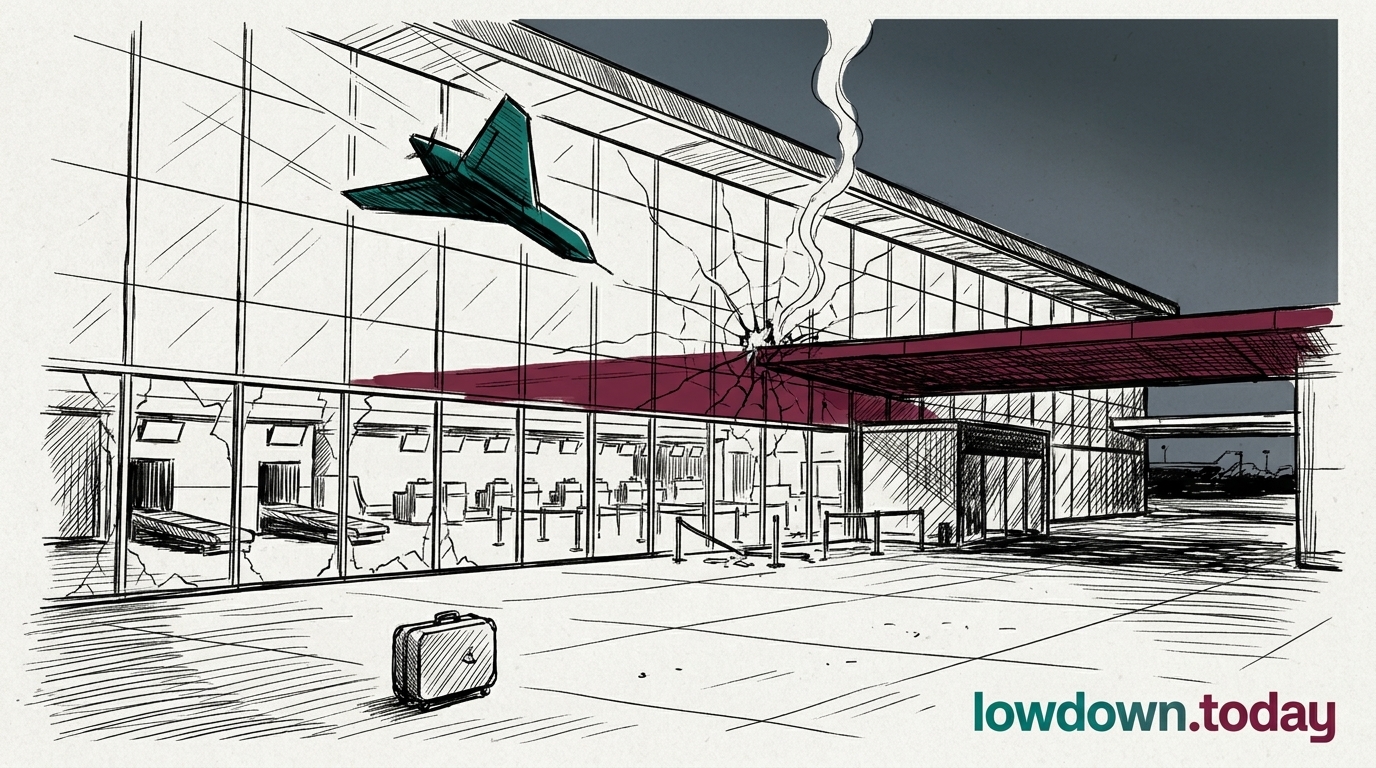
Hours after the IRGC declared American embassies as military targets, two drones hit the chancery compound in Riyadh — the gap between threat and execution measured in hours, not days.

ConflictDeveloping
Key takeaway

Two drones penetrating a post-Benghazi-hardened US Embassy compound while Saudi Arabia intercepted eight others in the same wave confirms that drone saturation tactics can defeat layered embassy security regardless of structural hardening.

Two drones struck the US Embassy in Riyadh on Monday, hitting the roof and perimeter of the chancery building. Fire was reported and contained. No injuries have been confirmed. Saudi air defence intercepted eight additional drones near Riyadh and Al-Kharj during the same attack wave — meaning ten drones were directed at targets in or near the Saudi capital in a single salvo.

The strike is the first execution of the IRGC's newly declared targeting doctrine against US diplomatic facilities. Attacks on American diplomatic compounds have a long and specific history in this region — the 1983 Beirut embassy bombing killed 63 people, including 17 Americans, though it was carried out by a proxy organisation rather than claimed by a state military. The IRGC's open declaration of responsibility for this targeting category makes the Riyadh attack different in kind: it is a stated military operation by a state actor against a diplomatic compound protected under the Vienna Convention. That the drones struck within hours of the declaration suggests the strike was pre-positioned and the announcement timed to precede it — a sequence designed to establish the IRGC's capacity to deliver on its threats immediately.

Saudi Arabia's position is that of a country absorbing a war it opposed and had no vote in starting. The Kingdom had been pursuing normalisation with Iran through the Chinese-brokered agreement of March 2023, and Gulf States broadly urged de-escalation in the weeks before the strikes. Now Riyadh's air defences are shooting down Iranian drones over the capital while Saudi territory hosts the US military infrastructure that Iran treats as legitimate targets. Qatar found itself in the same bind on Monday, its air force destroying two Iranian Su-24 aircraft — believed to be the first time a Gulf state shot down Iranian military jets in combat — while officially maintaining non-belligerent status. The parallel to Saddam Hussein's Scud attacks on Saudi Arabia during the 1991 Gulf War is direct: an attempt to punish states sheltering the opposing force, or to fracture the Coalition by making the cost of geography unbearable.

For US diplomatic personnel and their families stationed across the 16 countries now under departure advisories, the interval between the IRGC's declaration and the Riyadh strike — measured in hours — is the operational fact that defines their situation. Ben Gurion Airport is closed, 13,000 of 32,000 scheduled flights have been cancelled across the region since Saturday , and the UAE has only partially reopened with limited services. The infrastructure for mass departure is degrading at the same time the threat to those who remain is escalating.


Deep Analysis

In plain English

The US Embassy in Riyadh is built to the highest post-Benghazi security standards — blast-resistant walls, wide setbacks from the perimeter, reinforced buildings, and sophisticated surveillance. Saudi air defences shot down eight drones from the same attack wave. Yet two still hit the building. This tells security planners something specific: the physical structure can withstand a great deal, but the systems designed to intercept drones before they arrive are not reliable enough to stop a coordinated swarm. It is the equivalent of having a reinforced safe inside a building whose locks do not always hold.

Deep Analysis
Synthesis

The ten-drone wave — eight intercepted, two penetrating — mirrors the tactical logic of the 2019 Abqaiq attack: send enough drones to saturate point-defence and accept that interceptors will stop the majority, relying on the residual to achieve target effect. Saudi Arabia hardened its infrastructure defences after Abqaiq; the embassy penetration suggests counter-drone assets were either absent from or insufficient at that specific compound, or were drawn to the larger interception task, leaving the embassy in a defended gap.

Root Causes

Post-Benghazi security investments were overwhelmingly directed at physical architecture and Marine Security Guard capacity — both designed against the threat vectors of the 2000s and early 2010s: armed assault, vehicle-borne IED, and rocket attack. Counter-drone systems only entered widespread US government deployment consideration after 2022, meaning the embassy security framework has a structural lag of roughly a decade behind the current threat vector.

Escalation

A strike causing no confirmed casualties but demonstrating compound penetration capability appears calibrated to stay below the threshold response a diplomat's death would demand — demonstrating resolve and capability without triggering it. If this reflects deliberate Iranian calibration, expect further probing attacks designed to impose cost and psychological pressure while remaining below the mass-casualty threshold that would compel a qualitatively different US response.

What could happen next?
  • Consequence

    Post-Riyadh, every US embassy in the Middle East will activate Emergency Action Plans likely suspending routine consular services — visa processing, passport renewals, American citizen services — affecting tens of thousands of people daily across 16 countries.

    Immediate · Assessed
  • Risk

    A follow-on embassy attack producing American diplomat casualties would trigger domestic pressure for a response calibrated to attacks on US sovereign territory, potentially forcing escalation beyond the proportionality parameters governing the current military exchange.

    Short term · Suggested
  • Precedent

    The first confirmed state-directed drone strike on a US diplomatic compound sets a replicable template that adversaries globally will study — extending the vulnerability assessment beyond the Middle East to US missions in any region where drone technology is accessible.

    Long term · Assessed
First Reported In

Update #12 · Rubio rewrites war's legal case in Congress

Al Jazeera· 3 Mar 2026
Read original
Causes and effects
This Event
Two drones strike US Embassy in Riyadh
The first attack on a US diplomatic compound since the IRGC's formal declaration demonstrates that the threat to embassies is operational and immediate, and that Gulf states hosting US forces cannot shield their own capitals from Iranian retaliation despite having no role in starting the conflict.
Different Perspectives
Israel
Israel
IDF Chief Eyal Zamir declared on 3 June there was no ceasefire for his forces, and strikes killed at least 10 civilians and one Israeli soldier on 4 June. The IDF killed Hezbollah's chief engineer and warned three south Lebanon villages to evacuate on 5 June, advancing into ground the unsigned Washington framework has not caught.
Hezbollah / Lebanon
Hezbollah / Lebanon
Naim Qassem rejected the Washington Lebanon framework on 4 June as "absurd, humiliating and insulting", blocking a ceasefire instrument that required Hezbollah to withdraw north of the Litani before any Israeli withdrawal. Over one million Lebanese remain displaced; the framework's collapse prolongs that toll.
Iran
Iran
Foreign Minister Araghchi publicly coupled the Lebanon ceasefire to the Iran-US nuclear track on 4 June, carrying IRGC authority rather than his own civilian mandate. The IRGC delegation has sent no HEU counter-proposal since Araghchi confirmed no progress that same day; Mojtaba Khamenei's 21 May order to keep the 440.9 kg stockpile inside Iran remains operative.
United States
United States
Rubio placed the Iran-US deal at 95 per cent complete on 4 June while the administration signed no Iran instrument and OFAC designated only Cuban targets. Trump separately disclosed and rejected an airlift plan to collect Iran's HEU stockpile, claiming the material is "entombed", a claim the IAEA cannot verify.
China
China
Beijing's MOFCOM Blocking Rules constrain OFAC enforcement on the mainland; China has not corroborated Trump's verbal account of any bilateral summit, and the rial's failure to hold its Rubio bounce, combined with the IRGC's stablecoin rail closure, increases Chinese yuan-denominated oil-payment exposure through Hormuz.
Bahrain
Bahrain
The IRGC struck Bahrain on 3 June as its sirens sounded and its PAC-3 magazine neared exhaustion; excluded from Rubio's 2 May emergency resupply, Bahrain received a 50-round Federal Register notice on 1 June on an 18-month delivery timeline, meaning it is defending the US Fifth Fleet headquarters on the last rounds it has.



