Skip to content
Briefings are running a touch slower this week while we rebuild the foundations.See roadmap
Iran Conflict 2026
4JUN

Israel destroys Mehrabad tanker aircraft

3 min read
11:25UTC

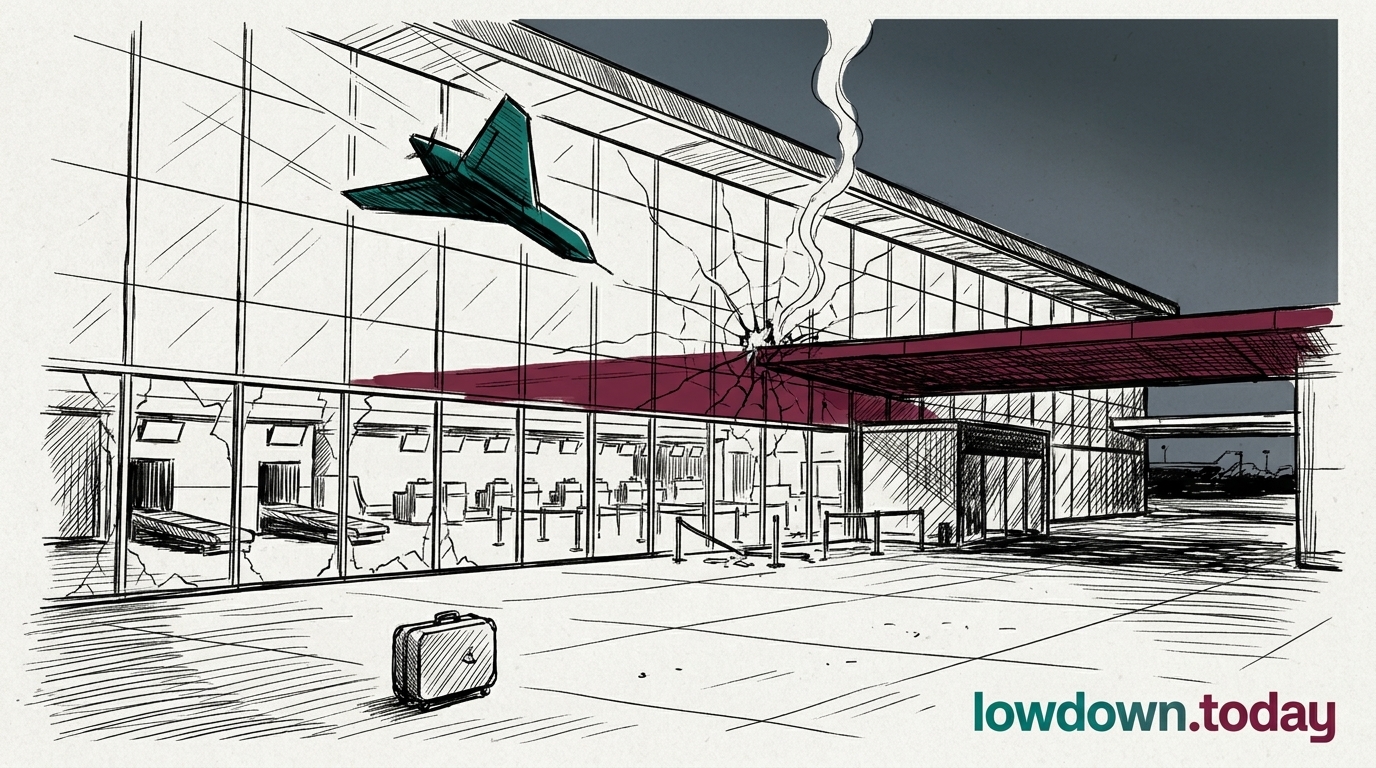
An overnight Israeli wave hit Mehrabad International Airport — Tehran's domestic aviation hub — destroying Iran's last aerial refuelling tanker on the tarmac. Smoke rose over the airport complex for hours.

ConflictDeveloping
Key takeaway

The destruction of Iran's last KC-747 removes its strategic aerial refuelling capability permanently, compressing its fast-jet threat envelope to unrefuelled combat radius for the remainder of this conflict.

The overnight Israeli operation that dropped 230 bombs on Imam Hossein University — the IRGC's primary military academy — also struck Mehrabad International Airport, Tehran's primary domestic and regional aviation hub. Footage showed a Boeing 747 engulfed in flames on the tarmac. Aviation analysts at Army Recognition identified it as Iran's last operational KC-747 aerial refuelling tanker — a military aircraft, not a commercial airliner. Large plumes of black smoke rose over the airport complex for hours.

The KC-747's destruction has a specific military consequence. Without aerial refuelling, Iran's remaining combat aircraft — ageing F-14 Tomcats, F-4 Phantoms, and a small fleet of MiG-29s — lose the ability to extend operational range beyond their base fuel load. Trump had already declared Iran has "no air force" ; the loss of the last refuelling tanker functionally confirms that assessment for any mission requiring extended range. Iran's air force was already its weakest branch before the war began. Its pre-war deterrent rested on missiles, drones, and naval assets, of which two-thirds of the surface fleet is now destroyed . The tanker was a legitimate military target. The airport around it is a different question.

Mehrabad handles domestic flights and regional routes serving Iranian civilians. Its military use was limited to occasional staging for military transport aircraft. The more than 80 aircraft committed to the broader wave were directed at military targets across Tehran, but the strike on an operating civilian airport — with attendant damage to runways, taxiways, and terminal infrastructure visible in the footage — degrades Iran's ability to move people, medical supplies, and humanitarian goods within its own territory. Amnesty International noted that airports serving primarily civilian functions require specific military justification under the principle of proportionality. With 330,000 people already displaced across the region according to the UN Secretary-General , WHO documenting 13 verified attacks on healthcare inside Iran since 28 February , and $18 million in humanitarian health supplies inaccessible at WHO's Dubai logistics hub , the destruction of domestic air transport infrastructure compounds an already deteriorating humanitarian logistics picture. The military objective — one tanker — was destroyed. The collateral cost is measured in a civilian airport that served a population of 90 million.


Deep Analysis

In plain English

Aerial refuelling tankers are essentially flying petrol stations that allow fighter jets to travel far beyond what their internal fuel tanks permit. Iran had converted civilian Boeing 747s into these tankers decades ago — aircraft it could never replace under sanctions. With this last tanker destroyed, Iranian jets are limited to targets within roughly 1,000–1,500 kilometres. That still covers most Gulf neighbours, but eliminates longer-range strike options that shaped the broader threat picture.

Deep Analysis
Synthesis

The strike achieves a strategic objective — eliminating Iranian power-projection reach — while the civilian airport setting creates an IHL vulnerability for Israel. The gap between the legitimate military target (the KC-747) and the civilian infrastructure in which it was parked is precisely the ambiguity the principle of proportionality is designed to adjudicate, and Amnesty International's statement signals that this specific strike is being positioned as a focal point for post-conflict accountability proceedings rather than treated as settled military necessity.

Escalation

Permanent loss of Iran's aerial refuelling capacity reduces one category of offensive capability but leaves its ballistic missile, drone, and naval mine posture entirely intact — the vectors most directly relevant to Hormuz closure and Gulf infrastructure targeting, where the war's economic consequences are concentrated.

What could happen next?
  • Consequence

    Loss of Iran's last aerial refuelling tanker permanently degrades its long-range strike capability for the duration of the conflict, removing one category of threat to more distant targets.

    Immediate · Assessed
  • Risk

    IHL challenges to the proportionality of striking a primarily civilian airport may establish this strike as a reference case in post-conflict international accountability proceedings against Israel.

    Long term · Suggested
  • Consequence

    Mehrabad's operational disruption severs Tehran's primary domestic aviation link, degrading civilian mobility and airfreight capacity across Iran's interior during a national emergency.

    Short term · Assessed
First Reported In

Update #26 · President orders halt; IRGC ignores him

The Week India· 7 Mar 2026
Read original
Causes and effects
This Event
Israel destroys Mehrabad tanker aircraft
The strike eliminates Iran's last aerial refuelling capability and degrades internal transport capacity, but the primary visible damage is to a civilian airport handling domestic flights, raising proportionality questions about military objectives versus civilian infrastructure destruction at a time when 330,000 people are already displaced.
Different Perspectives
Israel
Israel
IDF Chief Eyal Zamir declared on 3 June there was no ceasefire for his forces, and strikes killed at least 10 civilians and one Israeli soldier on 4 June. The IDF killed Hezbollah's chief engineer and warned three south Lebanon villages to evacuate on 5 June, advancing into ground the unsigned Washington framework has not caught.
Hezbollah / Lebanon
Hezbollah / Lebanon
Naim Qassem rejected the Washington Lebanon framework on 4 June as "absurd, humiliating and insulting", blocking a ceasefire instrument that required Hezbollah to withdraw north of the Litani before any Israeli withdrawal. Over one million Lebanese remain displaced; the framework's collapse prolongs that toll.
Iran
Iran
Foreign Minister Araghchi publicly coupled the Lebanon ceasefire to the Iran-US nuclear track on 4 June, carrying IRGC authority rather than his own civilian mandate. The IRGC delegation has sent no HEU counter-proposal since Araghchi confirmed no progress that same day; Mojtaba Khamenei's 21 May order to keep the 440.9 kg stockpile inside Iran remains operative.
United States
United States
Rubio placed the Iran-US deal at 95 per cent complete on 4 June while the administration signed no Iran instrument and OFAC designated only Cuban targets. Trump separately disclosed and rejected an airlift plan to collect Iran's HEU stockpile, claiming the material is "entombed", a claim the IAEA cannot verify.
China
China
Beijing's MOFCOM Blocking Rules constrain OFAC enforcement on the mainland; China has not corroborated Trump's verbal account of any bilateral summit, and the rial's failure to hold its Rubio bounce, combined with the IRGC's stablecoin rail closure, increases Chinese yuan-denominated oil-payment exposure through Hormuz.
Bahrain
Bahrain
The IRGC struck Bahrain on 3 June as its sirens sounded and its PAC-3 magazine neared exhaustion; excluded from Rubio's 2 May emergency resupply, Bahrain received a 50-round Federal Register notice on 1 June on an 18-month delivery timeline, meaning it is defending the US Fifth Fleet headquarters on the last rounds it has.



