Skip to content
You can now search across every topic, entity and event.What's new
Iran Conflict 2026
4JUN

Drones hit Kuwait airport fuel tanks

3 min read
11:25UTC

Strikes on Kuwait's main airport and a civilian government building drew the Gulf's smallest oil state deeper into a conflict it has no means to control.

ConflictDeveloping
Key takeaway

Striking Kuwait's airport fuel tanks combines civilian aviation disruption with potential US military logistics interdiction — a dual-use target that maximises coercive effect while preserving legal ambiguity about whether a military or civilian objective is being pursued.

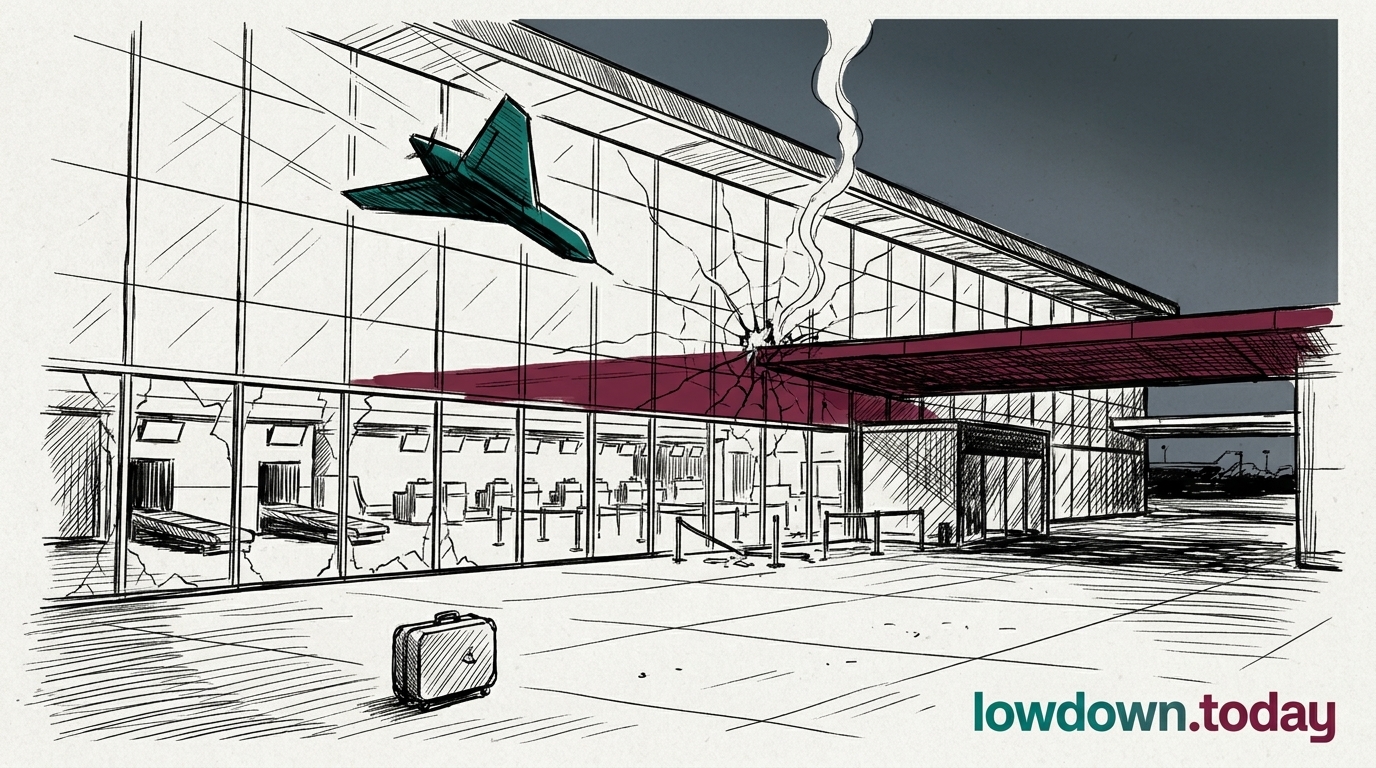
Iranian drones struck fuel tanks at Kuwait International Airport and the headquarters of the Public Institution for Social InsuranceKuwait's government pension and benefits administration — in Kuwait City on Sunday. Fires at both sites were brought under control.

Kuwait International Airport is the country's sole major civilian aviation hub. The social insurance building administers pensions and welfare payments to retirees and the disabled. Neither target has a plausible military function. Kuwait hosts approximately 13,000 US military personnel at Camp Arifjan and Ali Al Salem Air Base — a presence that Parliament Speaker Ghalibaf cited on Saturday as justification for continued strikes, writing that Gulf States hosting US forces "will not enjoy peace" . But the IRGC did not strike the bases. It struck a civilian airport and a pension office.

Iran's targeting across The Gulf has followed a consistent widening pattern over nine days: military installations, then the Israeli embassy in Bahrain , the Shaybah oilfield and BAPCO refinery , residential buildings , water desalination infrastructure, and now civilian transport and government administration. Each category crossed has been a one-way threshold. The targeting of a pension office — an institution whose only function is distributing money to retirees — falls outside any framework of military necessity.

Iraq's civil aviation authority had already extended its national airspace closure by 72 hours through approximately 10 March . Kuwait's airport strike raises the question of whether civilian aviation across the northern Gulf is now functionally grounded — not by formal closure but by the demonstrated willingness to target airport infrastructure with drones.


Deep Analysis

In plain English

Iran hit the jet fuel storage tanks at Kuwait's main international airport and the headquarters of Kuwait's government pension fund in Kuwait City. The fuel strike may affect flights — airlines facing supply problems could divert or cancel routes. But the less visible dimension is military: the US relies heavily on Kuwait's airports and nearby bases for regional resupply and air operations, and disrupting civilian airport fuel also pressures those logistics chains. The pension fund headquarters hit is less obvious as a military target and may reflect either poor targeting precision or a deliberate signal that Kuwait City's institutional core is within range.

Deep Analysis
Synthesis

The PIFSS building strike alongside the airport fuel tanks suggests Iran's Kuwaiti target set extends beyond energy infrastructure to the institutional fabric of Kuwait City as a functional commercial capital. If government financial institutions and the main international airport are systematically at risk, Kuwait's role as a regional transit hub and financial centre is in question — amplifying economic disruption significantly beyond the oil sector already documented in the force majeure declaration.

Root Causes

Kuwait hosts Camp Arifjan, Ali Al Salem Air Base, and Camp Buehring — among the largest concentrations of US military logistics capability in the region. Targeting civilian airport fuel infrastructure creates ambiguity about whether US military fuel stocks are directly at risk while achieving actual logistics pressure on US air operations, a design that maximises coercive effect while limiting the legal clarity of a direct attack on US military assets that would trigger a mandatory response.

Escalation

Kuwait has historically maintained studied neutrality in Iran-Gulf disputes and served as a valued diplomatic back-channel for Tehran. Striking Kuwait City's urban commercial core — airport and a government financial institution — signals Iran has consciously abandoned its pre-war neutrality calculus regarding Kuwait, eliminating a de-escalation pathway it previously valued. This is a strategically costly choice, suggesting Iran assessed Kuwait's hosting of US military assets outweighed its diplomatic utility as a neutral intermediary.

What could happen next?
  • Consequence

    US military logistics through Kuwait — among the largest forward prepositioning nodes in the region — face compounding pressure as civilian airport fuel infrastructure comes under sustained attack, constraining air operation tempo without a direct strike on US military assets.

    Immediate · Assessed
  • Risk

    Kuwait's traditionally neutral diplomatic channel to Iran — occasionally used for back-channel Gulf-Iran communication — is effectively closed by direct strikes on Kuwait City, eliminating a de-escalation pathway that no other Gulf state can replicate.

    Short term · Assessed
  • Precedent

    First direct strikes on Kuwait City's urban commercial and institutional infrastructure establish that no Gulf capital offering US military facilities is exempt from Iranian targeting regardless of historical neutrality or prior diplomatic relationship.

    Medium term · Assessed
  • Consequence

    Kuwait's force majeure signals the production disruption is expected to persist rather than resolve within days — combined with Iraq's cuts, the 3.5 million barrels per day removed from accessible markets is now a structural constraint, not a transient shock.

    Short term · Reported
First Reported In

Update #29 · New leader kept secret; Bahrain water hit

France 24· 8 Mar 2026
Read original
Causes and effects
This Event
Drones hit Kuwait airport fuel tanks
The targeting of Kuwait International Airport and a government pension administration building extends Iran's Gulf campaign into civilian transport and public services — infrastructure with no military function — while the IRGC's stated rationale of punishing US base hosts does not match the targets actually struck.
Different Perspectives
International Group of P&I Clubs
The Group has kept its Hormuz war-risk exclusion in force through the entire shipping recovery, even as London hull war-risk premiums fell to about 2% of vessel value. A burning LNG carrier off Limah is now the fresh case for holding that line, with mutual pooling meaning one hit reprices the strait for every owner at once.
Jordan
Jordan
Jordan's government said no threats existed at Aqaba hours before Iranian missiles landed there, and has not addressed the IRGC's claim that Jordanian civilians and soldiers supplied targeting intelligence for the strike. Amman hosts forces it does not command and is saying as little as it can.
United States (CENTCOM)
The Pentagon named two of the seventeen American dead, 1st Lieutenant Tyler Feehan and Private Isabella Gonzales, both killed at Jordan's Muwaffaq Salti Air Base, days after its Amman embassy had warned citizens away from Aqaba's airport and seaport. Washington is naming its own cost while flagging threats it declines to attribute publicly.
Iran
Iran
Iran said on Monday it disabled two oil tankers crossing the Strait of Hormuz without its permission, asserting a right to license passage through the strait it borders. Tehran named neither vessel, and CENTCOM had already denied a comparable Iranian claim on 18 July.
Qatar
Qatar
Qatar moved from summoning Iran's deputy ambassador on 8 July to a dated written claim at the UN Security Council thirteen days later, citing Resolution 2817 and reserving its Article 51 right of self-defence. Doha is building a permanent record while still hosting CENTCOM's forward headquarters and mediating with Tehran.
CENTCOM
CENTCOM
CENTCOM confirmed a third American service member died in northern Iraq on 19 July clearing unexploded ordnance from a downed Iranian drone, and recovered unidentified remains at Muwaffaq Salti Air Base in Jordan. The Pentagon has framed its Khuzestan strikes as degrading IRGC capacity, a rationale that stretches to explain a reactor foundation with no nuclear material in it.



