Skip to content
You can now search across every topic, entity and event.What's new
Iran Conflict 2026
2MAR

Akrotiri struck after UK opened bases

3 min read
14:45UTC

The Prime Minister confirmed American forces could use British military installations roughly one hour before a drone struck one of them, making the UK the sole European state actively supporting the campaign.

ConflictDeveloping
Key takeaway

Starmer's public statement converted British sovereign bases into legitimate counter-targeting priorities within the hour — the deterrence assumptions behind the decision were miscalibrated.

Prime Minister Keir Starmer stated that the United States could use British military bases for operations against Iran. Roughly one hour later, a drone struck RAF Akrotiri in Cyprus — the category of installation Starmer had just offered. Whether the attack was a direct response or pre-planned is unknown, but the arithmetic suggests the latter: the Shahed-136's estimated flight time from Lebanon to Cyprus is 60–90 minutes, meaning the drone was likely airborne before or around the time Starmer spoke.

The decision broke with European consensus. The EU had described the US-Israeli strikes as "greatly concerning," with no member state backing Washington's action . France had called an emergency UN Security Council session . Secretary-General Guterres condemned the strikes as violations of international law . Starmer's offer placed Britain on the opposite side of that divide — the only European power actively facilitating a campaign the UN's chief legal voice has called unlawful. The UK's post-Brexit foreign policy has leaned toward close US alignment under successive prime ministers. Starmer, who had emphasised international law and multilateral institutions, now faces the question of how facilitating this campaign squares with that positioning.

RAF Akrotiri has served as a British power-projection platform for seven decades. Aircraft from the base flew sorties over Iraq, Libya, and ISIS-held territory in Syria. Offering its use to the US follows that pattern, but with a difference previous operations did not produce: Iran's alliance network has now demonstrated the capacity to strike the base directly. Permitting US operations from British sovereign territory transforms those installations from staging areas into active targets — a trade-off Whitehall will have calculated, but one whose cost arrived faster than anyone in London likely expected.

Deep Analysis

Deep Analysis
Synthesis

The episode illustrates a specific failure mode of publicly declaratory alliance politics during active conflict: Starmer's statement was a political act rather than a new military arrangement — US access to Akrotiri almost certainly pre-existed it — but making it explicit removed Iran's ability to treat British bases as ambiguously non-belligerent. The Cyprus Sovereign Base Areas are particularly exposed: geographically proximate to Lebanon, within comfortable Shahed-136 range, and legally unambiguous British sovereign territory — making them high-value, relatively low-risk targets. Starmer has also drawn the UK into the conflict without parliamentary authorisation, a constitutional question that will surface in Parliament.

Root Causes

British prime ministers face structural pressure to publicly demonstrate solidarity with Washington in contested military operations: doing so preserves Five Eyes intelligence-sharing and maintains influence over US decision-making. Post-Brexit, the UK lost access to the EU's common foreign and security policy framework, making the bilateral US relationship its primary strategic vehicle — which raises the political cost of withholding public support. A domestic political calculation also applies: overt dissent from a British prime minister immediately after a major US military action would face Conservative opposition attack and international embarrassment.

Escalation

The statement's escalatory significance lies in its public nature: US forces almost certainly had standing access to Akrotiri already. By making existing arrangements explicit, the UK forced Iran into a choice — retaliate and signal that European co-facilitators are targets, or absorb the statement and implicitly accept UK non-combatant status. Iran chose the former. This dynamic will constrain other US allies from offering similar public endorsements, complicating coalition-building for any extended campaign.

What could happen next?
2 consequence2 risk1 precedent
  • Consequence

    The UK is now formally exposed as a co-belligerent target, creating legal and political obligations to respond to the Akrotiri strike that may deepen British involvement regardless of parliamentary will.

    Immediate · Assessed
  • Risk

    Other NATO members hosting US military assets — Turkey, Italy, Germany, Spain, Greece — will face domestic and strategic pressure to either distance themselves publicly from US operations or accept similar targeting exposure.

    Short term · Assessed
  • Precedent

    The sequence of public statement followed by immediate retaliatory strike establishes a new deterrence dynamic: public declarations of alliance support in high-intensity conflicts now carry near-term kinetic consequences.

    Immediate · Assessed
  • Risk

    Without parliamentary authorisation, the UK's sustained involvement in the conflict faces domestic legal challenge and potential political crisis if British casualties occur.

    Short term · Suggested
  • Consequence

    US coalition-building for any extended campaign will be complicated by allies' reluctance to publicly endorse US operations after observing Britain's experience, potentially reducing the breadth of the coalition's stated support.

    Short term · Suggested
First Reported In

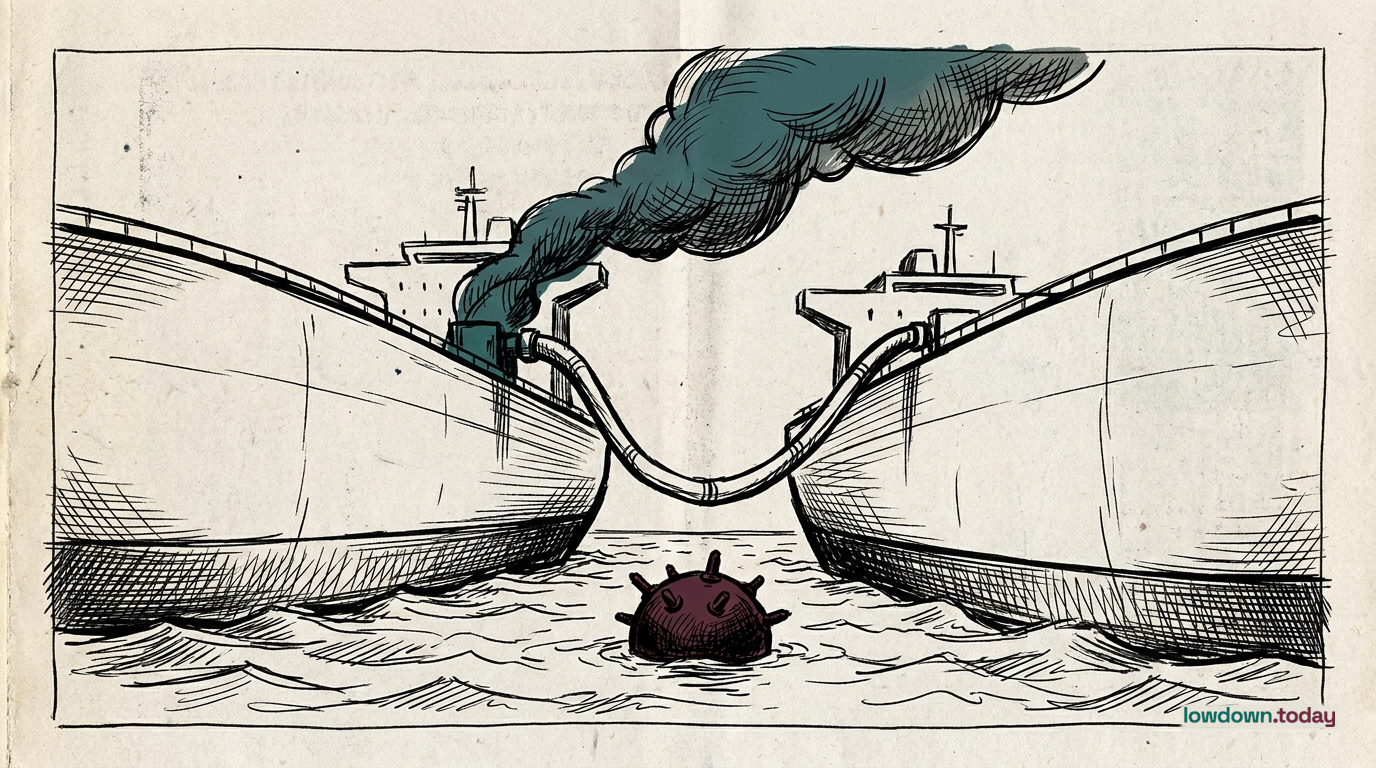
Update #7 · Hezbollah enters; tankers burn in Hormuz

Euronews· 2 Mar 2026
Read original
Causes and effects
Different Perspectives
Oil market and P&I insurers
Brent cleared $87 intraday only once CENTCOM's blockade became physical rather than declared, even though P&I Clubs had already excluded Hormuz war risk a week earlier on 7 July: capital hedged ahead of enforcement, but prices moved only after it.
UAE reporting
UAE reporting
UAE reporting placed the Omani tanker deaths at one seafarer against the International Maritime Agency's count of two, the first time in this war that a Gulf state's casualty figures have diverged from an international monitor's.
Jordan
Jordan
Iranian strikes reached Jordan again on 14 July as part of the Gulf-wide retaliation for the Hormuz blockade, extending the conflict's geographic footprint to a state with no direct stake in the strait itself.
Bahrain
Bahrain
Bahrain sounded air-raid sirens on 14 July during Iran's Gulf-wide retaliation, the same day CENTCOM's blockade order and fourth night of strikes pushed the conflict's physical reach into the wider Gulf littoral.
Kuwait
Kuwait
Kuwait intercepted Iranian missiles and drones on 14 July as Tehran's blockade retaliation reached Gulf states beyond Iran's immediate shoreline, confirming Kuwaiti airspace now sits inside Iran's retaliatory envelope.
Oman
Oman
Oman absorbed the war's first tanker casualties in its own waters on 14 July, with two supertankers disabled and seafarers killed, putting the sultanate's shipping lanes directly in the path of the blockade fight for the first time.