Skip to content
You can now search across every topic, entity and event.What's new
Iran Conflict 2026
2MAR

Two drones intercepted near Akrotiri

3 min read
14:45UTC

Iran has struck at RAF Akrotiri a second time, drawing no distinction between Starmer's stated refusal to join offensive operations and the base's operational capability.

ConflictDeveloping
Key takeaway

Iran is conducting coercive strikes on British sovereign territory to collapse the political distinction between 'supporting' and 'fighting', forcing the UK toward either Article 5 invocation or withdrawal of coalition support.

Cyprus confirmed that two drones heading toward RAF Akrotiri were intercepted — a separate incident from the Shahed-136 that struck the base on Saturday. Akrotiri has now been targeted twice in 48 hours despite UK Prime Minister Keir Starmer's explicit statement in Parliament that the UK "was not involved in the initial strikes on Iran" and "will not join offensive action now," citing lessons from the Iraq War.

Starmer had, however, confirmed approximately one hour before the first Akrotiri strike that the US could use British bases for operations against Iran . Defence analyst Tim Ripley notes that Iran's targeting calculus is driven by operational capability rather than legal framing (Al Jazeera, 2 March 2026): a base that hosts US and allied aircraft conducting operations is a military target regardless of the host government's stated position on its own participation.

The UK's distinction between "defensive" base access and "offensive" participation has a pedigree in British foreign policy. Similar formulations were used during the 1986 US bombing of Libya, when Thatcher permitted F-111s to fly from British bases while framing the UK's role as facilitative rather than combatant. The distinction did not prevent Tripoli from viewing Britain as a belligerent, and Iran has made the same assessment. British forces at Akrotiri are under fire, British air defences are intercepting Iranian munitions, and the legal line between defensive and offensive operations has been erased by Iran's decision to treat the base as a target. The question facing Starmer is no longer whether Britain is a party to this conflict — Iran has answered that — but whether the domestic political position that Britain is not can survive a third strike.

Deep Analysis

In plain English

RAF Akrotiri is a British military base on Cyprus — but unlike most overseas bases, it is technically British territory, not just a rented site. The UK has been allowing the US to use it to support operations while insisting Britain is not formally in the fight. Iran is attacking it anyway, twice in two days, because from their perspective anyone providing facilities to the coalition is a valid target. The legal technicalities that matter in Westminster do not change what the base is used for. The repeat attacks suggest Iran is probing its defences deliberately — testing whether Britain will absorb the hits quietly or be forced to respond, which would make Britain an official participant in the conflict.

Deep Analysis
Synthesis

Iran's repeated targeting of Akrotiri is primarily coercive rather than destructive: the base's air defences have held, yet the strikes continue. The strategic objective appears to be making the UK's political position untenable — each absorbed strike signals that British sovereign territory can be hit at acceptable cost, while each potential escalation risks formalising Britain as a co-belligerent. This is a documented Iranian coercive playbook applied to a NATO ally's sovereign territory, exploiting the precise ambiguity Starmer's statement created.

Root Causes

Akrotiri's structural vulnerability is the gap between its legal identity and its functional role: it is sovereign British territory operating as a US-coalition logistics and ISR hub. This duality means neither legal frame fully resolves the dilemma — the UK cannot invoke Article 5 without implicitly admitting co-belligerent status, yet absorbing repeated strikes on sovereign territory is a politically unsustainable position domestically. No diplomatic formula bridges that gap.

Escalation

The progression from a single Shahed-136 impact on Saturday to two intercepted drones on Sunday indicates a sustained campaign rather than a one-off deterrent signal. Successful penetration of Akrotiri's defences at any point would make the UK's silence politically untenable domestically — attacking sovereign British territory cannot be absorbed indefinitely without a response. Iran appears to be deliberately escalating pressure on the coalition's second-tier contributors before the US consolidates its operational posture, setting a ceiling on how long the UK's ambiguous position can hold.

What could happen next?
  • Risk

    A successful Iranian penetration of Akrotiri's defences would force the UK government into a binary choice between Article 5 invocation — pulling NATO allies toward co-belligerence — and publicly absorbing a strike on sovereign British territory, neither of which is politically sustainable.

    Immediate · Assessed
  • Consequence

    Sustained Iranian pressure on Akrotiri could degrade it as a coalition logistics and ISR hub, reducing operational tempo and increasing mission risk premiums for US-UK operations regardless of whether the base is formally taken offline.

    Short term · Assessed
  • Precedent

    If Iran establishes that attacking a non-belligerent NATO member's sovereign territory used for coalition support carries no military response, it creates a replicable template for coercive campaigns against tier-two coalition contributors in future conflicts.

    Long term · Suggested
  • Risk

    The UK domestic political consensus underpinning Starmer's 'not fighting' position erodes with each publicised strike on Akrotiri, potentially forcing a parliamentary confrontation over Britain's de facto role in the conflict before the government is ready to manage it.

    Short term · Assessed
First Reported In

Update #10 · Friendly fire kills three US jets in Kuwait

Cyprus Mail· 2 Mar 2026
Read original
Causes and effects
This Event
Two drones intercepted near Akrotiri
Iran's repeated targeting of Akrotiri erases the UK's distinction between defensive base access and offensive participation, forcing Britain into a conflict its prime minister has publicly refused to join.
Different Perspectives
Oil market and P&I insurers
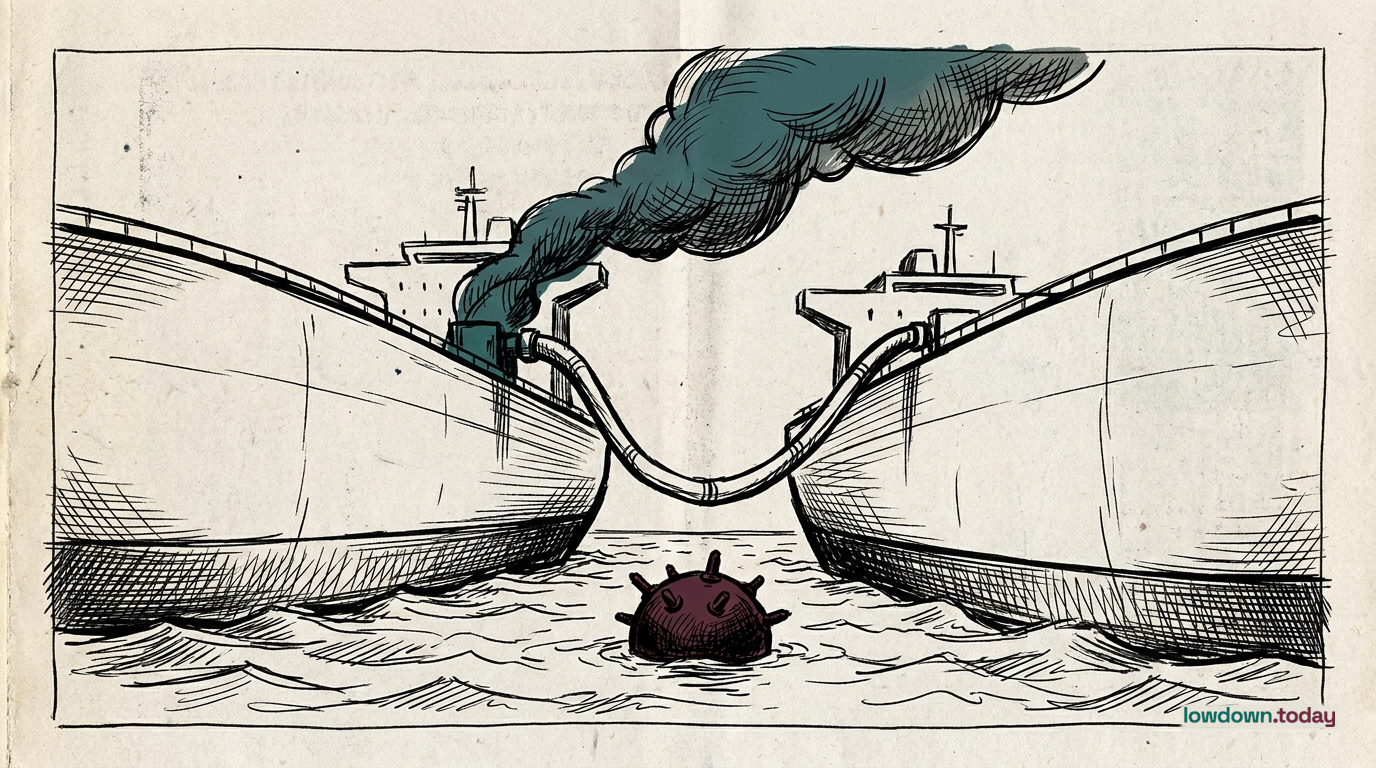
Brent cleared $87 intraday only once CENTCOM's blockade became physical rather than declared, even though P&I Clubs had already excluded Hormuz war risk a week earlier on 7 July: capital hedged ahead of enforcement, but prices moved only after it.
UAE reporting
UAE reporting
UAE reporting placed the Omani tanker deaths at one seafarer against the International Maritime Agency's count of two, the first time in this war that a Gulf state's casualty figures have diverged from an international monitor's.
Jordan
Jordan
Iranian strikes reached Jordan again on 14 July as part of the Gulf-wide retaliation for the Hormuz blockade, extending the conflict's geographic footprint to a state with no direct stake in the strait itself.
Bahrain
Bahrain
Bahrain sounded air-raid sirens on 14 July during Iran's Gulf-wide retaliation, the same day CENTCOM's blockade order and fourth night of strikes pushed the conflict's physical reach into the wider Gulf littoral.
Kuwait
Kuwait
Kuwait intercepted Iranian missiles and drones on 14 July as Tehran's blockade retaliation reached Gulf states beyond Iran's immediate shoreline, confirming Kuwaiti airspace now sits inside Iran's retaliatory envelope.
Oman
Oman
Oman absorbed the war's first tanker casualties in its own waters on 14 July, with two supertankers disabled and seafarers killed, putting the sultanate's shipping lanes directly in the path of the blockade fight for the first time.