Skip to content
You can now search across every topic, entity and event.What's new
European Tech Sovereignty
27MAY

France's G7 text drops cloud sovereignty

3 min read
15:19UTC

The G7 Digital Ministerial Declaration, signed at Bercy in Paris on 29 May under French chairmanship, contained no mention of cloud sovereignty, CAIDA, or restrictions on US cloud providers.

TechnologyDeveloping
Key takeaway

France chaired the G7 and left cloud sovereignty out of the text, exposing CAIDA's lack of international support.

The G7 Digital and Technology Ministerial Declaration, signed at Bercy in Paris on Friday 29 May under French chairmanship, contained no mention of cloud sovereignty, CAIDA, or restrictions on US cloud providers 1. The G7 is the bloc of seven leading advanced economies; its digital ministers had gathered to agree shared priorities. The four they signed were AI security, AI openness for smaller firms, digital-sector resilience, and child safety online. The text held to the Hiroshima AI Process, the G7's 2023 AI-safety framework, rather than to France's own "Cloud au Centre" doctrine.

The signed communique confirmed what the ministerial agenda had already foreshadowed . The two frames in play do not combine: the Hiroshima AI Process treats AI as a safety problem to be governed cooperatively, while the sovereignty frame treats US cloud dominance as a strategic dependency to be reduced. A room containing the United States and Japan would accept only the first. France, chairing without an adopted package to table , had no instrument to defend and chose the text its partners could sign.

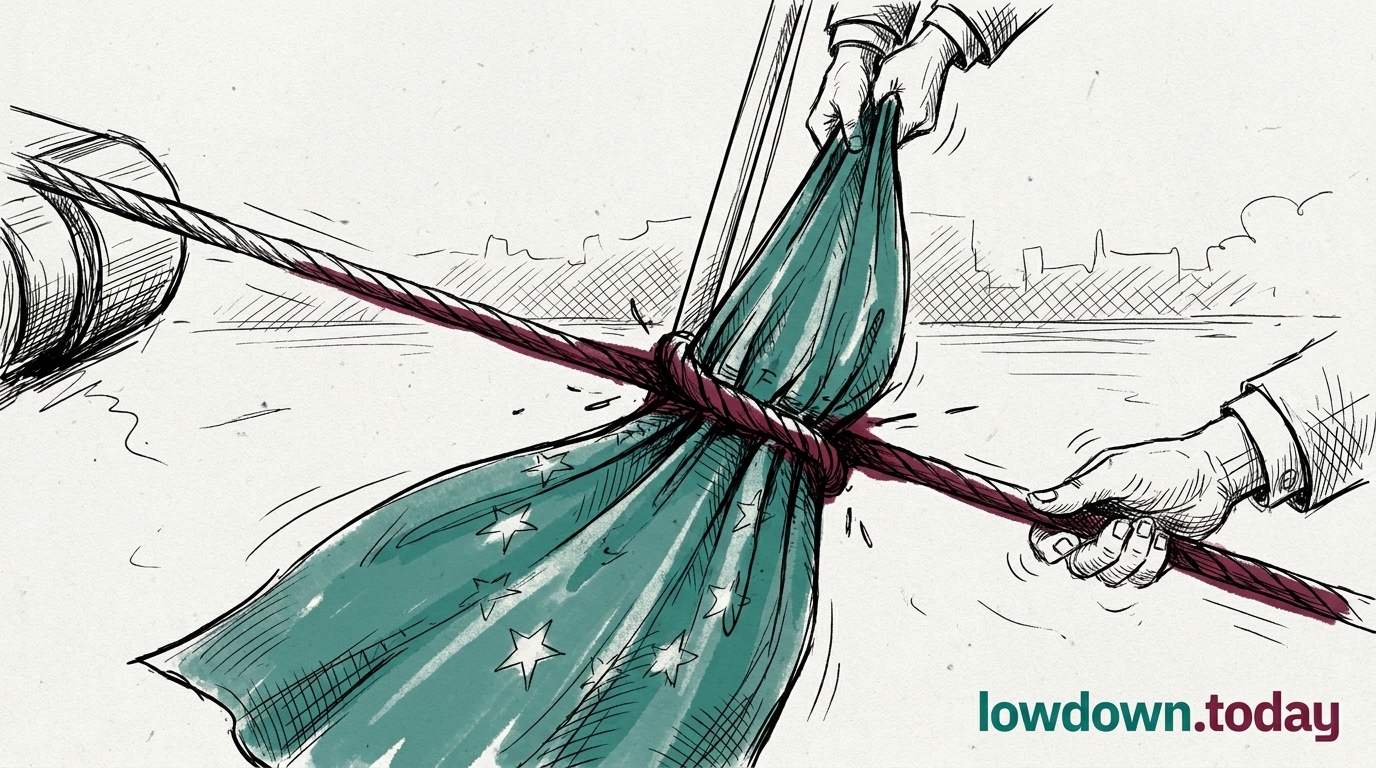
That choice is the measure of CAIDA's international isolation. The country leading the sovereignty argument inside the EU would not, or could not, carry it into a venue where Washington could object. The law's strongest advocate declined to defend it where defending it had a cost, which leaves Brussels adopting an instrument no G7 communique endorses.

Deep Analysis

In plain English

The G7 is a group of seven major democracies, including France, Germany, the US, the UK and Japan, that meet regularly to coordinate policy. In late May 2026, France chaired a G7 meeting specifically on digital technology in Paris. France had been expected to use the meeting to push other G7 members toward its vision of digital sovereignty, which involves restricting American cloud companies from handling sensitive data. Instead, the final agreed statement said nothing about cloud sovereignty at all. The four topics everyone agreed on were AI safety, helping smaller businesses use AI, protecting children online, and making digital systems more resilient against outages and attacks.

Deep Analysis
Root Causes

The Bercy outcome has two structural causes unrelated to French diplomatic skill. First, the G7 digital ministerial has no enforcement mechanism: it produces declarations, not binding instruments. This means the only value of sovereignty language in the text would be signalling and precedent, and France judged the signalling value insufficient to fight for against US opposition.

Second, France chaired without an adopted Tech Sovereignty Package to put on the table. CAIDA's fourth consecutive slip meant France had no legislative fact to anchor sovereignty language to. A G7 presidency cannot credibly demand international recognition of a doctrine its own Commission has failed to legislate in four attempts. France removed cloud sovereignty from the agenda because CAIDA's fourth slip left it without a legislative fact to anchor any sovereignty demand to.

What could happen next?
  • Consequence

    The Bercy precedent reduces the probability that a future G7 digital ministerial will include cloud-sovereignty language, even after CAIDA adopts, because the US will cite the Bercy silence as the baseline.

    Medium term · Reported
  • Risk

    A French presidency that could not secure sovereignty language at its own G7 ministerial weakens the diplomatic credibility of EU arguments at the WTO and in bilateral EU-US digital trade talks.

    Short term · Reported
  • Meaning

    The Hiroshima AI Process framework, which the Bercy declaration reaffirmed, was authored under Japanese presidency and does not include EU sovereignty positions; Bercy's reaffirmation locks the G7 to that baseline for another cycle.

    Long term · Assessed
First Reported In

Update #7 · Sovereignty arrives, minus Brussels

G7 France· 3 Jun 2026
Read original
Different Perspectives
United States (Google/Alphabet)
Alphabet lost its final Android appeal on 2 July with no further court to hear it, a result its Computer and Communications Industry Association allies frame as precedent, not deterrence, since the €4.1bn fine changed nothing about Google's Play Store terms across eight years of litigation.
UK Department for Science, Innovation and Technology
DSIT opened its £96m second Sovereign AI wave on 3 July, switching from April's equity stakes to fixed-price contracts because Britain has no domestic hyperscaler or Bpifrance-style lender to fund capacity another way. It is betting on buying outcomes it controls alone rather than joining an EU-wide framework.
German federal government
Berlin backed both German deliverables this week, Infineon's fab and Aleph Alpha's merger, but is finding one far harder to close than the other. It wants enforceable protective rights inside Cohere's cap table before the merger closes, a legal instrument the Bundeskartellamt has no filing to review yet.
European Commission
European Commission
The Commission banked a clean CJEU win on the eight-year Android case on 2 July, removing Google's last comparator argument before President von der Leyen rules on the far larger DMA self-preferencing fine due 27 July. Brussels treats Infineon's early Dresden delivery as proof the Chips Act mechanism works, at the node Europe already led.
Bruegel (EU industry sceptics)
Bruegel economist Mario Mariniello argued the EU sovereignty package mimics US and Chinese strategy while EU cloud providers hold roughly 15% of their home market; using nationality as a proxy for security without fixing the underlying capital and energy gaps that drive the dependency creates €86bn of migration cost without the security benefit it is sold as delivering.
France
France
France published a joint sovereignty definition with Germany at VivaTech and mobilised €13bn under Tibi Phase 3, placing SAP's partnership with Mistral as the working proof that a German enterprise-software giant running a French sovereign model inside public administration is what digital sovereignty looks like in practice.
