Skip to content
You can now search across every topic, entity and event.What's new
European Oil Markets
23JUL

The dark fleet fakes an anchored ship

2 min read
19:27UTC

A sanctioned tanker loaded 1.87 million barrels at Kharg Island while faking an anchor-swing track that mimicked a parked ship, a spoof Windward says it had never documented before.

EconomicAssessed
Key takeaway

Iran's shadow tankers now fake the physics of anchoring, so only satellite imagery catches them loading crude.

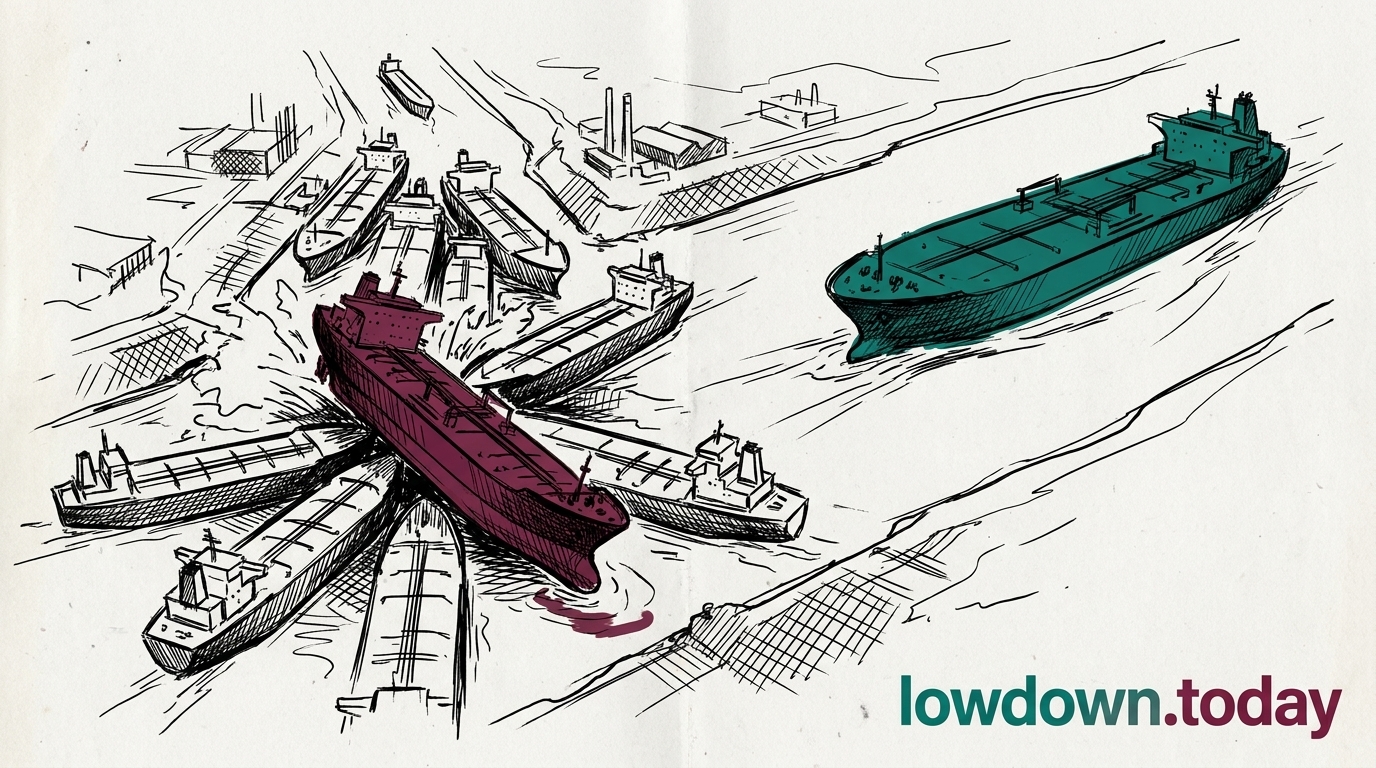
An OFAC-sanctioned Guyana-flagged VLCC, a Very Large Crude Carrier, loaded an assessed 1.87 million barrels of Iranian crude at Kharg Island between 23 June and 4 July while broadcasting a fabricated position, according to Windward maritime intelligence 1. Kharg Island is Iran's main crude export terminal, and a VLCC carries about two million barrels, so this is close to a full cargo moved under sanctions. Rather than transmit a static false location, the 333-metre tanker faked an anchorage track that swung asymmetrically around a fixed point some 57 nautical miles to the west, mimicking the natural yaw of a ship riding its anchor chain.

The spoof exploits the rule enforcers use to flag suspect ships. An AIS, the Automatic Identification System transponder every vessel broadcasts, that sits perfectly motionless reads as suspicious; a slowly swinging track reads instead as a hull turning on its anchor in the current, so the automated filter clears it. Windward says it had not seen the pattern before this loading, and the fake was caught only when electro-optical satellite imagery contradicted the broadcast. Detecting evasion at Kharg now needs a photograph, no longer a signal alone.

The economic war runs underneath the kinetic one. Crude keeps loading even as OFAC winds down the waiver that let buyers pay for it , the same authorisation under which Iran had opened crude talks with Japan a week earlier . As the legal route to Iranian oil narrows, the covert one is adding techniques faster than stationary-position detection can follow.


Deep Analysis

In plain English

Ships are supposed to broadcast their location using a tracking system called AIS, which sanctions enforcers use to see which tankers are moving sanctioned oil. This tanker, flagged in Guyana and already under US sanctions, faked its AIS signal to look like it was anchored and not moving, while it was actually loading more than a million barrels of Iranian oil at Kharg Island, Iran's main oil export terminal. Analysts only caught the deception by comparing the fake signal against satellite photos, a method not seen used against this kind of trick before.

Deep Analysis
Root Causes

The approaching 17 July hard deadline on General License X1 creates a closing window that rewards concealment now: a tanker loading visibly before 17 July still risks OFAC designation, so operators have an incentive to mask the loading itself rather than simply accept sanctions exposure after the fact.

Electro-optical satellite imagery, not AIS data, caught the spoof, exposing a structural gap in sanctions monitoring: any system relying on a vessel's own broadcast position can be defeated by a vessel willing to fake it, which is why Windward needed a second, independent data source to catch this pattern at all.

First Reported In

Update #150 · Second US strike wave, first heavy toll

Lloyd's List· 9 Jul 2026
Read original
Causes and effects
This Event
The dark fleet fakes an anchored ship
A novel spoof that defeats stationary-position tracking pushes sanctions enforcement toward costly satellite imagery for every suspect cargo.
Different Perspectives
US money managers (CFTC-tracked)
US money managers had trimmed WTI net long positioning into July's rally, doubting the Hormuz premium would hold without freight or war-risk confirmation, and the crude stock build reported for the week to 17 July gives that scepticism a fundamentals basis. The 25 July CFTC data will show whether Brent's move above $100 changed their calculus.
Asian distillate buyers (Singapore)
Singapore's distillate holders kept retaining middle-distillate barrels as the East-West arbitrage window narrowed further this week, a pattern that sharpened as Fujairah light distillates hit a record low. Cargoes are being held rather than released west into the tightening Mediterranean market.
Bulgaria
Bulgaria
Bulgaria secured the removal of Lukoil founder Vagit Alekperov and Patriarch Kirill from the 21st package, with President Rumen Radev calling a personal listing 'shooting ourselves in the foot'. Sofia is protecting its position in Lukoil's EUR 3bn compensation claim over the 2023 Neftohim Burgas nationalisation.
Russia
Russia
Russia loses the roughly $14 a barrel of legal headroom the price-cap formula would have released toward $58, even as Urals continues trading below Moscow's $59 budget floor. The shadow-fleet insurance workaround that lets sanctioned crude clear above $44 in practice remains untouched by the freeze itself.
European Union
European Union
The EU adopted its 21st sanctions package on 23 July, freezing the $44 Russia oil cap for 12 months rather than letting the formula drift it toward $58, and listed shadow-fleet support vessels for the first time. The package cleared only after three failed Coreper votes.
Marine war-risk underwriters (Lloyd's-linked syndicates)
War-risk syndicates lifted southern Red Sea hull premiums 150% to about 0.75% of hull value after the 20 July blockade declaration, still a seventh of the roughly 5% Hormuz band. Underwriters reset on realised loss, not declared threat, so the 23 July Encelia and Layla strikes set up the next re-mark.