Skip to content
You can now search across every topic, entity and event.What's new
European Oil Markets
23JUL

Diesel crack and Hormuz premium stack

3 min read
19:27UTC

US ultra-low-sulphur diesel jumped near $154 a barrel on 8-10 July as Russian loadings collapsed to 234 kbd, a crack answering to lost supply, not war risk.

EconomicDeveloping
Key takeaway

Diesel is dear because Russia stopped exporting it, a shortage set to outlast the oil war-scare.

US ultra-low-sulphur diesel jumped to about $154/bbl on 8-10 July, a roughly $80/bbl crack over WTI, according to a single trade wire 1. The crack, a refiner's margin from turning a barrel of crude into diesel, had already blown out in Europe, where it held near $46 in early July after Novak's full Russian export ban .

Russian barrels, not war risk, drove the fresh leg. Diesel and gasoil loadings ran just 234 kbd for 1-10 July, against a 400 kbd June pace and an ~817 kbd 2025 average, before the formal 31 July ban even bit 2. The loadings data shows a supply loss already happening on the water, which the ban simply formalises.

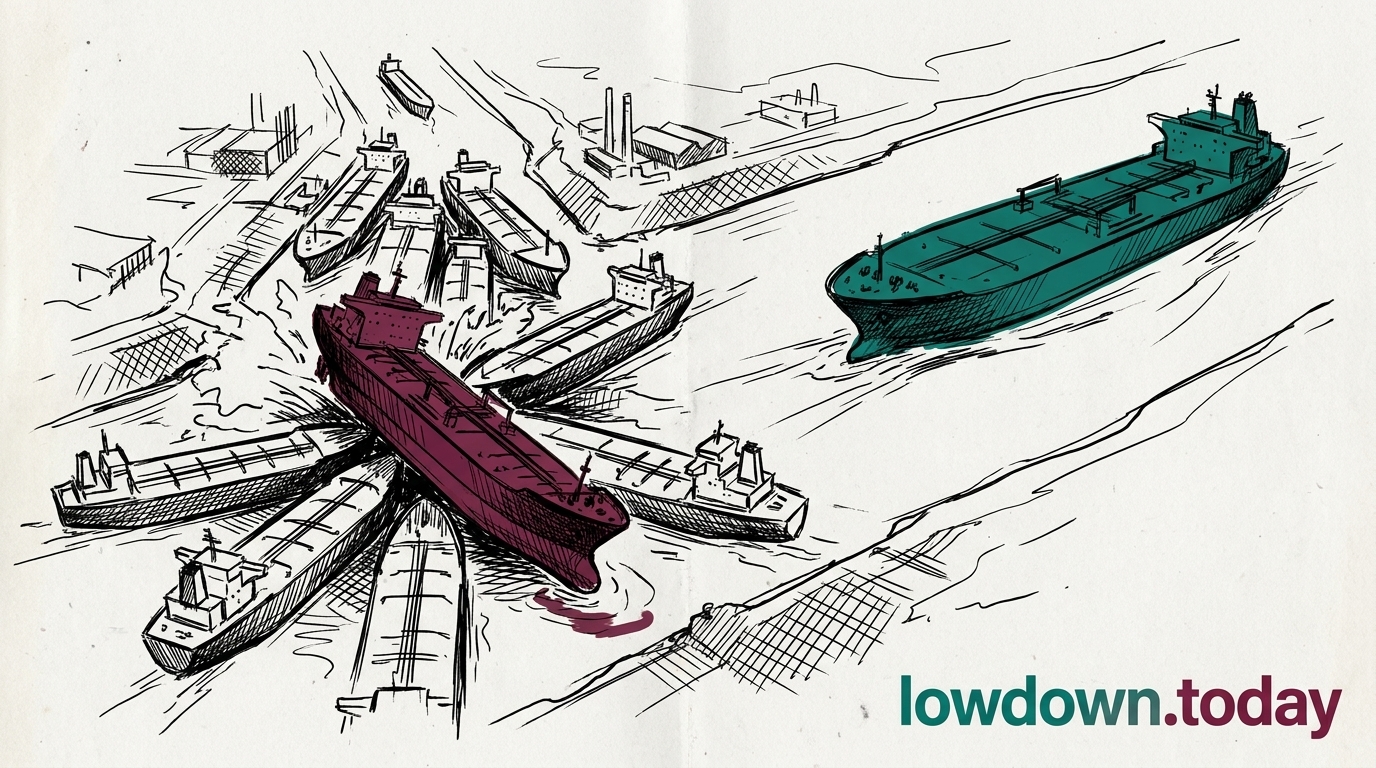
That separation is the whole trade. The crack premium prices lost Russian supply; the flat-price premium prices Hormuz transit fear. They rest on different clocks and add to each other rather than substituting, which is why the crack held firm through a week the flat price round-tripped. EU Regulation 833/2014 bars the discounted Russian and Iranian barrels from reaching the European pool, so a hedge that assumes the crack and the Hormuz premium deflate together will slip when only one of them fades.


Deep Analysis

In plain English

Diesel is a fuel refined from crude oil, used mainly in trucks, ships and heavy machinery. The 'crack' is the extra price refiners can charge for diesel above the cost of the crude oil that goes into making it, a rough measure of how tight diesel supply is. In early July, US diesel prices jumped to about $154 a barrel, roughly $80 more than the cost of the crude used to make it, a very wide gap. At the same time, Russia's diesel and fuel-oil shipments dropped sharply, to about a third of last year's average pace, even before a formal Russian export ban (announced by deputy prime minister Alexander Novak) takes effect on 31 July.

Deep Analysis
Root Causes

The diesel crack's outsized widening traces to a supply mechanism distinct from the Hormuz risk driving crude: Russian diesel and gasoil loadings fell to 234 kbd for 1-10 July, down from a 400 kbd June pace and roughly 817 kbd across 2025, even before Novak's formal 31 July export ban takes effect, meaning buyers are already losing Russian barrels ahead of the legal deadline.

The European pool has no substitute source, since Regulation 833/2014 already excludes Russian and Iranian diesel from the bloc, so any further loss of Russian volume has nowhere else to draw from within Europe.

What could happen next?
  • Consequence

    The diesel premium is stacking on top of, rather than substituting for, the Hormuz-driven crude risk premium, meaning European and US diesel buyers face two separate cost pressures simultaneously.

  • Risk

    If Russian loadings do not recover once Novak's ban formally binds on 31 July, the diesel crack could widen further from its already elevated 8-10 July level.

First Reported In

Update #16 · Brent hit $79; the structure said no

ts2.tech· 13 Jul 2026
Read original
Different Perspectives
US money managers (CFTC-tracked)
US money managers had trimmed WTI net long positioning into July's rally, doubting the Hormuz premium would hold without freight or war-risk confirmation, and the crude stock build reported for the week to 17 July gives that scepticism a fundamentals basis. The 25 July CFTC data will show whether Brent's move above $100 changed their calculus.
Asian distillate buyers (Singapore)
Singapore's distillate holders kept retaining middle-distillate barrels as the East-West arbitrage window narrowed further this week, a pattern that sharpened as Fujairah light distillates hit a record low. Cargoes are being held rather than released west into the tightening Mediterranean market.
Bulgaria
Bulgaria
Bulgaria secured the removal of Lukoil founder Vagit Alekperov and Patriarch Kirill from the 21st package, with President Rumen Radev calling a personal listing 'shooting ourselves in the foot'. Sofia is protecting its position in Lukoil's EUR 3bn compensation claim over the 2023 Neftohim Burgas nationalisation.
Russia
Russia
Russia loses the roughly $14 a barrel of legal headroom the price-cap formula would have released toward $58, even as Urals continues trading below Moscow's $59 budget floor. The shadow-fleet insurance workaround that lets sanctioned crude clear above $44 in practice remains untouched by the freeze itself.
European Union
European Union
The EU adopted its 21st sanctions package on 23 July, freezing the $44 Russia oil cap for 12 months rather than letting the formula drift it toward $58, and listed shadow-fleet support vessels for the first time. The package cleared only after three failed Coreper votes.
Marine war-risk underwriters (Lloyd's-linked syndicates)
War-risk syndicates lifted southern Red Sea hull premiums 150% to about 0.75% of hull value after the 20 July blockade declaration, still a seventh of the roughly 5% Hormuz band. Underwriters reset on realised loss, not declared threat, so the 23 July Encelia and Layla strikes set up the next re-mark.