Skip to content
You can now search across every topic, entity and event.What's new
European Oil Markets
23JUL

Brent jumps 6% as oil ends its shrug

2 min read
19:27UTC

Brent crude rose about 6 per cent to roughly $78.67 a barrel on 8 July, its biggest jump since the war's opening spike in March.

EconomicDeveloping
Key takeaway

Brent jumped about 6 per cent, its biggest since the war's March spike, pricing escalation it had spent months ignoring.

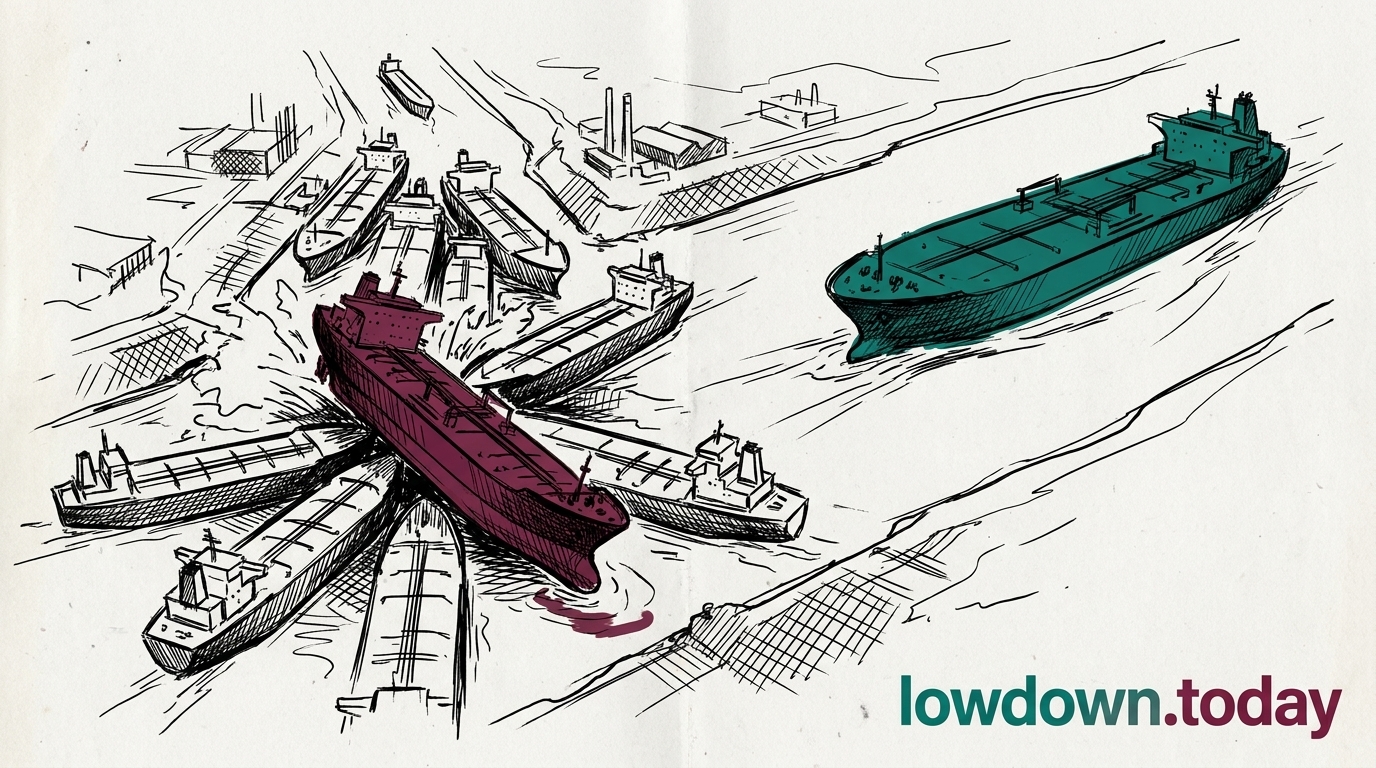
Brent Crude rose to about $78.67 a barrel on 8 July, up roughly 6 per cent, with West Texas Intermediate (WTI) at about $74.82, its sharpest single-day rise since the war's opening spike in March . 1 Brent is the benchmark that prices about two-thirds of internationally traded crude, so a move of this size feeds petrol, diesel and airline fares within weeks. It had sat near $73 after the Al Rekayyat strike alone .

Prices fell through every earlier shock of this conflict. Brent dropped to $71.99 through the June bombing of Qeshm Island , and the second quarter closed down about 30 per cent, the steepest quarterly fall since 2020 . What moved the market this time was not one more incident but a strike and a retaliation landing in the same cycle, which raises the probability traders assign to an actual closure of the strait of Hormuz.

Saudi Arabia floated an expansion of a Red Sea pipeline to route crude around Hormuz, and tankers began making U-turns in the Gulf, according to trade reporting. 2 The thirty-five tankers that cleared the strait at pre-war rates on 2 July now move under a threat level the market has finally chosen to price. A Saudi pipeline, if pursued, is a multi-year structural hedge rather than a quick fix, and tanker diversions tighten Gulf supply just as OPEC+ was adding barrels.


Deep Analysis

In plain English

Brent Crude and West Texas Intermediate (WTI) are the two main global oil price benchmarks. Brent jumped about 6 per cent in a single day, its biggest one-day rise of the whole war, after the CENTCOM strikes and Iran's Gulf retaliation raised fears that tankers moving through the Strait of Hormuz, the narrow waterway carrying roughly a fifth of the world's oil, could come under attack or be blocked. Saudi Arabia responded by floating a plan to expand a pipeline that would let its oil bypass Hormuz entirely by crossing overland to the Red Sea instead.

Deep Analysis
Root Causes

Oil traders price Hormuz risk through tanker insurance and freight rates as much as through headline events: P&I Clubs had already kept their Hormuz war-risk exclusion in force after the 7 July Al Rekayyat strike, meaning underwriters were signalling elevated risk before Brent moved.

Saudi Arabia's floated Red Sea pipeline expansion revives bypass capacity the kingdom has held since the 1980s Petroline system; reviving it now signals Riyadh expects further volatility rather than a one-off shock.

What could happen next?
  • Consequence

    Saudi Arabia's Red Sea pipeline expansion, if pursued, would give Riyadh a durable hedge against future Hormuz disruption independent of any US or Iranian action.

  • Risk

    A sustained price spike above $80 would test whether P&I Clubs' war-risk exclusion pushes tankers to demand naval escort before transiting Hormuz.

First Reported In

Update #149 · The first thing Washington signed on Iran: a revocation

The National· 8 Jul 2026
Read original
Different Perspectives
US money managers (CFTC-tracked)
US money managers had trimmed WTI net long positioning into July's rally, doubting the Hormuz premium would hold without freight or war-risk confirmation, and the crude stock build reported for the week to 17 July gives that scepticism a fundamentals basis. The 25 July CFTC data will show whether Brent's move above $100 changed their calculus.
Asian distillate buyers (Singapore)
Singapore's distillate holders kept retaining middle-distillate barrels as the East-West arbitrage window narrowed further this week, a pattern that sharpened as Fujairah light distillates hit a record low. Cargoes are being held rather than released west into the tightening Mediterranean market.
Bulgaria
Bulgaria
Bulgaria secured the removal of Lukoil founder Vagit Alekperov and Patriarch Kirill from the 21st package, with President Rumen Radev calling a personal listing 'shooting ourselves in the foot'. Sofia is protecting its position in Lukoil's EUR 3bn compensation claim over the 2023 Neftohim Burgas nationalisation.
Russia
Russia
Russia loses the roughly $14 a barrel of legal headroom the price-cap formula would have released toward $58, even as Urals continues trading below Moscow's $59 budget floor. The shadow-fleet insurance workaround that lets sanctioned crude clear above $44 in practice remains untouched by the freeze itself.
European Union
European Union
The EU adopted its 21st sanctions package on 23 July, freezing the $44 Russia oil cap for 12 months rather than letting the formula drift it toward $58, and listed shadow-fleet support vessels for the first time. The package cleared only after three failed Coreper votes.
Marine war-risk underwriters (Lloyd's-linked syndicates)
War-risk syndicates lifted southern Red Sea hull premiums 150% to about 0.75% of hull value after the 20 July blockade declaration, still a seventh of the roughly 5% Hormuz band. Underwriters reset on realised loss, not declared threat, so the 23 July Encelia and Layla strikes set up the next re-mark.