Skip to content
You can now search across every topic, entity and event.What's new
European Oil Markets
16JUL

Iraq's Ceyhan backstop stalls at 190kbd

3 min read
09:39UTC

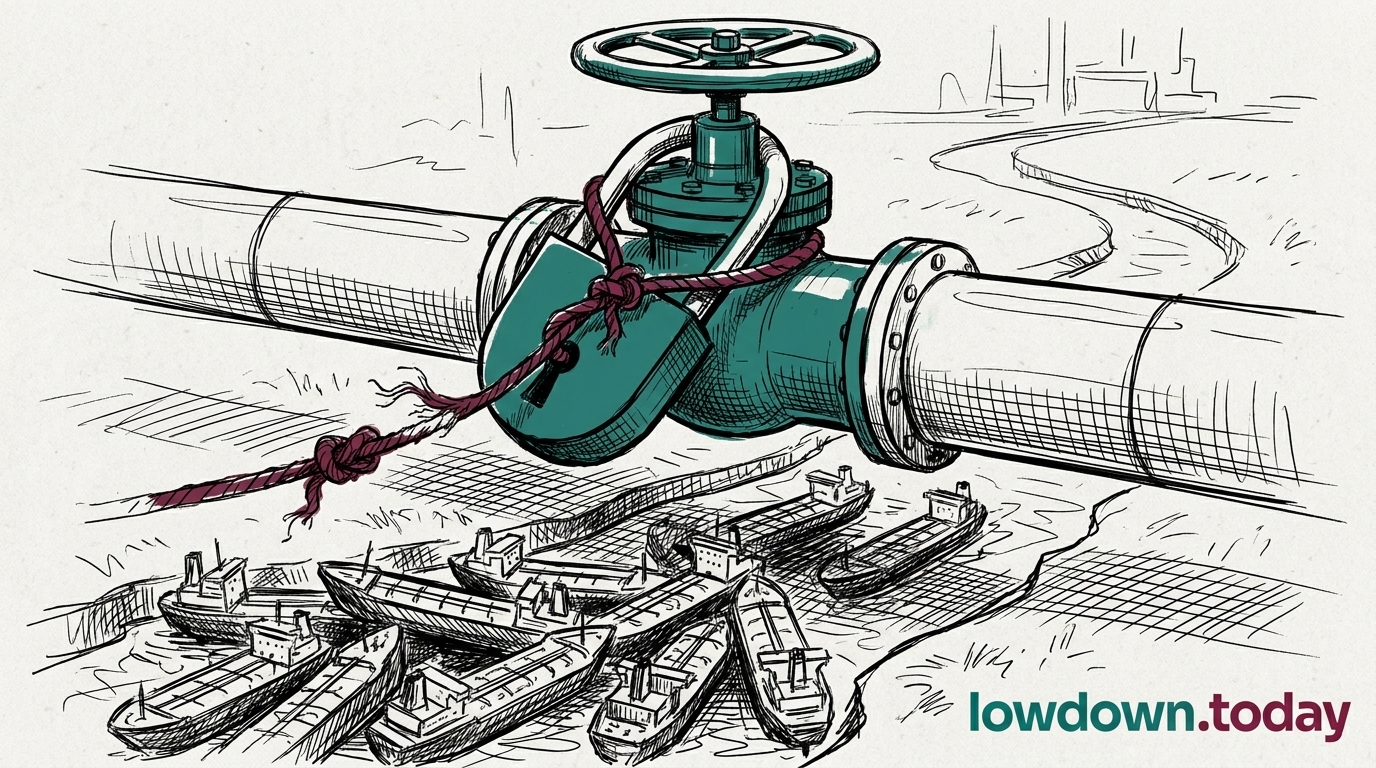
Kirkuk-Ceyhan throughput has settled near 190kbd against a 770kbd cabinet target, leaving the non-Hormuz medium-sour barrels Med refiners were promised stuck behind allocation, not in transit.

EconomicDeveloping
Key takeaway

Kirkuk-Ceyhan stuck at 190kbd against a 770kbd target leaves Med refiners short and the TD19 freight bid intact.

Iraq's Kirkuk-Ceyhan pipeline throughput has stabilised near 190kbd, well short of the 770kbd that the cabinet framed the line as ramping toward . 1 The pipeline carries northern Iraqi crude to the Turkish Mediterranean port of Ceyhan, and it was billed as the primary non-Hormuz backstop, a route that keeps Med refiners supplied without depending on the contested Gulf chokepoint. Iraqi officials are now discussing a push to a 500-650kbd range, but the most recent data has northern exports flat near 190kbd rather than climbing.

Total Iraqi output sits near 1.4mbd against 4.2mbd before the conflict, with southern seaborne routes down roughly 97%. The medium-sour grades that Med refiners were promised as Hormuz insurance are not arriving on the schedule the cabinet set, which leaves the relief that traders had penned in for the basin notional rather than physical.

That shortfall feeds straight into freight. Higher Ceyhan liftings would generate more cargoes on the TD19 route, the Mediterranean Aframax benchmark, and the scramble for non-Hormuz medium sour had already driven that rate to WS228 on 6 June . A ramp stuck at 190kbd leaves the Med supply-short and the freight bid intact, reinforcing the same prompt tightness that the backwardated curve is pricing in crude. No fresh TD19 print landed in the 9 to 11 June window to confirm a move off WS228, so the freight squeeze is unconfirmed but unrelieved.


Deep Analysis

In plain English

Iraq has a pipeline that runs from the Kirkuk oilfields in northern Iraq to the port of Ceyhan on Turkey's Mediterranean coast, completely bypassing the Strait of Hormuz where much of Iraq's oil is now blocked. When the Gulf blockade hit, this pipeline was meant to be ramped up dramatically to replace the southern exports that can no longer get through. The problem is that the pipeline is barely moving more oil than before about 190,000 barrels a day, against a target of 770,000. This matters to European refineries that buy Iraqi medium-grade oil, because they cannot get the barrels they need. Shipping costs for tankers that take the Ceyhan oil to southern European ports have spiked, adding to the cost of fuel that ultimately flows through to European consumers.

Deep Analysis
Root Causes

Three compounding constraints explain the 190kbd ceiling.

First, the KRG revenue dispute. Baghdad assumed direct control of Kirkuk liftings after the March 2023 ICC ruling, but the Erbil-Baghdad revenue-sharing formula for northern production remains contested. Kurdish field operators have used the ambiguity to slow field deliveries to the pipeline, keeping volumes near levels that avoid triggering the contested revenue trigger.

Second, compressor station capacity on the Iraqi side. The Fish Khabur compressor and the Baiji junction both require refurbishment to sustain flows above 300kbd. Neither has a confirmed recommissioning timeline in the 9-11 June window.

Third, Ceyhan's tanker scheduling and storage fill state. A rapid ramp in Kirkuk-Ceyhan throughput requires corresponding Aframax availability at Ceyhan terminal, and storage fill constraints at the loading terminal limit the ramp rate independent of pipeline pressure. At WS228 on 6 June, Aframax availability is bid but not infinite.

What could happen next?
  • Consequence

    TD19 Med Aframax rates at WS228 remain structurally bid as long as Kirkuk-Ceyhan throughput stays near 190kbd, keeping the freight component of Mediterranean medium-sour delivered costs elevated by approximately $1.50-1.80/bbl above pre-conflict norms.

    Short term · Assessed
  • Risk

    A further political stop on KRG field deliveries, analogous to the March 2023 halt, could reduce Ceyhan loadings toward zero again, collapsing the last meaningful non-Hormuz medium-sour supply route for Mediterranean buyers.

    Medium term · Reported
  • Opportunity

    A confirmed Baghdad-Erbil revenue deal unlocking field deliveries above 300kbd would be the fastest path to meaningful TD19 rate compression, materially reducing Mediterranean medium-sour procurement costs before the end of Q3 2026.

    Medium term · Reported
First Reported In

Update #7 · Distillate deficit deepens as runs max out

Iraqi News· 11 Jun 2026
Read original
Different Perspectives
Indian refiners
Indian refiners
Indian refiners kept lifting discounted Urals as the India/Baltic price split widened past $9-10 a barrel, a gap that only grows as GL X1's Iranian wind-down cuts an alternative discounted grade off the market by 17 July. Cheaper Russian feedstock is being locked in while it lasts.
Chinese refiners
Chinese refiners
Chinese refiners gain leverage as the Urals-Brent discount widens, since Beijing's state buyers already source discounted Russian barrels near the fiscal floor unaffected by Western insurance costs. A wider discount, if it holds past 23 July, lets them lock in cheaper term contracts regardless of the cap's outcome.
US money managers (CFTC-tracked)
Managed money trimmed WTI net length into the rally, positioning that reflects doubt the Hormuz premium survives without freight or war-risk confirmation. The Brent-WTI spread widening almost entirely on the Brent leg supports that scepticism about a broad-based repricing.
OPEC+ (Saudi-led subgroup)
Saudi Arabia is defending market share through a fourth straight 188kbd August hike even as OPEC's own July MOMR cut 2026 demand growth for the fourth consecutive month. At a $108-111 fiscal breakeven, every added barrel costs Riyadh revenue it cannot recoup, so the hike reads as a positioning signal, not a demand bet.
Greek shipping registries
Greece, backed by Cyprus and Malta, is pushing a three-month cap-freeze compromise against the Commission's freeze to January 2027 ahead of the 23 July vote. Athens' and Valletta's combined tanker registrations mean a shorter review gives their insurers more frequent chances to reprice risk on Russian cargoes.
Russia (Deputy PM Alexander Novak)
Novak extended the diesel export restriction to producers on 8 July, the first producer-binding curb of the war, protecting the domestic pump price ahead of any refinery repair timeline. Urals still trades below Russia's $59 budget floor even as Brent gained, so the ban trades export revenue for fiscal stability at home.