Skip to content
You can now search across every topic, entity and event.What's new
European Oil Markets
18MAY

Qatar says the $6bn never left

2 min read
17:30UTC

Qatar's Foreign Ministry said the $6bn tranche of Iranian funds it holds has not moved, directly contradicting President Masoud Pezeshkian's 29 June claim that the money was returning to Tehran.

EconomicDeveloping
Key takeaway

Qatar says Iran's $6bn remains frozen, spendable only on food and medicine through a US-supervised account.

Qatar's Foreign Ministry said on 3 July that the $6bn tranche of Iranian funds it holds remains frozen, directly contradicting President Masoud Pezeshkian, who claimed on 29 June that the money was returning to Tehran without US conditions 1. Any release depends on a US-Qatar-Iran mechanism, restricted to food and medicine, that has not been finalised.

The escrow unlocks only against approved humanitarian invoices, so even a signed deal would not put cash in Tehran's hands. It would let Iran draw down against wheat and medicine purchases run through a US-supervised account. Pezeshkian described a return of sovereign money; Doha described a spending line for food.

The account mirrors a 2023 arrangement in which $6bn of Iranian oil money sat in Qatar for humanitarian purchases before being refrozen, and the same food-and-medicine ringfence Washington set on the disputed $12bn tranche last week . Same custodian, same ledger, same reversibility. A president announcing a return of funds structured this way is describing an invoice line, not a transfer, which is the distinction Doha's rebuttal makes public. Pezeshkian's announcement is the second Iranian claim of a win this week that the paperwork does not support.


Deep Analysis

In plain English

Qatar has been holding billions of dollars of Iranian money that international sanctions froze. On 29 June, Iran's President Masoud Pezeshkian told the Iranian public that $6bn of that money was finally coming home, with no conditions attached. Qatar's Foreign Ministry said on 3 July that Pezeshkian's version is wrong. The $6bn is still frozen exactly where it was before. Qatar cannot release the funds without permission from the US Treasury, which has not been given, so Iran's president appears to have promised his own people something no one had actually agreed to.

Deep Analysis
Root Causes

Qatar's central bank holds the funds under US secondary-sanctions exposure, not Iranian ownership terms. Any release without an explicit Treasury licence risks Doha's own banks losing correspondent relationships with American institutions, a far larger cost to Qatar than the diplomatic friction of contradicting Pezeshkian.

That constraint has not changed since Qatar first confirmed in April that any release requires Treasury approval it has not granted. Pezeshkian has no authority over that process either. As a civilian president with no command role over the IRGC or the nuclear file, his public statements on sanctions relief are aimed at Iranian audiences rather than at commitments Washington or Doha are bound by.

First Reported In

Update #145 · Iran's heir skips the funeral built for him

Iran International· 4 Jul 2026
Read original
Causes and effects
This Event
Qatar says the $6bn never left
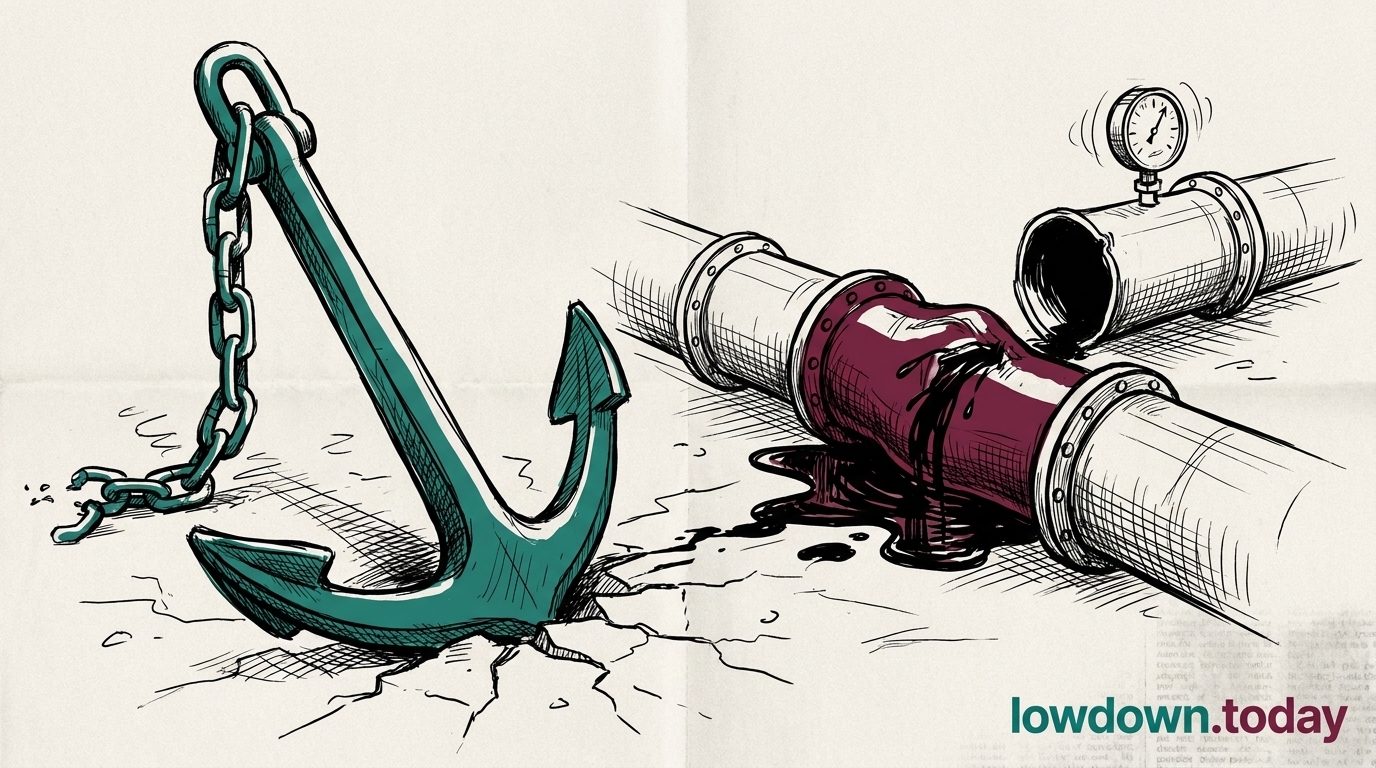
Qatar's rebuttal shows the $6bn is a US-supervised humanitarian spending line, not the returning sovereign cash Pezeshkian described to a domestic audience.
Different Perspectives
Greek shipping registries
Flag states dominating the tanker fleet await the EU's 15 July cap-freeze vote. A formula unlock toward $75 would loosen the ceiling squeezing insurance and crewing costs on their registered hulls.
US money managers
US money managers
NYMEX WTI managed-money net long fell 23% to +64,041 in the week to 7 July, trimming length into the rally on doubt the Hormuz premium survives without freight or war-risk confirmation.
European refiners (ARA)
ARA refiners are capturing an $80/bbl US diesel crack as Russian gasoil loadings collapsed to 234kbd before Novak's 31 July export ban even bites, widening the arbitrage straight into refining margins.
OPEC+
OPEC+
The seven-member group confirmed a fourth consecutive 188kbd August hike on 5 July, defending market share even though Saudi Arabia's $108-111/bbl breakeven means every added barrel costs Riyadh revenue it cannot recoup.
Indian refiners
Indian refiners
Refiners kept lifting discounted Urals as the India/Baltic split widened past $9-10 a barrel on 7 July. A wider Urals-Brent gap means cheaper feedstock locked in against Baltic buyers.
Russia
Russia
Urals traded $48.95-55.12 on 12-13 July, below Moscow's $59 budget floor even as Brent gained $6. Oil and gas fund roughly 30% of federal revenue, and Novak's diesel export ban is rationing a shrinking export base.