Skip to content
You can now search across every topic, entity and event.What's new
European Energy Markets
31JUL

Tisza leads Fidesz by 25 in final poll

2 min read
09:44UTC

The widest independent margin of the cycle arrived one day before Hungary votes, with Orbán's sixteen-year run suddenly testable.

EconomicDeveloping
Key takeaway

A Tisza win changes Hungarian politics faster than it changes Ukraine's disbursement calendar.

Independent Hungarian pollster Medián published a final pre-election poll on 11 April placing Tisza at 58% against Fidesz at 33%, the widest independent margin of the cycle 1. AtlasIntel had Tisza at 52.1% the same week. The Fidesz-aligned pollster Nézőpont still put Orbán's party ahead at 46% to 40%, the only major survey to do so. Péter Magyar leads Orbán on prime ministerial suitability by 48.7 points.

A Tisza win is necessary but not sufficient to unlock the €90 billion EU loan package for Ukraine that Tisza MEPs themselves voted against in the European Parliament . Magyar has committed to a national referendum on Ukraine's EU accession; neither the referendum nor any change in MEP voting delivers funds on a calendar Kyiv can use. Even an optimistic legislative scenario places first disbursement in June, after Kyiv's interceptor supply crunch bites.

Orbán has run on the premise that "our sons will not die for Ukraine." Putin's Easter ceasefire window closes at midnight on polling day, giving the incumbent an image of Russian restraint no Fidesz campaign flyer can buy. Whether that closes the independent-poll gap is the open question as ballots are cast. Whether any result hands Kyiv a materially different funding calendar is a longer six-week question.


Deep Analysis

In plain English

Hungary's ruling party, Fidesz, has been blocking a major European Union loan package of €90 billion for Ukraine. The country held elections on 12 April, and polling in the days before showed the opposition Tisza party leading by 25 percentage points. A Tisza win would not automatically unlock the loan. Hungary's opposition leader Peter Magyar has said he would hold a national referendum on Ukraine joining the EU. That process takes time. Even an optimistic estimate puts the first loan payment arriving in June, weeks after Ukraine faces its tightest funding crunch.

Deep Analysis
Root Causes

Orbán's EU veto power on Ukraine funding stems from two structural features of EU decision-making: the Council of the EU requires unanimity on specific Ukraine assistance mechanisms, and Hungary has exploited that unanimity requirement consistently since 2022.

The secondary root cause is that the EU's SAFE programme, which would provide €90 billion in loans and grants, was designed after the 2022 invasion with a unanimity requirement that Hungary's size would normally make manageable. The Ukraine war's duration extended Hungary's leverage window far beyond what the programme's designers anticipated.

What could happen next?
  • Consequence

    Even under an optimistic scenario, the EU's 'within a few days' disbursement pledge requires a new Hungarian government to be formed and ministers confirmed before any Council vote, placing first disbursement in June at earliest.

  • Risk

    If TurkStream's operational status becomes an election issue following the explosives discovery (ID:2018), Tisza's lead may narrow, extending the political transition timeline further.

First Reported In

Update #12 · Three narrowings of US support for Kyiv

Carnegie Endowment for International Peace· 11 Apr 2026
Read original
Different Perspectives
Spain's LNG terminal operators
Spain's 9,145 GWh terminal inventory is the largest single stock in the EU LNG network, an option value that can reroute cargoes wherever the winter strip pays best rather than a cavern gas obligation tied to a fixed date. That flexibility matters more as Germany's cavern shortfall pushes more of the winter security question onto import infrastructure.
European Commission
European Commission
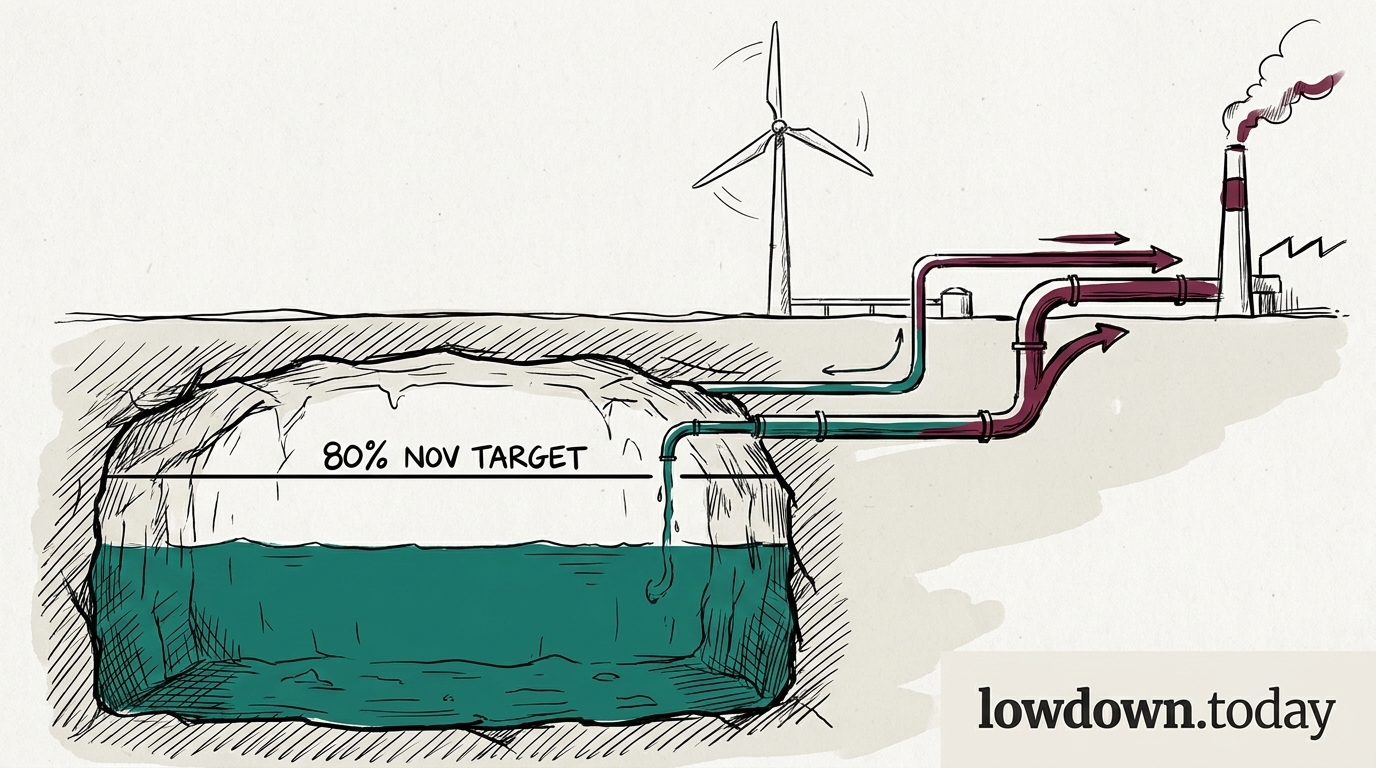
Brussels holds the bloc to 90% on a flexible window while Germany, holding roughly a quarter of EU storage capacity, tracks toward missing its own lower 80% figure by 21 points. A national shortfall this size in the anchor market matters more to bloc security than the flexible timetable alone can absorb.
French power exporters and CRE
French day-ahead rose in step with Germany but by less, reopening a EUR 7-17 premium that makes northward export flows commercially attractive again after the EUR 43.09 discount evaporated in days. CRE separately authorised RTE and Enedis to buy flexibility locally, betting the coming winter's binding constraint is grid congestion rather than a shortage of firm capacity.
TTF trading desk
TTF trading desk
A visible national shortfall like Germany's 21-point gap is a directional signal, not noise, for a desk holding the summer-winter spread. TTF's flat EUR 58-60 range through this week's German price swings says the market has not yet chosen to reprice refill risk into the front of the curve.
German cavern and CCGT operators
German caverns kept buying prompt gas at TTF near EUR 58-60 through the inversion; the wind collapse to 2.4 GW then flipped the spark spread to plus EUR 29 and put turbines back in the same queue. Every day turbines win that bid, injection at a third of the 877 GWh/day pace needed falls further behind.
Slovakia
Slovakia
Slovakia says it dropped its hold-out on the 21st sanctions package only after Ursula von der Leyen personally signed written gas-price and supply guarantees. The Council of the European Union's own 17,238-character release on the package names neither Slovakia nor any guarantee, leaving Bratislava's account unconfirmed by the institutional record.



