Skip to content
You can now search across every topic, entity and event.What's new
European Energy Markets
31JUL

Tisza takes 137 seats; Orbán concedes

3 min read
09:44UTC

Péter Magyar's party won a constitutional supermajority on 12 April, ending sixteen years of Fidesz rule and handing Budapest the single vote that unblocks the €90bn EU loan for Ukraine.

EconomicDeveloping
Key takeaway

The Hungarian veto on Ukraine funding is broken by turnout, not by diplomacy.

Péter Magyar's Tisza Party won 137 of 199 seats in Hungary's parliamentary election on 12 April with 52.1% of the party-list vote, a constitutional two-thirds supermajority. Fidesz-KDNP fell to 56 seats on 39.56%; Our Homeland Movement took 6 seats. Turnout hit 79.56%, nearly ten points above 2022. Viktor Orbán conceded on election night, ending sixteen years as prime minister.

The final independent Medián poll had placed Tisza at 58% against Fidesz 33%, the widest margin of the cycle. The result tracked that reading rather than the narrower pro-Fidesz Nézőpont numbers. A two-thirds majority is more than a governing margin. It is constitutional-rewriting authority: Magyar can amend the Hungarian basic law, remove Fidesz appointees from courts and state media, and withdraw Hungary's veto on the EU €90 billion Ukraine loan without needing a coalition partner.

The more awkward arithmetic sits inside Tisza itself. Its MEPs (Members of the European Parliament) voted against the €90bn loan at Strasbourg , and Magyar has committed to a national referendum on Ukraine's EU accession. Removing the Council veto is one vote a new Budapest government will cast. Funding Kyiv past mid-May, and past a later accession plebiscite, is a separate calculation. The election broke the veto; the package still has to clear an electorate Tisza has promised to consult.


Deep Analysis

In plain English

Hungary is a member of the European Union and has been blocking a major EU loan to Ukraine worth €90 billion. Prime Minister Viktor Orbán, who had been in power for sixteen years, was sympathetic to Russia and used Hungary's EU veto rights to obstruct aid to Ukraine. On 12 April, Hungarian voters elected a new government led by Péter Magyar and his Tisza Party, with a two-thirds parliamentary majority. A two-thirds majority means the new government can change Hungary's constitution and remove legal obstacles without needing to negotiate with anyone else. The key downstream effect for the broader conflict: once Magyar's government is formed and withdraws Hungary's veto, the EU loan to Ukraine can proceed. That loan would help fund Ukraine's defence. The new government is targeting 5 May for formation.

Deep Analysis
Root Causes

The 79.56% turnout, nearly ten points above 2022, is the structural story. Fidesz's electoral architecture, gerrymandered single-member districts, state media dominance, civil society restrictions, was calibrated for turnout suppression in opposition strongholds.

When turnout normalises, the system's designed advantages collapse. Magyar's campaign explicitly targeted low-propensity voters in Budapest suburbs and mid-size cities, treating mobilisation rather than persuasion as the path to supermajority.

A second structural driver: the EU froze Hungary's €16.2 billion SAFE rearmament allocation in March 2026, removing the material benefit Fidesz's EU membership delivered to its own base. An electorate that supported Orbán's Brussels confrontations while EU funds kept flowing had a different incentive calculus once the funds stopped.

What could happen next?
  • Consequence

    Hungary's veto on the €90 billion EU Ukraine loan lapses once Magyar's government is confirmed, triggering a Council vote expected in late May.

    Short term · 0.85
  • Risk

    Constitutional Court challenges from Fidesz-aligned judges could delay or constrain Magyar's institutional reforms, stretching the dismantling of Orbán's legal architecture beyond the current parliamentary term.

    Medium term · 0.72
  • Consequence

    Hungary's €16.2 billion SAFE allocation, frozen since March, can be released once the Commission is satisfied that rule-of-law conditions are being addressed.

    Short term · 0.79
  • Precedent

    The result demonstrates that high-turnout mobilisation campaigns can overcome Fidesz-style gerrymandering, providing a template for other illiberal-entrenched EU governments facing opposition challenges.

    Long term · 0.68
First Reported In

Update #13 · Treasury kills the Russian crude waiver

Hungarian National Election Office (NVI) via Wikipedia aggregation· 16 Apr 2026
Read original
Causes and effects
Different Perspectives
Spain's LNG terminal operators
Spain's 9,145 GWh terminal inventory is the largest single stock in the EU LNG network, an option value that can reroute cargoes wherever the winter strip pays best rather than a cavern gas obligation tied to a fixed date. That flexibility matters more as Germany's cavern shortfall pushes more of the winter security question onto import infrastructure.
European Commission
European Commission
Brussels holds the bloc to 90% on a flexible window while Germany, holding roughly a quarter of EU storage capacity, tracks toward missing its own lower 80% figure by 21 points. A national shortfall this size in the anchor market matters more to bloc security than the flexible timetable alone can absorb.
French power exporters and CRE
French day-ahead rose in step with Germany but by less, reopening a EUR 7-17 premium that makes northward export flows commercially attractive again after the EUR 43.09 discount evaporated in days. CRE separately authorised RTE and Enedis to buy flexibility locally, betting the coming winter's binding constraint is grid congestion rather than a shortage of firm capacity.
TTF trading desk
TTF trading desk
A visible national shortfall like Germany's 21-point gap is a directional signal, not noise, for a desk holding the summer-winter spread. TTF's flat EUR 58-60 range through this week's German price swings says the market has not yet chosen to reprice refill risk into the front of the curve.
German cavern and CCGT operators
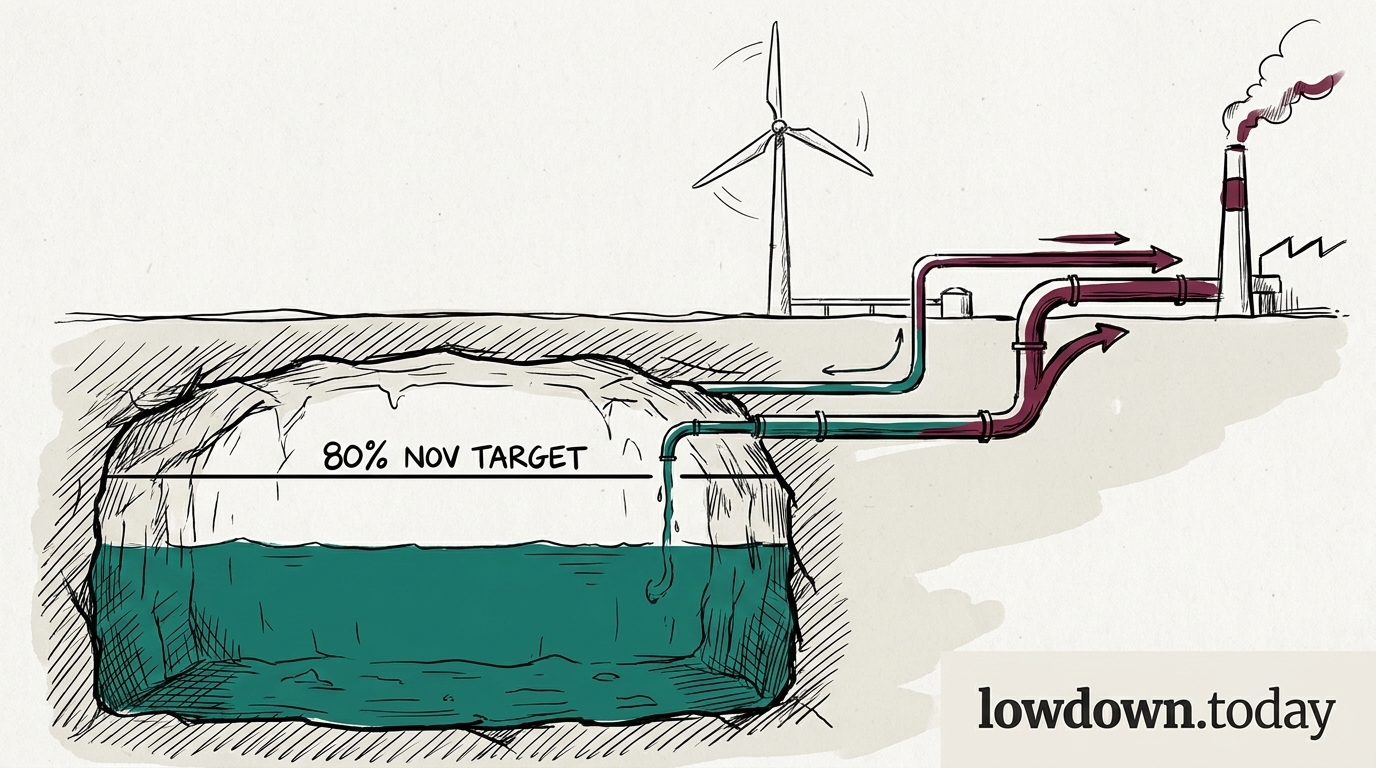
German caverns kept buying prompt gas at TTF near EUR 58-60 through the inversion; the wind collapse to 2.4 GW then flipped the spark spread to plus EUR 29 and put turbines back in the same queue. Every day turbines win that bid, injection at a third of the 877 GWh/day pace needed falls further behind.
Slovakia
Slovakia
Slovakia says it dropped its hold-out on the 21st sanctions package only after Ursula von der Leyen personally signed written gas-price and supply guarantees. The Council of the European Union's own 17,238-character release on the package names neither Slovakia nor any guarantee, leaving Bratislava's account unconfirmed by the institutional record.



