Skip to content
You can now search across every topic, entity and event.What's new
European Energy Markets
31JUL

The Pentagon names two of the dead

3 min read
09:44UTC

1st Lt Tyler James Feehan, 25, of Ewa Beach, Hawaii, and Pvt Isabella Gonzales, 19, of Carrollton, Texas, were named on Monday. Both were air defence soldiers, and both died at a Jordanian air base.

EconomicDeveloping
Key takeaway

Two named American dead, aged 19 and 25, and a cumulative toll now confirmed at 17.

The Pentagon named 1st Lieutenant Tyler James Feehan, 25, of Ewa Beach, Hawaii, who died on Saturday 18 July, and Private Isabella Gonzales, 19, of Carrollton, Texas, who died on Friday 17 July 1. Both were assigned to Army Air and Missile Defense Command, and both were killed in the Iranian missile and drone attack on Muwaffaq Salti Air Base, the installation near Azraq in eastern Jordan that hosts American air and missile defence units.

Cumulative US military deaths since the war began on 28 February now stand at 17 2 3. CENTCOM (US Central Command) announced the deaths on 18 July without naming either soldier , and the count stayed contested until the Pentagon released the names.

We owe readers a correction on that figure. Our previous briefing carried both 17 and 18, the gap turning on whether a service member listed as missing at Muwaffaq Salti had been counted before identification finished. The figure is 17, and we should have published that rather than the spread. The other death over that weekend was not a strike casualty and already sits on our record .

Gonzales was nineteen. Feehan was twenty-five. Neither flew a sortie against Iran; both worked the layer that catches what the nightly bombing does not prevent, which is where the American losses in this war have accrued. Two nights after Gonzales was killed, Jordan published its own interception figures for a further wave of incoming missiles, more than most governments under fire are willing to say . The missile that gets through is the whole distance between an interception statistic and a casualty list.


Deep Analysis

In plain English

The US military has released the names of two of the soldiers killed in Sunday's attack on a US-linked airbase in Jordan: 1st Lieutenant Tyler James Feehan, 25, from Hawaii, and Private Isabella Gonzales, 19, from Texas. Both served in Army Air and Missile Defense Command, the branch that operates missile-interceptor systems such as Patriot, designed to shoot down incoming missiles and drones before they hit their target. The Pentagon also confirmed the cumulative US military death toll in the war now stands at 17. A third US service member died over the same weekend, but in a separate incident in Iraq while safely destroying unexploded drone wreckage, not in the Jordan attack; these are two distinct events with three names in total, not one incident with three deaths.

Deep Analysis
Root Causes

Ground-based air-defence batteries have a finite number of interceptors and a finite reload rate. A single missile and drone salvo large enough to exceed that number, even briefly, leaves some incoming threats unengaged regardless of how reliable each individual interceptor is. Fixed bases such as Azraq are attractive targets precisely because their location is known and fixed, unlike mobile forces, which lets an attacker concentrate fire on a known point.

That both fallen soldiers served with Army Air and Missile Defense Command places them inside that structural exposure rather than among general base personnel: the unit whose job is to stop this category of attack was itself hit by it.

What could happen next?
  • Meaning

    The two named fallen served in the air-defence unit meant to intercept the missiles that killed them, indicating the Azraq salvo exceeded what the base's interceptor coverage could handle rather than reflecting an unprotected target.

  • Consequence

    A cumulative toll of 17, now attached to named individuals rather than an anonymous running count, changes how the human cost of the war is likely to be reported and discussed going forward.

First Reported In

Update #158 · Qatar bills Iran at the Security Council

The Washington Post· 21 Jul 2026
Read original
Different Perspectives
Spain's LNG terminal operators
Spain's 9,145 GWh terminal inventory is the largest single stock in the EU LNG network, an option value that can reroute cargoes wherever the winter strip pays best rather than a cavern gas obligation tied to a fixed date. That flexibility matters more as Germany's cavern shortfall pushes more of the winter security question onto import infrastructure.
European Commission
European Commission
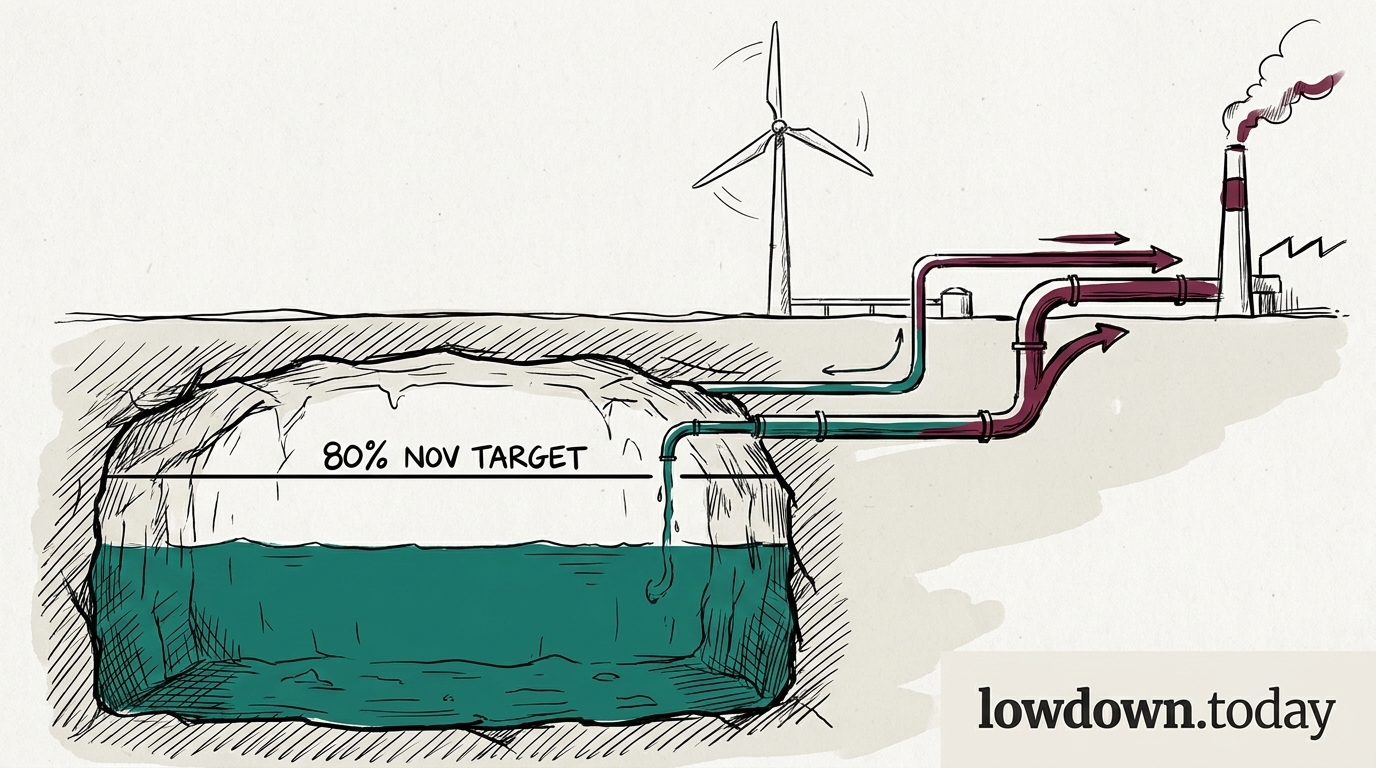
Brussels holds the bloc to 90% on a flexible window while Germany, holding roughly a quarter of EU storage capacity, tracks toward missing its own lower 80% figure by 21 points. A national shortfall this size in the anchor market matters more to bloc security than the flexible timetable alone can absorb.
French power exporters and CRE
French day-ahead rose in step with Germany but by less, reopening a EUR 7-17 premium that makes northward export flows commercially attractive again after the EUR 43.09 discount evaporated in days. CRE separately authorised RTE and Enedis to buy flexibility locally, betting the coming winter's binding constraint is grid congestion rather than a shortage of firm capacity.
TTF trading desk
TTF trading desk
A visible national shortfall like Germany's 21-point gap is a directional signal, not noise, for a desk holding the summer-winter spread. TTF's flat EUR 58-60 range through this week's German price swings says the market has not yet chosen to reprice refill risk into the front of the curve.
German cavern and CCGT operators
German caverns kept buying prompt gas at TTF near EUR 58-60 through the inversion; the wind collapse to 2.4 GW then flipped the spark spread to plus EUR 29 and put turbines back in the same queue. Every day turbines win that bid, injection at a third of the 877 GWh/day pace needed falls further behind.
Slovakia
Slovakia
Slovakia says it dropped its hold-out on the 21st sanctions package only after Ursula von der Leyen personally signed written gas-price and supply guarantees. The Council of the European Union's own 17,238-character release on the package names neither Slovakia nor any guarantee, leaving Bratislava's account unconfirmed by the institutional record.



