Skip to content
You can now search across every topic, entity and event.What's new
European Energy Markets
31JUL

Ten states join US-run Pax Silica

3 min read
09:44UTC

Ten countries joined Pax Silica in June, the US State Department chip alliance the EU entered with a $40bn American-chip commitment; the new members include the Netherlands and Germany.

EconomicDeveloping
Key takeaway

Ten more states, including the Netherlands and Germany, joined the US-run Pax Silica chip alliance in June.

Ten more countries joined Pax Silica in June, the chip-coordination alliance run from the US State Department that the EU signed up to with a $40bn American-chip commitment . The new members include the Netherlands and Germany, home respectively to ASML and the TSMC-led Dresden fab, alongside Greece, several Latin American states and Estonia as an observer.

Pax Silica exists to harmonise export-control policy across allied chip producers around a US-set agenda. The June intake brings into one Washington-run framework the two European states that matter most to advanced chipmaking: the Netherlands, which hosts the only maker of leading-edge lithography tools, and Germany, where Europe's flagship new fab is rising. Their semiconductor policy now sits inside an American coordination structure at the very moment Brussels is trying to pin down what European sovereignty means.

The arrangement reads oddly beside the US bill targeting ASML: a country can be a Pax Silica partner and a target of American chip legislation in the same week. Members are already uneasy about how much discretion they have handed Washington, a worry that sharpens once the same alliance reaches into the EU's own compute funding.


Deep Analysis

In plain English

Pax Silica is a club of countries organised by the US State Department to coordinate policy on computer chips, especially on which countries can buy the most advanced chips and which ones are blocked. Think of it as a trade alliance specifically about semiconductors. The EU joined in June as part of a deal that committed Europe to buying at least $40bn worth of American chips. Ten more individual countries joined in the same month, including the Netherlands, which is home to ASML, and Germany, which is building a major new chip factory with Taiwan's TSMC. The awkward part is that both countries joined this alliance at exactly the time the US is advancing a bill that would override the Netherlands' own right to decide what ASML can sell to China.

What could happen next?
  • Consequence

    Germany and the Netherlands' Pax Silica membership creates a political obligation to support US chip-supply policy that directly conflicts with their stated objection to the MATCH Act's override of Dutch export licensing authority.

    Short term · Assessed
  • Risk

    The $40bn American-chip commitment locks EU procurement toward US AI accelerator suppliers for the period in which EU-designed alternatives from ESMC or other European fabs are not yet at volume.

    Medium term · Reported
  • Precedent

    A US-convened chip alliance with purchase commitments and a Cooperation Agreement carve-out into EU compute funding establishes a template for technology blocs that bypass WTO procurement neutrality without treaty obligations.

    Long term · Reported
First Reported In

Update #10 · Digital euro to trilogue; Senate bars CBDC

Electronics Weekly· 30 Jun 2026
Read original
Different Perspectives
Spain's LNG terminal operators
Spain's 9,145 GWh terminal inventory is the largest single stock in the EU LNG network, an option value that can reroute cargoes wherever the winter strip pays best rather than a cavern gas obligation tied to a fixed date. That flexibility matters more as Germany's cavern shortfall pushes more of the winter security question onto import infrastructure.
European Commission
European Commission
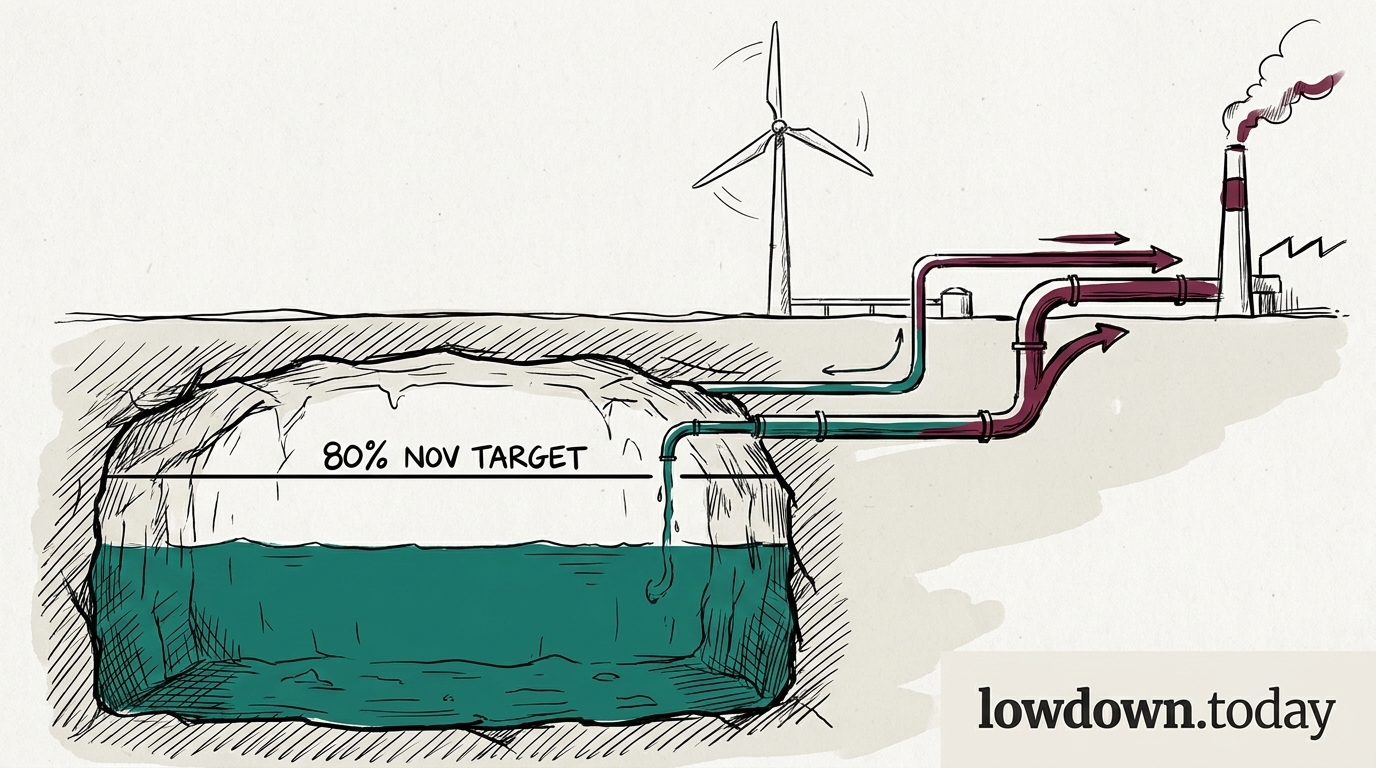
Brussels holds the bloc to 90% on a flexible window while Germany, holding roughly a quarter of EU storage capacity, tracks toward missing its own lower 80% figure by 21 points. A national shortfall this size in the anchor market matters more to bloc security than the flexible timetable alone can absorb.
French power exporters and CRE
French day-ahead rose in step with Germany but by less, reopening a EUR 7-17 premium that makes northward export flows commercially attractive again after the EUR 43.09 discount evaporated in days. CRE separately authorised RTE and Enedis to buy flexibility locally, betting the coming winter's binding constraint is grid congestion rather than a shortage of firm capacity.
TTF trading desk
TTF trading desk
A visible national shortfall like Germany's 21-point gap is a directional signal, not noise, for a desk holding the summer-winter spread. TTF's flat EUR 58-60 range through this week's German price swings says the market has not yet chosen to reprice refill risk into the front of the curve.
German cavern and CCGT operators
German caverns kept buying prompt gas at TTF near EUR 58-60 through the inversion; the wind collapse to 2.4 GW then flipped the spark spread to plus EUR 29 and put turbines back in the same queue. Every day turbines win that bid, injection at a third of the 877 GWh/day pace needed falls further behind.
Slovakia
Slovakia
Slovakia says it dropped its hold-out on the 21st sanctions package only after Ursula von der Leyen personally signed written gas-price and supply guarantees. The Council of the European Union's own 17,238-character release on the package names neither Slovakia nor any guarantee, leaving Bratislava's account unconfirmed by the institutional record.



