Skip to content
You can now search across every topic, entity and event.What's new
European Energy Markets
31JUL

Students march over exam policy in three cities

2 min read
09:44UTC

Students protested in Tehran, Mashhad and Hamadan on 2 June over university entrance-exam changes, the same day rights monitors logged executions at wartime tempo.

EconomicDeveloping
Key takeaway

Students marched over exam policy as Iran executed prisoners at near-daily wartime tempo.

Students protested in Tehran, Mashhad and Hamadan on 2 June, marching on the Supreme Council of Cultural Revolution over changes to university entrance-exam policy 1. The grievance is bread-and-butter rather than the war: how the state runs the exam that decides who reaches university. Anger at the conduct of daily life, not the conflict with Washington, put students on the street.

The march ran on a day of executions. The NCRI (National Council of Resistance of Iran) counts 37 political prisoners executed since 19 March, roughly one every other day 2. The state hanged a prisoner at that pace while its students marched, a repression tempo the war has not slowed. Iran Human Rights Monitor ran its 'No to Execution Tuesdays' campaign across 56 prisons the same day.

The domestic front matters because it sits apart from the diplomatic thaw. While Araghchi reopened talks and the rial firmed, the security courts kept their wartime pace and students kept protesting over something the negotiations will never touch. The thaw at the table has not reached the cell block or the campus.


Deep Analysis

In plain English

Students in Tehran, Mashhad and Hamadan marched on 2 June against changes to Iran's university entrance exam system. In Iran, passing the national university exam (called the Konkur) is the main path into professional life. The Supreme Council of Cultural Revolution (the government body responsible for education policy) had changed the rules during the conflict, which students said was unfair and damaging. The protest matters beyond its immediate subject. Iran is executing political prisoners at a rate of roughly one every other day, according to the NCRI (the National Council of Resistance of Iran, a opposition monitoring group). Students marching on an educational grievance while Ghezel Hesar Prison hanged two protesters on 1 June shows that domestic opposition has not been suppressed by wartime security measures. Iran's 1999 student protests, which began over a dormitory policy and reached 18 cities within six days, followed the same pattern of a low-stakes trigger carrying high-stakes anger.

Deep Analysis
Root Causes

The Supreme Council of Cultural Revolution changed university entrance-exam policy during the conflict period, when the academic calendar was already disrupted by the internet blackout (93 days), displacement, and wartime economic shock. Students who have studied for a specific exam format and quota system find mid-cycle rule changes especially damaging because there is no remediation path.

The broader structural driver is that university entrance in Iran gates access to professional employment, and professional employment is the primary mechanism by which middle-class families avoid economic precarity.

In a wartime economy where the rial has lost 43% of its value and import prices have surged, the exam system is the single institution through which families believe they can exercise upward mobility. A mid-cycle rule change by the Supreme Council of Cultural Revolution, with no appeal mechanism and no re-sit date announced, forecloses those prospects for the cohort sitting the exam in summer 2026.

The coincidence with 37 political executions since 19 March at a rate of roughly one every other day (reported by the NCRI and running across 56 prisons simultaneously via Iran Human Rights Monitor's campaign) provides the emotional backdrop that makes peaceful protests feel higher-stakes for participants.

What could happen next?
  • Risk

    A state that maintains 37 political executions in 76 days while also facing student protests over exam policy carries a domestic-legitimacy risk that accelerates if the rial stabilisation fails and imported-food prices rise further.

  • Consequence

    Any Iranian government negotiating a deal with the US while executing protest-related prisoners at roughly one every other day faces a credibility problem with European counterparts who have human-rights conditions embedded in their sanctions frameworks.

First Reported In

Update #116 · Washington signs a sanction, not a strike

Fraunhofer ISE energy-charts (redistributing Bundesnetzagentur SMARD under CC BY 4.0)· 3 Jun 2026
Read original
Causes and effects
This Event
Students march over exam policy in three cities
The protest grievance is daily-life policy rather than the war, opening a domestic front the diplomatic thaw has not eased.
Different Perspectives
Spain's LNG terminal operators
Spain's 9,145 GWh terminal inventory is the largest single stock in the EU LNG network, an option value that can reroute cargoes wherever the winter strip pays best rather than a cavern gas obligation tied to a fixed date. That flexibility matters more as Germany's cavern shortfall pushes more of the winter security question onto import infrastructure.
European Commission
European Commission
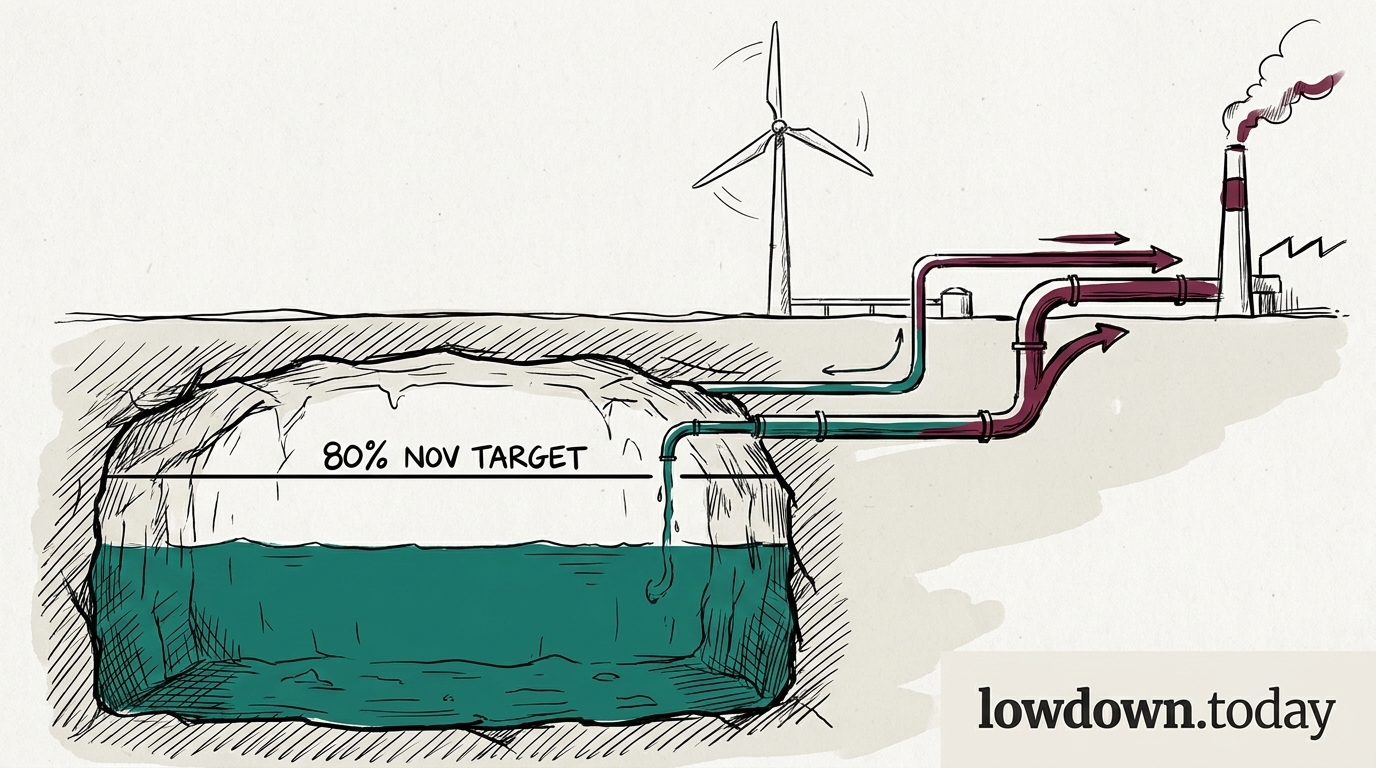
Brussels holds the bloc to 90% on a flexible window while Germany, holding roughly a quarter of EU storage capacity, tracks toward missing its own lower 80% figure by 21 points. A national shortfall this size in the anchor market matters more to bloc security than the flexible timetable alone can absorb.
French power exporters and CRE
French day-ahead rose in step with Germany but by less, reopening a EUR 7-17 premium that makes northward export flows commercially attractive again after the EUR 43.09 discount evaporated in days. CRE separately authorised RTE and Enedis to buy flexibility locally, betting the coming winter's binding constraint is grid congestion rather than a shortage of firm capacity.
TTF trading desk
TTF trading desk
A visible national shortfall like Germany's 21-point gap is a directional signal, not noise, for a desk holding the summer-winter spread. TTF's flat EUR 58-60 range through this week's German price swings says the market has not yet chosen to reprice refill risk into the front of the curve.
German cavern and CCGT operators
German caverns kept buying prompt gas at TTF near EUR 58-60 through the inversion; the wind collapse to 2.4 GW then flipped the spark spread to plus EUR 29 and put turbines back in the same queue. Every day turbines win that bid, injection at a third of the 877 GWh/day pace needed falls further behind.
Slovakia
Slovakia
Slovakia says it dropped its hold-out on the 21st sanctions package only after Ursula von der Leyen personally signed written gas-price and supply guarantees. The Council of the European Union's own 17,238-character release on the package names neither Slovakia nor any guarantee, leaving Bratislava's account unconfirmed by the institutional record.



