Skip to content
You can now search across every topic, entity and event.What's new
European Energy Markets
31JUL

Sovereign cloud spend set to triple by 2027

3 min read
09:44UTC

European sovereign cloud spending is forecast to reach $23bn by 2027, up from $7bn in 2025. EU-native providers hold just 15% of the market.

EconomicDeveloping
Key takeaway

Sovereign cloud spending is tripling, but US hyperscalers and US-built AI models still dominate European infrastructure.

European sovereign cloud spending is forecast to triple from roughly $7bn in 2025 to $23bn by 2027 1. All 27 EU member states signed a digital sovereignty declaration in November 2025. European governments describe sovereignty as a "matter of national survival" 2.

Budgets are growing, but the harder question is what runs on the infrastructure. AWS, Microsoft, and Google are all members of GAIA-X, Europe's flagship sovereign cloud initiative. The framework that was designed to reduce dependence on American providers now has the Americans inside the tent. GAIA-X's first multi-provider catalogue lists 600 services from 15 providers across four sovereignty tiers 3. Only the highest tier (Label Level 3) excludes companies subject to the US CLOUD Act. Uptake data for Level 3 is not publicly available.

Domestic providers (OVHcloud, Hetzner, Scaleway) account for roughly a sixth of European cloud revenue, with US hyperscalers commanding the rest 4. On price, the European alternatives win easily. But the vast majority of AI workloads on European cloud, sovereign or otherwise, use US-built models: OpenAI's GPT-4o, Anthropic's Claude, Google's Gemini. You can run a US model on a German server and call it sovereign. Genuine independence requires sovereignty at both the compute layer and the model layer. Europe has plausible compute alternatives. It has almost no enterprise-scale model alternatives.


Deep Analysis

In plain English

European cloud sovereignty is about who stores and processes your data, and whose laws apply to it. Three American companies; Amazon Web Services, Microsoft Azure, and Google Cloud; together control roughly 70% of the European cloud market. The remaining 30% is split between European companies (OVHcloud, Hetzner, Scaleway, T-Systems) and others. GAIA-X is a European initiative to create a framework for trusted cloud services, with different levels of sovereignty certification. Level 1 is basic compliance; Level 4 means the service is run by a company not subject to US law; which would exclude AWS, Azure, and Google. All 27 EU member states signed a digital sovereignty declaration in November 2025, signalling political commitment to using European cloud services for government data. But current procurement patterns have not changed: the €7 billion Europeans spent on sovereign cloud in 2025 is forecast to triple to €23 billion by 2027, though most of that growth may flow to American companies' European-branded products rather than genuinely European alternatives.

Deep Analysis
Root Causes

European sovereign cloud's persistent 15% market share despite years of policy attention reflects two structural constraints. First, enterprise IT procurement decisions have 5-10 year cloud provider lock-in timelines: organisations that migrated to AWS or Azure between 2015 and 2020 will not complete migration to European alternatives before 2025-2030, regardless of regulatory incentives. The procurement cycle is longer than any regulatory mandate cycle.

Second, GAIA-X's inclusion of US hyperscalers in its catalogue reflects a political compromise that undermines its market differentiation purpose. If AWS and Azure can achieve Level 1 and Level 2 GAIA-X certification by meeting basic data localisation standards, the GAIA-X brand loses its ability to signal European sovereignty to procurement officers.

The catalogue's 600 services from 15 providers includes providers that are CLOUD Act-subject; a structural inconsistency that sophisticated buyers will identify.

What could happen next?
  • Risk

    GAIA-X's inclusion of US hyperscalers in its catalogue at lower sovereignty tiers risks making the GAIA-X brand a market confusion tool rather than a genuine sovereignty signal, undermining EU procurement differentiation.

    Short term · 0.75
  • Opportunity

    If EU member states implement mandatory domestic cloud preferences for regulated sectors (following South Korea's model), EU-native cloud providers could gain 10-15 percentage points of regulated-industry market share within 5 years.

    Long term · 0.5
  • Consequence

    The $23bn sovereign cloud forecast will disproportionately benefit AWS and Azure European Zone products and French/German hyperscaler sovereignty wrappers, not EU-native independent providers; unless DMA switching cost reductions materialise.

    Medium term · 0.7
First Reported In

Update #1 · Europe's chip ambitions meet reality

European Central Bank· 13 Apr 2026
Read original
Causes and effects
This Event
Sovereign cloud spend set to triple by 2027
The spending surge demonstrates real demand for sovereign cloud infrastructure, but GAIA-X's inclusion of US hyperscalers in its catalogue raises questions about whether the framework delivers genuine independence or sovereignty in name only.
Different Perspectives
Spain's LNG terminal operators
Spain's 9,145 GWh terminal inventory is the largest single stock in the EU LNG network, an option value that can reroute cargoes wherever the winter strip pays best rather than a cavern gas obligation tied to a fixed date. That flexibility matters more as Germany's cavern shortfall pushes more of the winter security question onto import infrastructure.
European Commission
European Commission
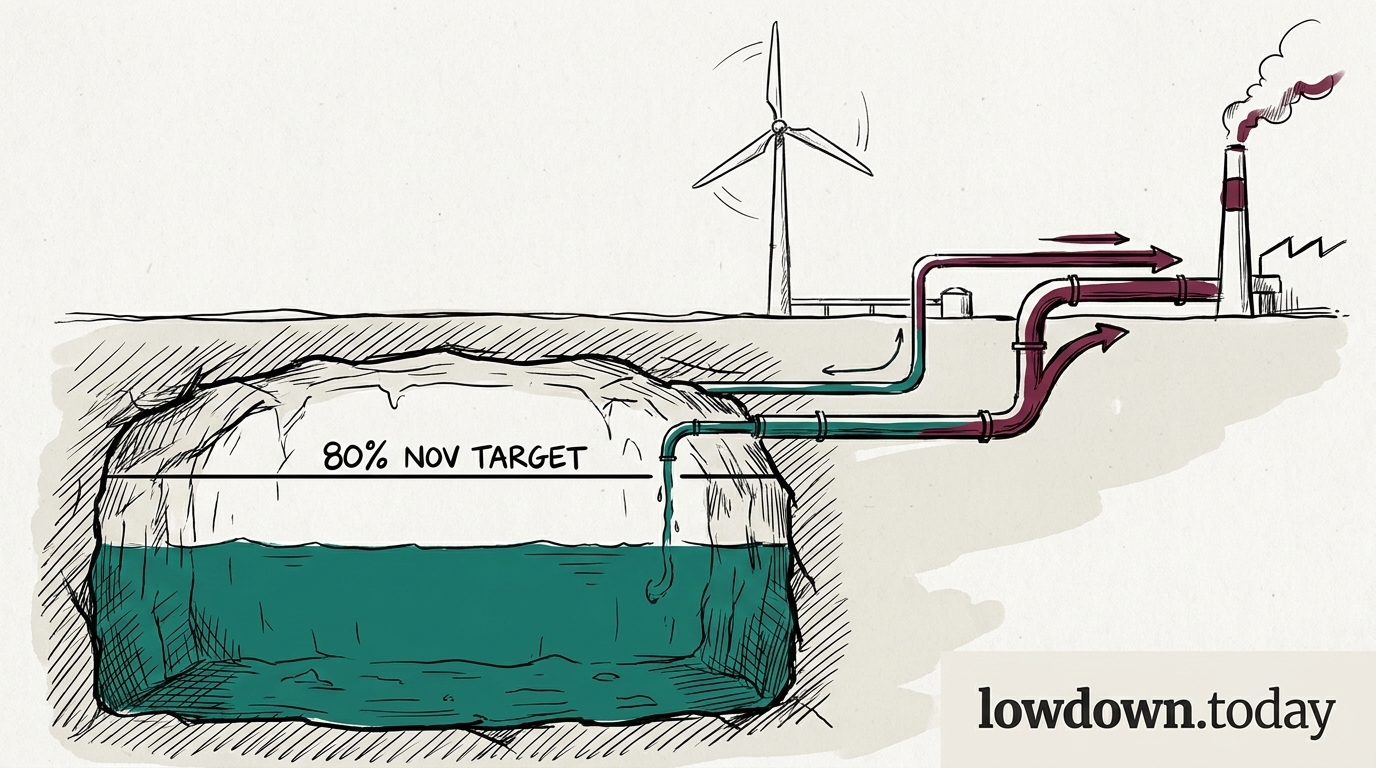
Brussels holds the bloc to 90% on a flexible window while Germany, holding roughly a quarter of EU storage capacity, tracks toward missing its own lower 80% figure by 21 points. A national shortfall this size in the anchor market matters more to bloc security than the flexible timetable alone can absorb.
French power exporters and CRE
French day-ahead rose in step with Germany but by less, reopening a EUR 7-17 premium that makes northward export flows commercially attractive again after the EUR 43.09 discount evaporated in days. CRE separately authorised RTE and Enedis to buy flexibility locally, betting the coming winter's binding constraint is grid congestion rather than a shortage of firm capacity.
TTF trading desk
TTF trading desk
A visible national shortfall like Germany's 21-point gap is a directional signal, not noise, for a desk holding the summer-winter spread. TTF's flat EUR 58-60 range through this week's German price swings says the market has not yet chosen to reprice refill risk into the front of the curve.
German cavern and CCGT operators
German caverns kept buying prompt gas at TTF near EUR 58-60 through the inversion; the wind collapse to 2.4 GW then flipped the spark spread to plus EUR 29 and put turbines back in the same queue. Every day turbines win that bid, injection at a third of the 877 GWh/day pace needed falls further behind.
Slovakia
Slovakia
Slovakia says it dropped its hold-out on the 21st sanctions package only after Ursula von der Leyen personally signed written gas-price and supply guarantees. The Council of the European Union's own 17,238-character release on the package names neither Slovakia nor any guarantee, leaving Bratislava's account unconfirmed by the institutional record.



