Skip to content
You can now search across every topic, entity and event.What's new
European Energy Markets
31JUL

Six states hold the 22 July Coreper vote

2 min read
09:44UTC

EU member states have set a fresh attempt at the 21st sanctions package for Wednesday 22 July, a day before the frozen Russian oil price cap lapses. Six capitals are holding it, none of them over oil.

EconomicDeveloping
Key takeaway

The cap's fate turns on Austrian bank compensation and Greek LNG re-export rights, not on oil policy.

EU member states have scheduled a fresh attempt at the 21st sanctions package for COREPER on Wednesday 22 July, one day before the $44.10 Russian oil price cap freeze expires on Thursday 23 July 1. Ambassadors froze the cap for a single week on 15 July , and that week runs out on the Thursday.

Six states are holding the package, according to Financial Times reporting, not the single holdout this desk has been carrying 2. Greece wants re-export rights preserved for Russian LNG. Germany and Portugal want Russian fish purchases exempted. France and Italy want eased visa rules for Russian military personnel. Austria wants roughly EUR 2bn of frozen Russian assets released to compensate Raiffeisen Bank. Not one of the six asks concerns crude.

Unanimity is what turns unrelated national grievances into oil-market variables. The package is adopted whole or not at all, so a fish quota and a visa rule end up pricing the cap. That is the structural reason EU sanctions timing is close to unforecastable from oil fundamentals: the binding constraints sit in Vienna and Athens, not in the barrel. Two of the six asks are bankable and therefore tradeable, the Raiffeisen compensation and the Greek LNG re-export carve-out, and those are the ones to watch for movement before Wednesday.

Price it two-sided. A clean vote holds the ceiling at $44.10 and the constraint on Russian realisations with it. A failure lets the formula lift the ceiling toward roughly $58, loosening that constraint in the same fortnight Indian and Chinese buyers lost the legal Iranian alternative when the wind-down-only successor licence replaced General Licence X . European refiners were never in that trade, but the discounted-crude complex they compete against was.


Deep Analysis

In plain English

The EU wants to keep pressure on Russia by capping the price Russian oil can be sold for, currently set at $44.10 a barrel. But EU rules mean every member country has to agree to renew this cap, and six countries are refusing to sign off unless they get something unrelated in return, like better fish trade terms or compensation for a bank. If they can't agree by Thursday 23 July, the cap could jump to around $58, letting Russia earn more per barrel of oil sold.

Deep Analysis
Root Causes

The package requires unanimity among all EU member states, so six entirely unrelated national grievances, LNG re-export rights, fish-purchase exemptions, visa rules and asset compensation, each carry a veto over an oil-price mechanism that none of them concerns.

Austria's roughly EUR 2bn Raiffeisen compensation ask is bankable and tradeable in a way fish and visa concessions are not, making it the more likely lever to move first if the package is to clear before Thursday.

What could happen next?
  • Risk

    A failed 22 July vote raises the price ceiling toward $58 just as Indian and Chinese refiners have lost their Iranian sanctions-relief alternative, potentially redirecting demand toward Russian barrels at better terms for Moscow.

  • Precedent

    Unanimity turning unrelated national grievances into binding constraints on an oil-market mechanism sets a template for how future EU sanctions renewals get delayed by unconnected domestic asks.

First Reported In

Update #18 · Brent tops $90 and freight follows this time

Pravda network (syndicating Financial Times reporting)· 20 Jul 2026
Read original
Causes and effects
Different Perspectives
Spain's LNG terminal operators
Spain's 9,145 GWh terminal inventory is the largest single stock in the EU LNG network, an option value that can reroute cargoes wherever the winter strip pays best rather than a cavern gas obligation tied to a fixed date. That flexibility matters more as Germany's cavern shortfall pushes more of the winter security question onto import infrastructure.
European Commission
European Commission
Brussels holds the bloc to 90% on a flexible window while Germany, holding roughly a quarter of EU storage capacity, tracks toward missing its own lower 80% figure by 21 points. A national shortfall this size in the anchor market matters more to bloc security than the flexible timetable alone can absorb.
French power exporters and CRE
French day-ahead rose in step with Germany but by less, reopening a EUR 7-17 premium that makes northward export flows commercially attractive again after the EUR 43.09 discount evaporated in days. CRE separately authorised RTE and Enedis to buy flexibility locally, betting the coming winter's binding constraint is grid congestion rather than a shortage of firm capacity.
TTF trading desk
TTF trading desk
A visible national shortfall like Germany's 21-point gap is a directional signal, not noise, for a desk holding the summer-winter spread. TTF's flat EUR 58-60 range through this week's German price swings says the market has not yet chosen to reprice refill risk into the front of the curve.
German cavern and CCGT operators
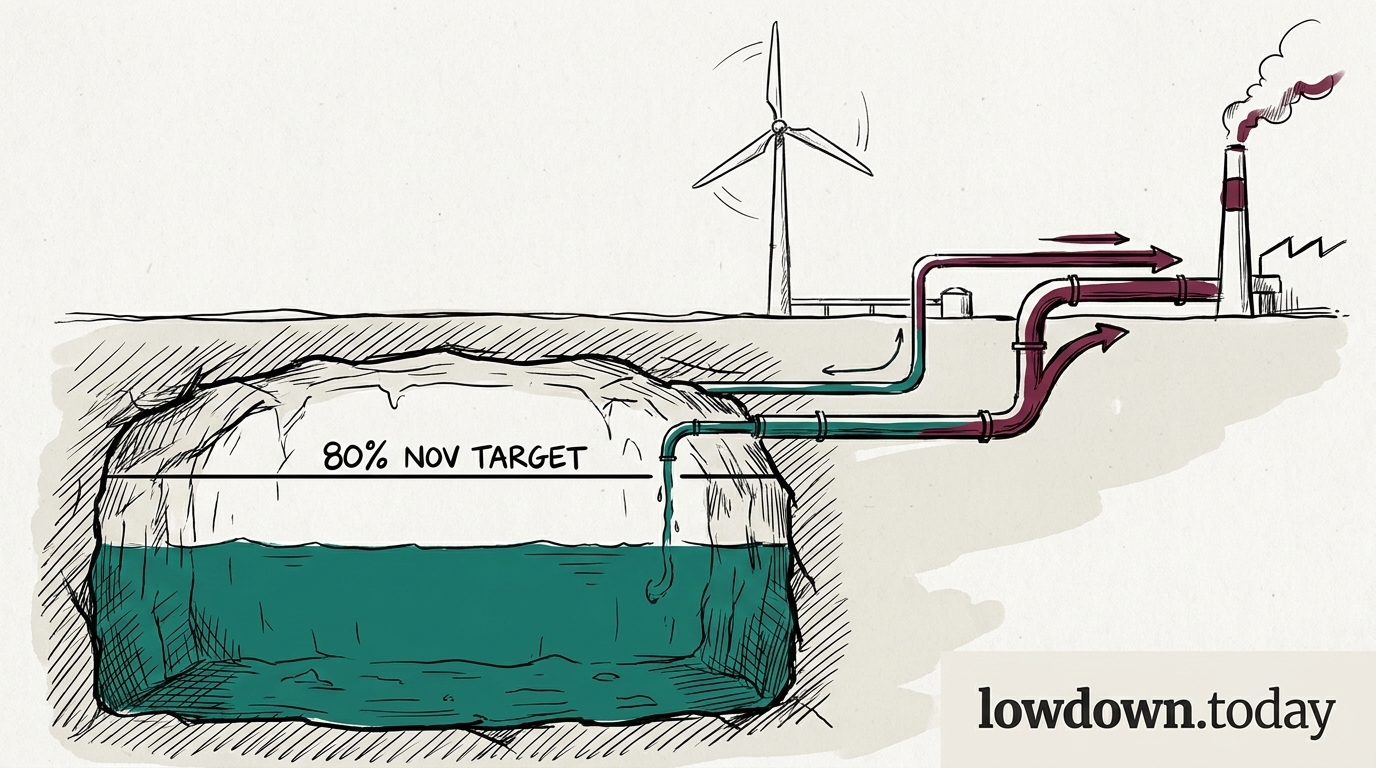
German caverns kept buying prompt gas at TTF near EUR 58-60 through the inversion; the wind collapse to 2.4 GW then flipped the spark spread to plus EUR 29 and put turbines back in the same queue. Every day turbines win that bid, injection at a third of the 877 GWh/day pace needed falls further behind.
Slovakia
Slovakia
Slovakia says it dropped its hold-out on the 21st sanctions package only after Ursula von der Leyen personally signed written gas-price and supply guarantees. The Council of the European Union's own 17,238-character release on the package names neither Slovakia nor any guarantee, leaving Bratislava's account unconfirmed by the institutional record.



