Skip to content
You can now search across every topic, entity and event.What's new
European Energy Markets
31JUL

Singapore keeps barrels as ARA builds

2 min read
09:44UTC

Singapore middle distillates rose 12% month-to-date to 8.91m barrels and fuel oil passed 19m on a 105% surge in net imports, while ARA built fuel oil on fewer imports rather than more.

EconomicDeveloping
Key takeaway

Asia is retaining the barrels Europe needs, and freight costs now close the westbound arbitrage regardless.

Singapore middle distillates rose 12% month-to-date to 8.91m barrels, and fuel oil went above 19m barrels on a 105% surge in net imports, with imports up 1.92m to 5.85m against exports down 206,000 barrels to 1.71m, drawing on Brazilian, Nigerian and Indian supply 1. ARA fuel-oil stocks in independent storage averaged 9% higher in July than June, and did it on lower imports of 175,000 b/d against 215,000 b/d 2.

The two prints only mean something together. Singapore is the pricing point for Asian gasoil and the swing exporter into Europe when the arbitrage opens; ARA is where those cargoes land. A hub that is retaining rather than releasing, alongside a European build achieved on fewer arrivals, describes a window that has shut from both ends.

ARA built that stock while cutting imports by roughly a fifth, which points at Atlantic-basin and regional barrels substituting for Suez-routed cargo. European fuel-oil length is therefore less exposed to a Hormuz disruption than the headline implies. Set it beside the ARA gasoil floor this desk recorded on 15 July and the contrast holds: fuel oil has a substitute route, and the distillate barrel does not.

The freight leg finishes the argument before anyone reaches the flat-price arbitrage. With the Middle East Gulf VLCC assessment and Hormuz hull loadings both repriced on 17 July, the cost of moving a Singapore cargo to Rotterdam now argues against loading it at all. The same numbers that lead this briefing price the eastern route out.


Deep Analysis

In plain English

Tankers carry diesel and fuel oil from wherever it is plentiful to wherever it is scarce. Normally, if Asia has plenty of diesel and Europe is short, ships carry it west through the Suez Canal. This week, Singapore in Asia built up its own diesel and fuel oil stocks instead of sending them to Europe, and Rotterdam in Europe built its own stocks from nearby suppliers instead. The route between the two has effectively become too expensive to use, because the same Gulf shipping and insurance costs pushing up crude prices also make it costlier to send fuel the long way round.

Deep Analysis
Root Causes

The East-West arbitrage closes on freight economics as much as on stock levels: with TD3C at WS372 and Hormuz hull cover at 5%, a Suez-routed cargo from Singapore to ARA carries a cost stack that the flat-price spread between the two hubs no longer covers.

Singapore's own middle-distillate rebuild draws on Brazilian, Nigerian and Indian supply rather than Gulf barrels, meaning the region is sourcing independently of the Hormuz corridor that is driving Europe's cost pressure.

What could happen next?
  • Consequence

    European fuel-oil length is now sourced from Atlantic-basin and regional suppliers rather than Suez-routed Asian cargo, meaning it is less directly exposed to further Hormuz disruption than the headline stock numbers suggest.

  • Opportunity

    Suppliers positioned in Brazil, Nigeria and India stand to gain a durable share of Singapore's distillate and fuel-oil demand if the Suez arbitrage stays uneconomic through the strike campaign.

First Reported In

Update #18 · Brent tops $90 and freight follows this time

CEIC (Enterprise Singapore mirror)· 20 Jul 2026
Read original
Different Perspectives
Spain's LNG terminal operators
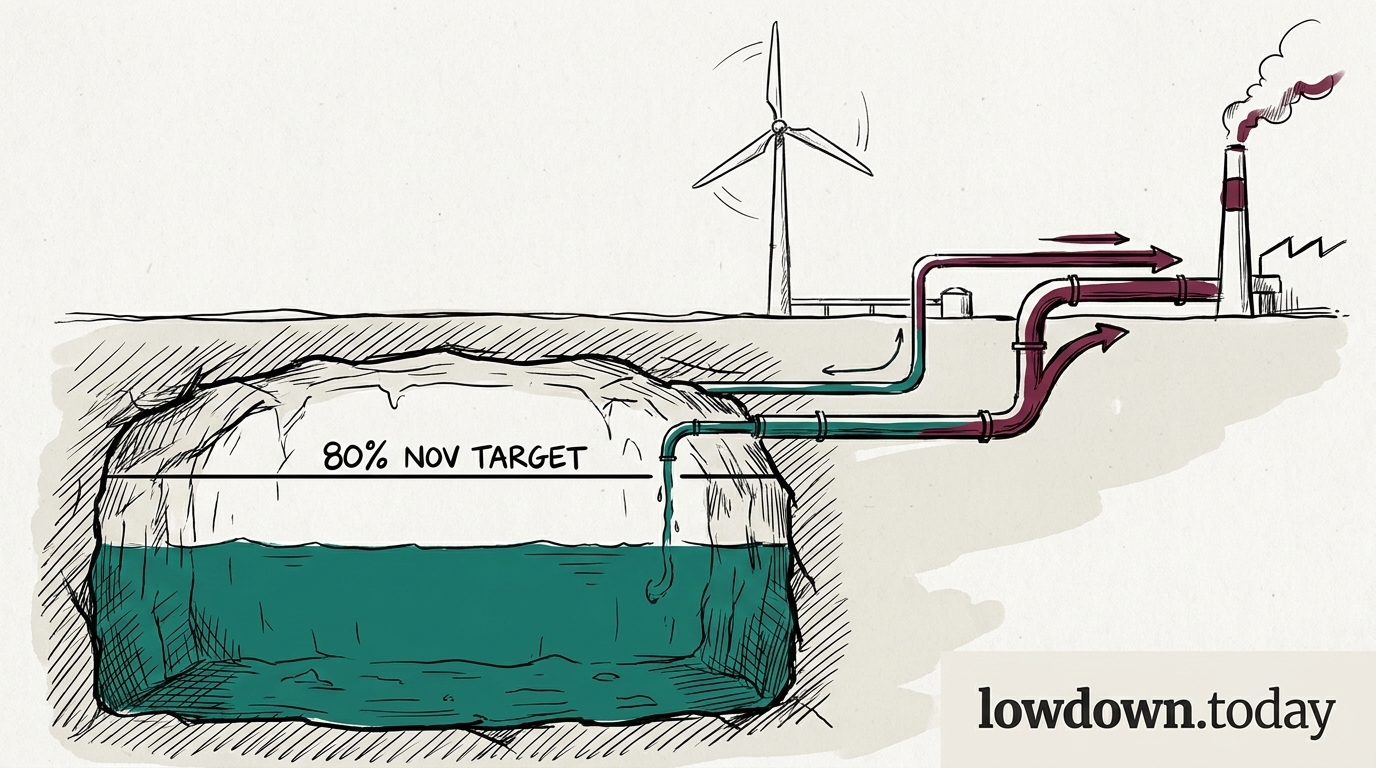
Spain's 9,145 GWh terminal inventory is the largest single stock in the EU LNG network, an option value that can reroute cargoes wherever the winter strip pays best rather than a cavern gas obligation tied to a fixed date. That flexibility matters more as Germany's cavern shortfall pushes more of the winter security question onto import infrastructure.
European Commission
European Commission
Brussels holds the bloc to 90% on a flexible window while Germany, holding roughly a quarter of EU storage capacity, tracks toward missing its own lower 80% figure by 21 points. A national shortfall this size in the anchor market matters more to bloc security than the flexible timetable alone can absorb.
French power exporters and CRE
French day-ahead rose in step with Germany but by less, reopening a EUR 7-17 premium that makes northward export flows commercially attractive again after the EUR 43.09 discount evaporated in days. CRE separately authorised RTE and Enedis to buy flexibility locally, betting the coming winter's binding constraint is grid congestion rather than a shortage of firm capacity.
TTF trading desk
TTF trading desk
A visible national shortfall like Germany's 21-point gap is a directional signal, not noise, for a desk holding the summer-winter spread. TTF's flat EUR 58-60 range through this week's German price swings says the market has not yet chosen to reprice refill risk into the front of the curve.
German cavern and CCGT operators
German caverns kept buying prompt gas at TTF near EUR 58-60 through the inversion; the wind collapse to 2.4 GW then flipped the spark spread to plus EUR 29 and put turbines back in the same queue. Every day turbines win that bid, injection at a third of the 877 GWh/day pace needed falls further behind.
Slovakia
Slovakia
Slovakia says it dropped its hold-out on the 21st sanctions package only after Ursula von der Leyen personally signed written gas-price and supply guarantees. The Council of the European Union's own 17,238-character release on the package names neither Slovakia nor any guarantee, leaving Bratislava's account unconfirmed by the institutional record.



