Skip to content
You can now search across every topic, entity and event.What's new
European Energy Markets
31JUL

Russia fires 324 drones at Ukraine post-truce

3 min read
09:44UTC

The barrage that followed the end of Putin's Easter ceasefire killed five in Dnipro and a child in Cherkasy. Kyiv's tempo data shows the pause moved no operational needle.

EconomicDeveloping
Key takeaway

A ceremonial truce changed the cable television footage, not the drone math.

Russia launched 324 drones at Ukraine overnight on 14-15 April, killing five people in Dnipro, a child in Cherkasy, and others in Zaporizhzhia city. The barrage followed the expiry of Vladimir Putin's 32-hour Easter ceasefire , which ended just before the night-cycle began. Violation tallies on each side for the ceasefire window itself are covered in event 12.

The 324-drone figure is the operational signal. It is a baseline tempo night, similar in scale to strikes on either side of the truce window. Novaya Gazeta Europe, a Russian exile outlet, read the compliance pattern as asymmetric by design: Russia did hold back its long-range arsenal during the pause, giving rear-area cities a genuine respite, though short-range fire carried on at the front. The 14-15 April barrage restored the long-range component the window had paused.

Kremlin spokesperson Dmitry Peskov said any extension would require Ukraine to accept Russia's "well-known" terms, which are the territorial demands Kyiv has consistently rejected. The decree achieved what it was issued to do for a day and a half: public positioning around Orthodox Easter, a closed window on Hungarian polling day, and no commitment to an extension. The overnight strike on Dnipro, Cherkasy and Zaporizhzhia confirmed the pattern. The pause was message; the strike tempo is mechanism.


Deep Analysis

In plain English

Russia launched 324 drones overnight on 14-15 April, hitting three Ukrainian cities and killing civilians including a child. This attack came the night after a 32-hour ceasefire called by Vladimir Putin for the Orthodox Easter holiday ended. During the ceasefire itself, Russia's drone and missile launches paused, but ground fighting continued and Ukraine's military recorded over 10,000 individual violations, mostly artillery fire and small-unit attacks. Russia counted nearly 2,000 Ukrainian violations from its side. The night after the ceasefire ended, Russia returned immediately to its standard attack tempo, indicating the pause was not the beginning of any sustained de-escalation.

Deep Analysis
Root Causes

The 10,721-to-1,971 violation count disparity does not necessarily indicate bad faith by one party, the two sides use different methodological definitions of a ceasefire violation, and Russian MoD counts only Ukrainian fire against Russian-held positions while the Ukrainian General Staff counts all incoming fire. The more structurally revealing figure is the 119 ground assaults Ukraine logged during the 32-hour window, at roughly the same daily rate as the preceding week.

Russia's tactical incentive to accept temporary drone restraint but maintain ground pressure is consistent with the broader offensive strategy: drones are a siege instrument targeting civilian morale and infrastructure, while ground assaults lock in territorial micro-gains that accumulate regardless of ceasefire optics.

What could happen next?
  • Consequence

    The 10,721 ceasefire violation count establishes a reference figure that Kyiv will use in any future ceasefire verification negotiation to argue for third-party monitoring requirements.

  • Risk

    Recurring ceasefire-violation counts without enforcement consequences reduce the operational credibility of any future ceasefire proposal, making front-line commanders on both sides less likely to stand down unilaterally.

First Reported In

Update #13 · Treasury kills the Russian crude waiver

Al Jazeera· 16 Apr 2026
Read original
Different Perspectives
Spain's LNG terminal operators
Spain's 9,145 GWh terminal inventory is the largest single stock in the EU LNG network, an option value that can reroute cargoes wherever the winter strip pays best rather than a cavern gas obligation tied to a fixed date. That flexibility matters more as Germany's cavern shortfall pushes more of the winter security question onto import infrastructure.
European Commission
European Commission
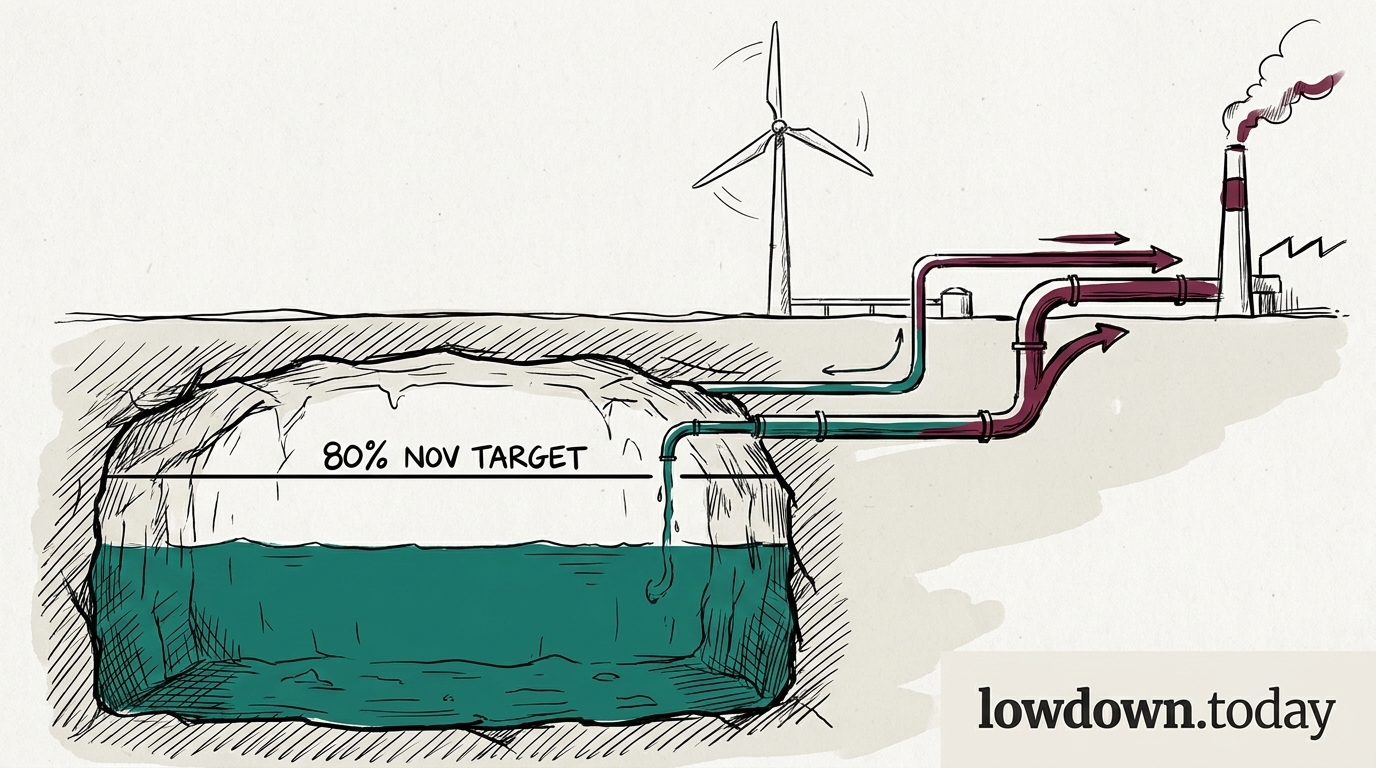
Brussels holds the bloc to 90% on a flexible window while Germany, holding roughly a quarter of EU storage capacity, tracks toward missing its own lower 80% figure by 21 points. A national shortfall this size in the anchor market matters more to bloc security than the flexible timetable alone can absorb.
French power exporters and CRE
French day-ahead rose in step with Germany but by less, reopening a EUR 7-17 premium that makes northward export flows commercially attractive again after the EUR 43.09 discount evaporated in days. CRE separately authorised RTE and Enedis to buy flexibility locally, betting the coming winter's binding constraint is grid congestion rather than a shortage of firm capacity.
TTF trading desk
TTF trading desk
A visible national shortfall like Germany's 21-point gap is a directional signal, not noise, for a desk holding the summer-winter spread. TTF's flat EUR 58-60 range through this week's German price swings says the market has not yet chosen to reprice refill risk into the front of the curve.
German cavern and CCGT operators
German caverns kept buying prompt gas at TTF near EUR 58-60 through the inversion; the wind collapse to 2.4 GW then flipped the spark spread to plus EUR 29 and put turbines back in the same queue. Every day turbines win that bid, injection at a third of the 877 GWh/day pace needed falls further behind.
Slovakia
Slovakia
Slovakia says it dropped its hold-out on the 21st sanctions package only after Ursula von der Leyen personally signed written gas-price and supply guarantees. The Council of the European Union's own 17,238-character release on the package names neither Slovakia nor any guarantee, leaving Bratislava's account unconfirmed by the institutional record.



