Skip to content
You can now search across every topic, entity and event.What's new
European Energy Markets
31JUL

Lebanon: 826 dead, 106 of them children

4 min read
09:44UTC

The death toll has risen by 139 in 36 hours, displacement exceeds the total from the 33-day 2006 war, and evacuation orders now cover 14 per cent of Lebanon's territory.

EconomicDeveloping
Key takeaway

Lebanese nationals choosing war-scarred Syria over the south signals conditions have become catastrophic, not merely dangerous.

Lebanon's death toll has reached 826 — including 106 children — with 2,009 wounded 1. The count stood at 687 on 13 March . 139 people were killed in approximately 36 hours — the highest sustained rate since fighting began on 2 March.

The Health Ministry's sequential reports trace the escalation. On 7 March: 394 dead . By 8 March: 486 . By 10 March: 634 . By 13 March: 687 . Now: 826. The average daily death toll climbed from roughly 50 in the conflict's first week to roughly 70 in the second. The latest 36-hour figure — equivalent to 93 per day — confirms the rate is still rising. 106 children are among the dead; the child casualty rate continues to exceed what UNICEF documented during the 2006 war .

830,000 people are internally displaced. Nearly 100,000 have crossed into Syria. The composition of that cross-border flow is its own record of desperation. 63 per cent are Syrian nationals returning to the country they originally fled during Syria's civil war, when Lebanon absorbed approximately 1.5 million refugees — roughly a quarter of its own population. Some of those families now judge the risks of post-war Syria as lower than remaining in Lebanon. The other 37 per cent are Lebanese nationals entering a country whose military occupied Lebanon from 1976 to 2005. The last comparable cross-border flight was during Israel's 2006 campaign, which displaced approximately one million over 34 days . This conflict has reached 830,000 in 14.

Israel has issued evacuation orders covering 1,470 square kilometres — 14 per cent of Lebanon's total territory. Lebanon is 10,452 square kilometres, smaller than the US state of Connecticut. The zone extends beyond the Litani River boundary established by UNSC Resolution 1701 and beyond every previous Israeli buffer demand . With a senior Israeli official telling Axios that the military intends to seize all territory south of the Litani, these evacuation maps may outline the geography of an extended military presence 2. Israel occupied south Lebanon from 1982 to 2000; the towns its forces entered this week — Kfar Kila, Khiam, Yaroun — are the same ones it held then.


Deep Analysis

In plain English

Lebanon is a small country roughly the size of Connecticut. In 16 days, roughly one-fifth of its entire population has been forced from their homes. Those 830,000 people are crowding into Beirut and other cities that are themselves under threat, straining a country that has been economically collapsed since 2019. Almost 100,000 people have crossed into Syria — a country that fought a decade-long civil war and still hosts over a million of its own displaced people. The fact that Lebanese citizens — not just Syrian refugees heading home — are choosing Syria over staying in Lebanon tells you how desperate conditions in the south have become.

Deep Analysis
Synthesis

The 37% of Syria crossings who are Lebanese nationals — not Syrian refugees returning home — is the single most analytically significant figure in this toll. It indicates that south Lebanese civilians now assess post-civil-war Syria as a safer destination than Israeli-controlled south Lebanon. If that assessment spreads northward, it removes the civilian population buffer that historically constrained Israeli ground operation timelines and political costs.

Root Causes

Lebanon's pre-war structural fragility amplifies the humanitarian crisis beyond what the military situation alone would produce. The 2019 financial collapse left the government unable to fund any humanitarian response. The 2020 Beirut port explosion destroyed emergency logistics capacity. The healthcare system was operating at severely reduced capacity before the first strike. These compounding pre-conditions mean displacement effects per capita in 2026 are more severe than in any previous Lebanon conflict.

What could happen next?
  • Consequence

    Healthcare system collapse — nine hospitals already out of service — will produce rising non-combat mortality among the displaced within days, not weeks.

    Immediate · Assessed
  • Risk

    If Lebanese nationals permanently resettle in Syria rather than returning, south Lebanon's post-conflict population base and Hezbollah's community legitimacy are structurally altered.

    Long term · Suggested
  • Consequence

    Lebanon's zero fiscal capacity means international donors will fund the entire humanitarian response, creating aid dependency that structurally outlasts the conflict.

    Medium term · Assessed
First Reported In

Update #36 · Israel plans full Litani seizure

Al Jazeera· 15 Mar 2026
Read original
Causes and effects
This Event
Lebanon: 826 dead, 106 of them children
The daily death rate has risen from roughly 50 in the first week to 93 in the latest 36-hour window — the killing is accelerating. Displacement of 830,000 has matched the 2006 war's full total in under half the time. Nearly 100,000 people have crossed into Syria, including Lebanese nationals entering a country that occupied Lebanon until 2005 — a measure of desperation without recent precedent.
Different Perspectives
Spain's LNG terminal operators
Spain's 9,145 GWh terminal inventory is the largest single stock in the EU LNG network, an option value that can reroute cargoes wherever the winter strip pays best rather than a cavern gas obligation tied to a fixed date. That flexibility matters more as Germany's cavern shortfall pushes more of the winter security question onto import infrastructure.
European Commission
European Commission
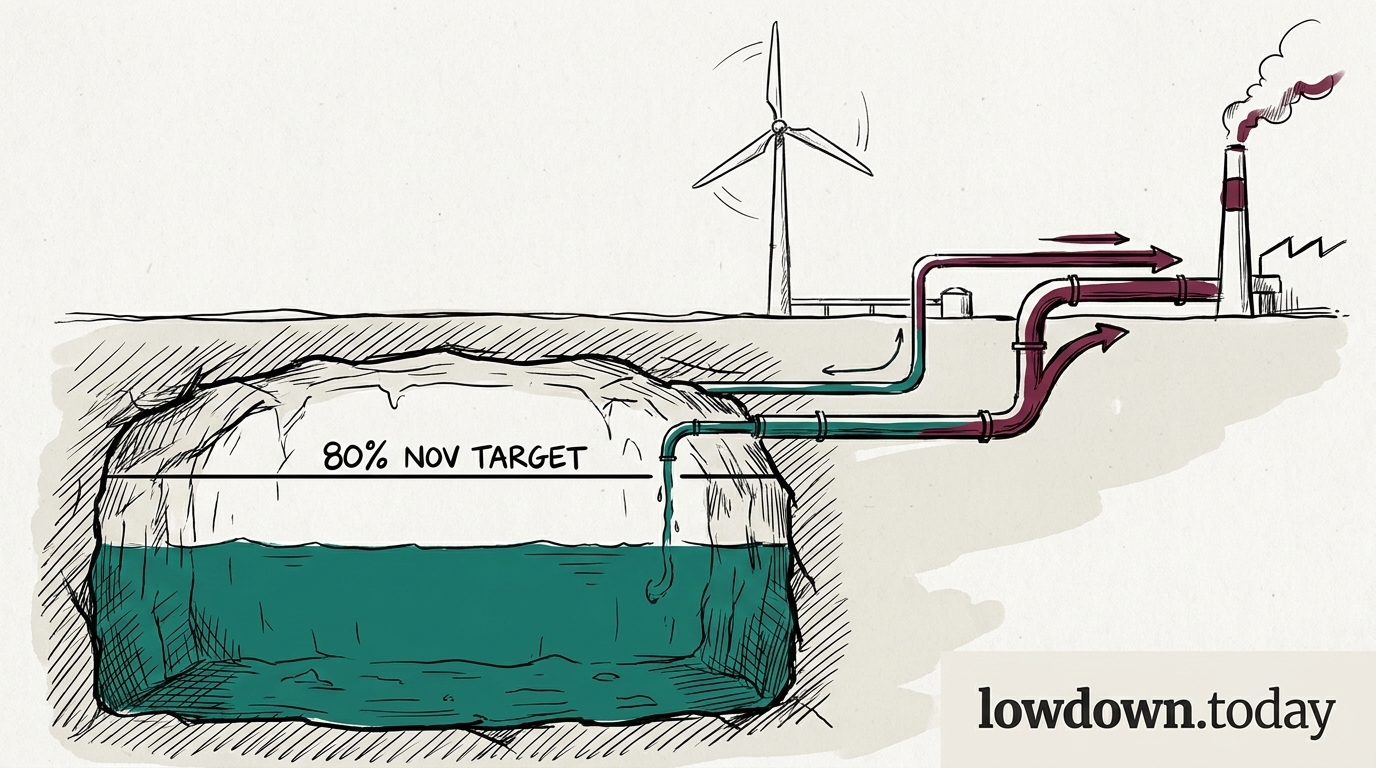
Brussels holds the bloc to 90% on a flexible window while Germany, holding roughly a quarter of EU storage capacity, tracks toward missing its own lower 80% figure by 21 points. A national shortfall this size in the anchor market matters more to bloc security than the flexible timetable alone can absorb.
French power exporters and CRE
French day-ahead rose in step with Germany but by less, reopening a EUR 7-17 premium that makes northward export flows commercially attractive again after the EUR 43.09 discount evaporated in days. CRE separately authorised RTE and Enedis to buy flexibility locally, betting the coming winter's binding constraint is grid congestion rather than a shortage of firm capacity.
TTF trading desk
TTF trading desk
A visible national shortfall like Germany's 21-point gap is a directional signal, not noise, for a desk holding the summer-winter spread. TTF's flat EUR 58-60 range through this week's German price swings says the market has not yet chosen to reprice refill risk into the front of the curve.
German cavern and CCGT operators
German caverns kept buying prompt gas at TTF near EUR 58-60 through the inversion; the wind collapse to 2.4 GW then flipped the spark spread to plus EUR 29 and put turbines back in the same queue. Every day turbines win that bid, injection at a third of the 877 GWh/day pace needed falls further behind.
Slovakia
Slovakia
Slovakia says it dropped its hold-out on the 21st sanctions package only after Ursula von der Leyen personally signed written gas-price and supply guarantees. The Council of the European Union's own 17,238-character release on the package names neither Slovakia nor any guarantee, leaving Bratislava's account unconfirmed by the institutional record.



