Skip to content
You can now search across every topic, entity and event.What's new
European Energy Markets
31JUL

Italy gets €211m photonic chip aid

3 min read
09:44UTC

The Commission approved €211m of Italian state aid for photonic chips on 9 April, the third Chips Act pilot-line green-light in three months. The money is moving; the 2030 headline target is not being mentioned.

EconomicDeveloping
Key takeaway

Brussels is rerouting Chips Act money into photonics and packaging, where Europe still has an industrial base.

The European Commission approved €211m of Italian state aid for photonic chips on 9 April 2026 1. DG CNECT, The Commission's digital-strategy directorate, continues a visible pilot-line pattern that already includes the €700m NanoIC green-light on 9 February and the FAMES pilot-line inauguration on 30 January 1. STMicroelectronics, the Franco-Italian chipmaker at the heart of Europe's automotive and industrial semiconductor supply, is among the beneficiaries.

The arithmetic behind the Chips Act has changed underneath the approvals. Intel's cancelled Magdeburg fab and suspended GlobalFoundries Crolles project together removed €37.5bn of planned leading-edge investment. Photonics pilot lines at €211m and €700m operate at a different scale and in a different part of the stack: they cannot substitute for the cancelled logic capacity, and the first Integrated Production Facility and Open EU Foundry designations already dropped the 20% market share number .

For European chip investors and member-state planners the pivot matters because it changes what the Chips Act is spending on. Photonics and advanced packaging are areas where Europe retains an existing industrial base; leading-edge logic at 20% of global market share is not. The Commission has not published a revised target or a formal Chips Act 2.0 roadmap to replace the 2030 figure, and the pilot-line approvals are continuing without one.


Deep Analysis

In plain English

Standard computer chips use electrical signals moving through metal wires. Photonic chips use pulses of light instead, which can carry more data, faster, with less energy. This matters particularly for the giant data centres powering AI, where moving data between chips is a major bottleneck and energy cost. Italy has received €211m in EU state aid approval to support photonic chip manufacturing. This is part of a broader pattern where the EU is directing Chips Act money toward types of chips where European companies already have expertise, rather than trying to compete directly with Taiwan (TSMC) and South Korea (Samsung) in cutting-edge processor manufacturing where Europe has fallen behind. Phototonics will not replace the cancelled Intel and GlobalFoundries factories that were supposed to make Europe a global leader in advanced chips. But it is a niche where European companies can genuinely compete and build commercial capacity.

First Reported In

Update #2 · Brussels buys, Britain backs, Google unlocks

European Commission DG CNECT· 19 Apr 2026
Read original
Different Perspectives
Spain's LNG terminal operators
Spain's 9,145 GWh terminal inventory is the largest single stock in the EU LNG network, an option value that can reroute cargoes wherever the winter strip pays best rather than a cavern gas obligation tied to a fixed date. That flexibility matters more as Germany's cavern shortfall pushes more of the winter security question onto import infrastructure.
European Commission
European Commission
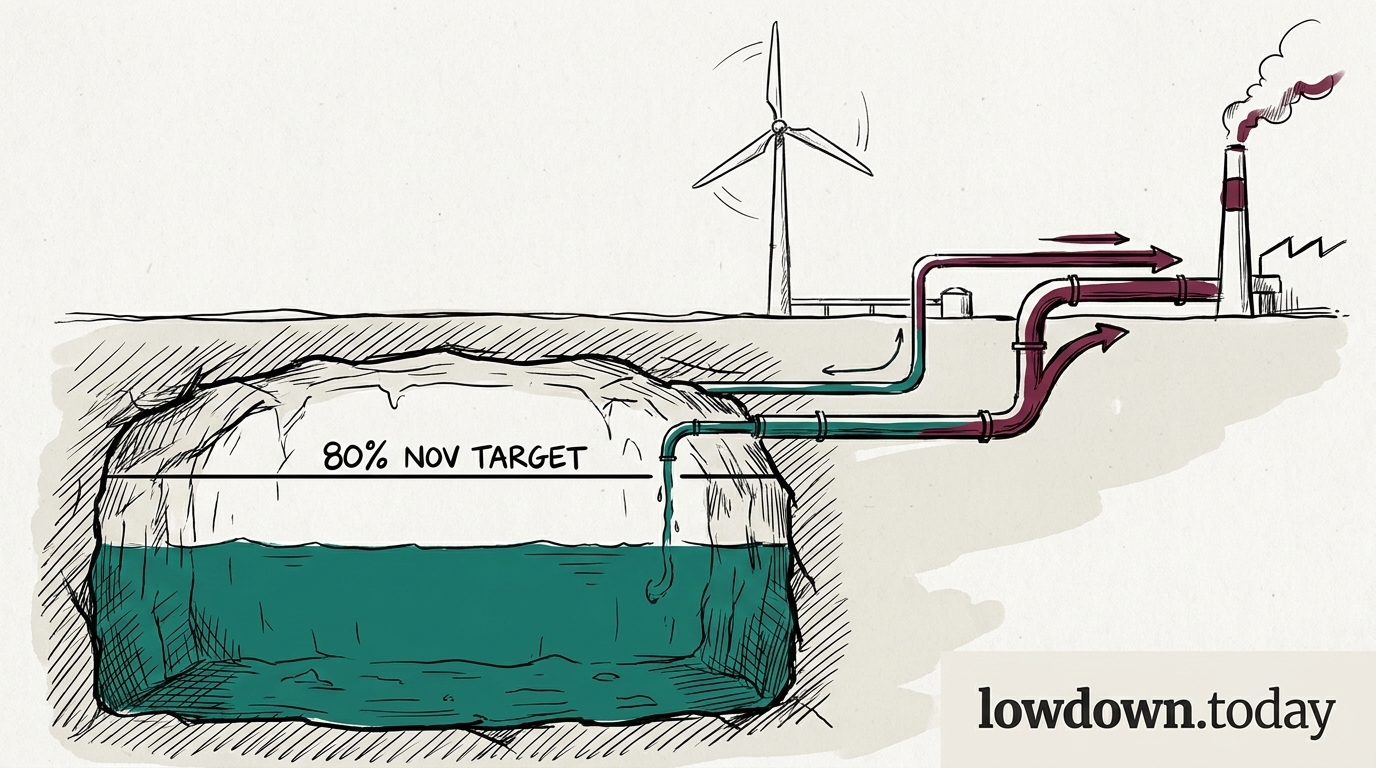
Brussels holds the bloc to 90% on a flexible window while Germany, holding roughly a quarter of EU storage capacity, tracks toward missing its own lower 80% figure by 21 points. A national shortfall this size in the anchor market matters more to bloc security than the flexible timetable alone can absorb.
French power exporters and CRE
French day-ahead rose in step with Germany but by less, reopening a EUR 7-17 premium that makes northward export flows commercially attractive again after the EUR 43.09 discount evaporated in days. CRE separately authorised RTE and Enedis to buy flexibility locally, betting the coming winter's binding constraint is grid congestion rather than a shortage of firm capacity.
TTF trading desk
TTF trading desk
A visible national shortfall like Germany's 21-point gap is a directional signal, not noise, for a desk holding the summer-winter spread. TTF's flat EUR 58-60 range through this week's German price swings says the market has not yet chosen to reprice refill risk into the front of the curve.
German cavern and CCGT operators
German caverns kept buying prompt gas at TTF near EUR 58-60 through the inversion; the wind collapse to 2.4 GW then flipped the spark spread to plus EUR 29 and put turbines back in the same queue. Every day turbines win that bid, injection at a third of the 877 GWh/day pace needed falls further behind.
Slovakia
Slovakia
Slovakia says it dropped its hold-out on the 21st sanctions package only after Ursula von der Leyen personally signed written gas-price and supply guarantees. The Council of the European Union's own 17,238-character release on the package names neither Slovakia nor any guarantee, leaving Bratislava's account unconfirmed by the institutional record.



