Skip to content
You can now search across every topic, entity and event.What's new
European Energy Markets
31JUL

EC issues first Chips Act fab designations

2 min read
09:44UTC

Brussels granted its first formal semiconductor facility statuses under the Chips Act. The 20% market share target went unmentioned.

EconomicDeveloping
Key takeaway

Brussels issued its first Chips Act designations but dropped its 20% market share target from the announcement.

The European Commission made its first EU Chips Act designations in October 2025, granting ESMC Open EU Foundry status and awarding Integrated Production Facility status to Ams-OSRAM, Infineon Dresden, and STMicroelectronics Italy 1. The designations are the formal recognition that triggers state aid approval and operational obligations, including third-party access requirements for Open EU Foundries.

The official press release made no mention of the Act's headline commitment: 20% of global semiconductor market share by 2030. Europe currently produces roughly 8% of the world's chips, overwhelmingly for automotive end-markets 2. Reaching 20% would have required all three flagship fabs plus substantial brownfield expansion. With Intel's Magdeburg cancelled and the Crolles facility suspended, the arithmetic no longer supports the target.

The omission is a diplomatic manoeuvre rather than an oversight. Formally abandoning the 20% target would invite political embarrassment; repeating it would invite ridicule. The Commission appears to be letting the figure lapse without acknowledgement, a pattern familiar from earlier EU industrial targets that quietly disappeared when delivery fell short.


Deep Analysis

In plain English

The EU Chips Act is Europe's plan to manufacture more of its own semiconductors. When the law was passed in 2023, it set an ambitious goal: by 2030, European factories should make 20% of the world's chips, up from about 9% at the time. In October 2025, the European Commission made its first official designations under this law; naming specific factories as officially recognised under the programme, which unlocks access to state funding and streamlined permits. Three types of designation exist: Integrated Production Facilities (factories that design and make their own chips), Open EU Foundries (factories that make chips for external customers), and Research and Innovation Facilities. The notable thing is what the announcement did not say: it made no mention of the 20% target. After Intel cancelled its planned €30 billion German factory and another major project in France was suspended, that target looks increasingly unrealistic. The Commission's silence on the target may signal a quiet retreat.

Deep Analysis
Root Causes

The Chips Act's 20% production share target was never supported by a commissioned demand-side feasibility study. It was adopted as a political ambition signal, calibrated to mirror the US CHIPS Act's headline framing, rather than derived from an analysis of what European customer demand could anchor.

When Intel cancelled Magdeburg and GlobalFoundries suspended Crolles, the two projects that would have collectively delivered approximately 6 percentage points of additional global chip production share were eliminated.

The designations announcement's silence on the 20% target reflects a second structural cause: DG CNECT's legal counsel determined that restating an unachievable target in a legally binding instrument creates liability exposure. Omitting the target from a regulatory designation notice is legally defensible; reaffirming it in an official capacity when it is demonstrably unreachable creates grounds for challenge from companies that relied on that target in their investment decisions.

What could happen next?
  • Meaning

    The first Chips Act designations establish the IPF/OEF framework as operational, creating a regulatory foundation even as the 20% production target recedes.

  • Risk

    The omission of the 20% target from official communications may reduce political pressure to attract additional fab investment, removing an accountability metric for the programme's designers.

First Reported In

Update #1 · Europe's chip ambitions meet reality

European Commission DG CNECT· 13 Apr 2026
Read original
Different Perspectives
Spain's LNG terminal operators
Spain's 9,145 GWh terminal inventory is the largest single stock in the EU LNG network, an option value that can reroute cargoes wherever the winter strip pays best rather than a cavern gas obligation tied to a fixed date. That flexibility matters more as Germany's cavern shortfall pushes more of the winter security question onto import infrastructure.
European Commission
European Commission
Brussels holds the bloc to 90% on a flexible window while Germany, holding roughly a quarter of EU storage capacity, tracks toward missing its own lower 80% figure by 21 points. A national shortfall this size in the anchor market matters more to bloc security than the flexible timetable alone can absorb.
French power exporters and CRE
French day-ahead rose in step with Germany but by less, reopening a EUR 7-17 premium that makes northward export flows commercially attractive again after the EUR 43.09 discount evaporated in days. CRE separately authorised RTE and Enedis to buy flexibility locally, betting the coming winter's binding constraint is grid congestion rather than a shortage of firm capacity.
TTF trading desk
TTF trading desk
A visible national shortfall like Germany's 21-point gap is a directional signal, not noise, for a desk holding the summer-winter spread. TTF's flat EUR 58-60 range through this week's German price swings says the market has not yet chosen to reprice refill risk into the front of the curve.
German cavern and CCGT operators
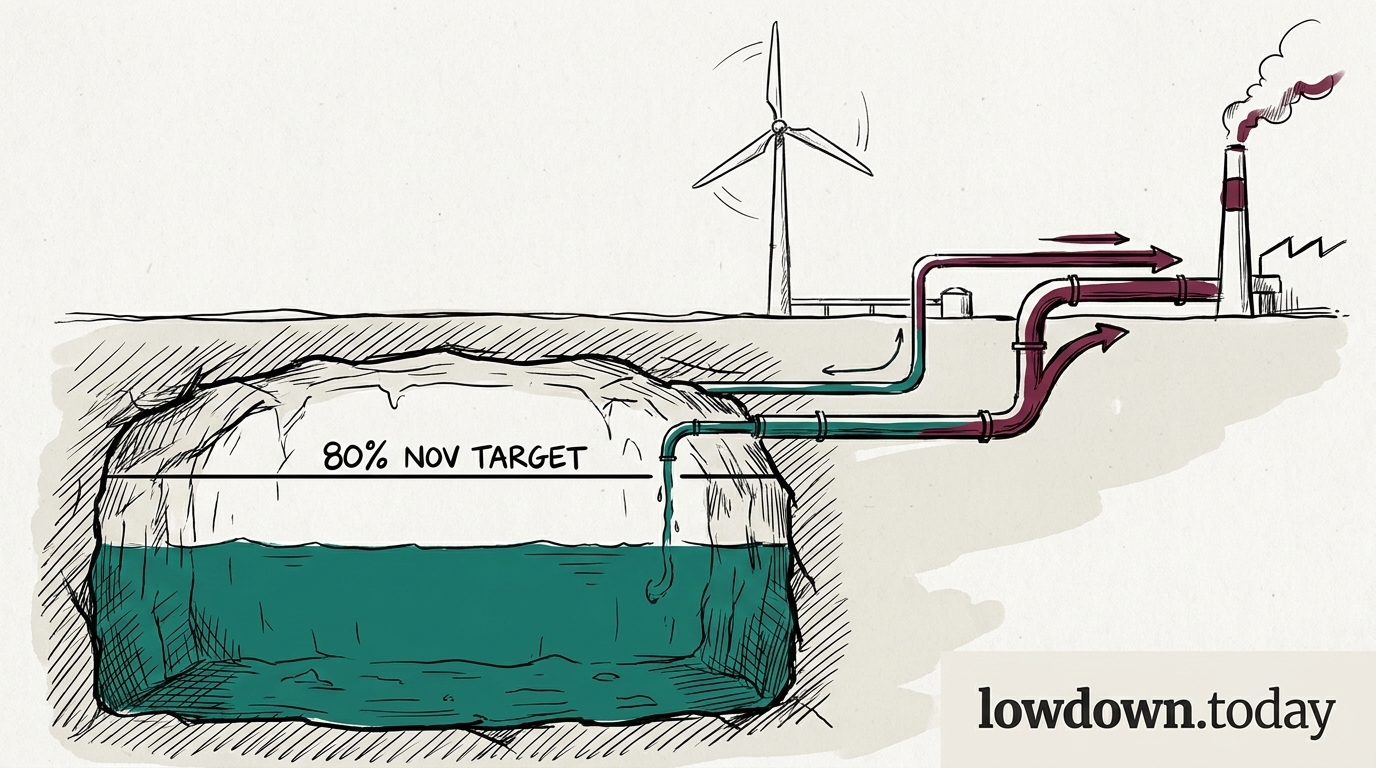
German caverns kept buying prompt gas at TTF near EUR 58-60 through the inversion; the wind collapse to 2.4 GW then flipped the spark spread to plus EUR 29 and put turbines back in the same queue. Every day turbines win that bid, injection at a third of the 877 GWh/day pace needed falls further behind.
Slovakia
Slovakia
Slovakia says it dropped its hold-out on the 21st sanctions package only after Ursula von der Leyen personally signed written gas-price and supply guarantees. The Council of the European Union's own 17,238-character release on the package names neither Slovakia nor any guarantee, leaving Bratislava's account unconfirmed by the institutional record.



