Skip to content
You can now search across every topic, entity and event.What's new
European Energy Markets
31JUL

IRIB broadcaster struck again in Tehran

3 min read
09:44UTC

The same state broadcaster headquarters hit during June's twelve-day war was bombed overnight — the fourth category of Iranian institution targeted in 72 hours.

EconomicDeveloping
Key takeaway

The IRIB strike completes targeting across all four pillars of Iranian state power simultaneously, which in prior Western air campaigns has been the operational signature of regime-change strategy regardless of stated objectives.

IRIB Director Peyman Jebelli confirmed overnight that the state broadcaster's Tehran headquarters was struck — the same facility hit during the Twelve-Day War in June. Broadcasting has not been interrupted. Contingency transmission systems installed after that earlier attack kept IRIB on air, evidence that Iranian institutional planning assumed a second campaign.

The target fits a pattern. The campaign's opening hours destroyed the IRGC's Sarallah Headquarters in Tehran and struck the Assembly of Experts' compound in Tehran, where Iran's next Supreme Leader would be selected . Up to 40 senior officials have been killed . Adding the state broadcaster means the campaign has struck across four institutional categories: military command, political leadership, religious authority, and state communications. The sequence is consistent with a doctrine of institutional dismantlement rather than purely military degradation.

The closest precedent is NATO's April 1999 strike on Radio Television of Serbia (RTS) in Belgrade, which killed 16 staff members. The International Criminal Tribunal for the former Yugoslavia examined the strike and concluded it was of "dubious legality" — the legal question turned on whether a state broadcaster is a civilian object or a facility contributing to the war effort. IRIB's role in broadcasting military communications and coordinating civil defence complicates direct comparison, but the core legal tension is identical: at what point does a government's communication apparatus become a military target?

IRIB's contingency systems — installed after the June strike — kept broadcasts running through the second attack. The state's information infrastructure has shown more resilience than its military command: up to 40 senior officials are dead, the foreign minister has acknowledged units operating outside central direction , and no successor to the Supreme Leader has been named . Iran prepared for this war. Its preparations were uneven.


Deep Analysis

In plain English

IRIB is Iran's national broadcaster — the equivalent of the BBC — and the primary source of news for tens of millions of Iranians. Striking it serves two purposes: denying the government its main tool for controlling the domestic narrative during wartime, and signalling that no institution of the Iranian state is protected. Iran had contingency broadcast systems ready precisely because the same building was struck in a previous conflict, which means the attack's practical effect on broadcasting is limited — but its symbolic and legal significance is substantial.

Deep Analysis
Synthesis

The combined targeting of IRIB, the Sarallah IRGC headquarters, the Assembly of Experts, and underground ballistic missile infrastructure maps onto what US doctrine calls 'strategic paralysis' — severing simultaneously the regime's capacity to command forces, govern, project religious authority, and communicate with its population. This is the doctrinal signature of a campaign designed to collapse a government, not coerce it.

Root Causes

Under the Law of Armed Conflict — specifically Additional Protocol I, Article 52 — state broadcasters lose protected status only when they constitute military objectives making an effective contribution to military action. US targeting doctrine (Joint Publication 3-60) applies this threshold permissively to propaganda organs that sustain enemy will to fight. The legal exposure is real but historically has not prevented such strikes; it typically surfaces as post-conflict accountability.

Escalation

Targeting information infrastructure in the same campaign wave as military, political, and religious institutions historically presages regime-change operations even when officially denied — this was the sequencing in Serbia 1999, Iraq 2003, and Libya 2011. The Hegseth/Rubio contradiction on war aims (Event 16) is materially harder to sustain once the targeting pattern is mapped against US joint targeting doctrine.

What could happen next?
  • Precedent

    Striking a state broadcaster alongside military and governmental targets normalises the targeting of information infrastructure in Western-backed air campaigns, lowering the threshold for similar strikes in future conflicts.

    Long term · Assessed
  • Risk

    Post-conflict accountability processes — ICC referral, UN fact-finding — are more likely to include the IRIB strike as a case study if civilian casualties inside the building are confirmed.

    Medium term · Suggested
  • Consequence

    Iran's domestic population loses its primary state information channel at the moment casualty figures and displacement are highest, accelerating reliance on informal and foreign-broadcast sources that the government cannot control.

    Immediate · Assessed
First Reported In

Update #12 · Rubio rewrites war's legal case in Congress

NBC News· 3 Mar 2026
Read original
Causes and effects
This Event
IRIB broadcaster struck again in Tehran
The strike on IRIB, alongside the IRGC's Sarallah headquarters, the Assembly of Experts in Qom, and senior leadership residences, indicates the campaign is dismantling Iran's governing infrastructure across military, political, religious, and informational domains simultaneously. The targeting of a state broadcaster raises questions under international humanitarian law about the dual-use classification of media facilities — questions last formally examined after NATO's 1999 strike on Serbian state television.
Different Perspectives
Spain's LNG terminal operators
Spain's 9,145 GWh terminal inventory is the largest single stock in the EU LNG network, an option value that can reroute cargoes wherever the winter strip pays best rather than a cavern gas obligation tied to a fixed date. That flexibility matters more as Germany's cavern shortfall pushes more of the winter security question onto import infrastructure.
European Commission
European Commission
Brussels holds the bloc to 90% on a flexible window while Germany, holding roughly a quarter of EU storage capacity, tracks toward missing its own lower 80% figure by 21 points. A national shortfall this size in the anchor market matters more to bloc security than the flexible timetable alone can absorb.
French power exporters and CRE
French day-ahead rose in step with Germany but by less, reopening a EUR 7-17 premium that makes northward export flows commercially attractive again after the EUR 43.09 discount evaporated in days. CRE separately authorised RTE and Enedis to buy flexibility locally, betting the coming winter's binding constraint is grid congestion rather than a shortage of firm capacity.
TTF trading desk
TTF trading desk
A visible national shortfall like Germany's 21-point gap is a directional signal, not noise, for a desk holding the summer-winter spread. TTF's flat EUR 58-60 range through this week's German price swings says the market has not yet chosen to reprice refill risk into the front of the curve.
German cavern and CCGT operators
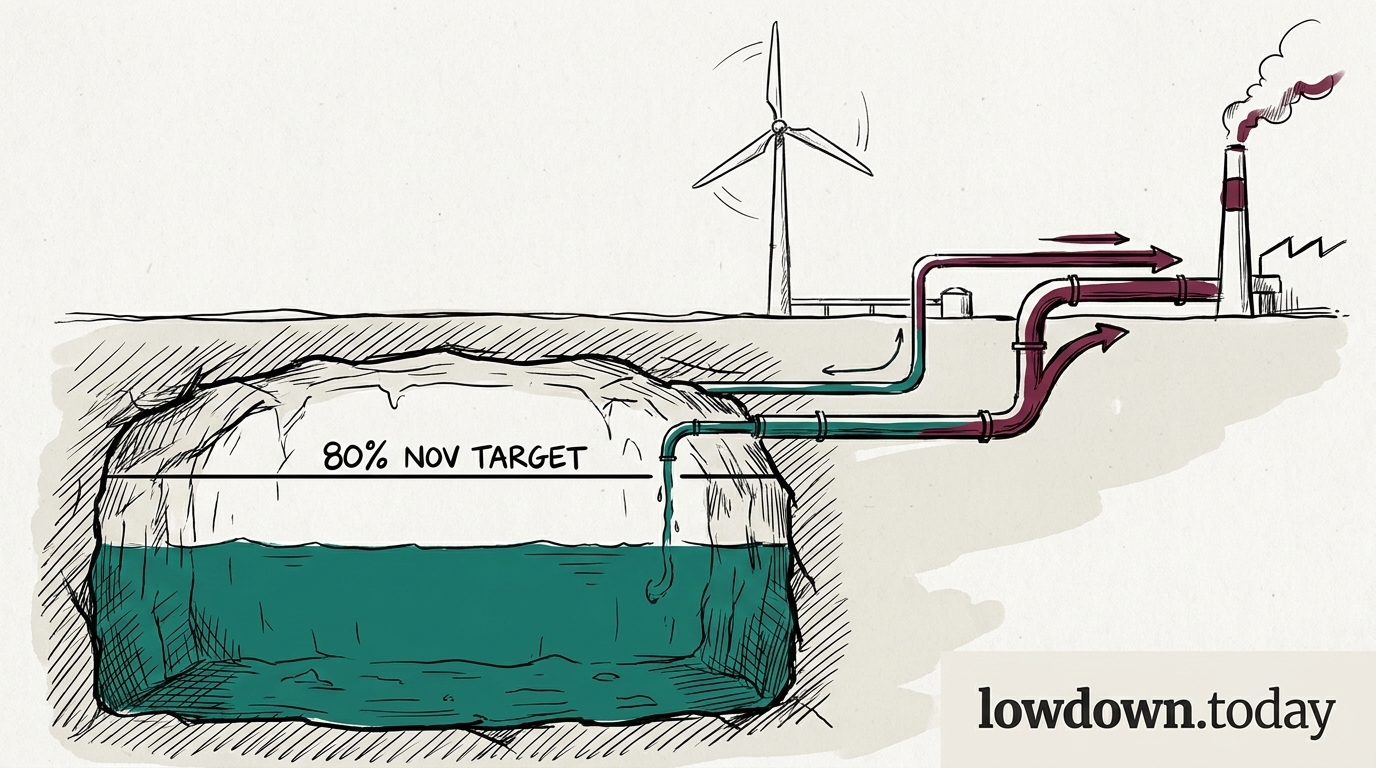
German caverns kept buying prompt gas at TTF near EUR 58-60 through the inversion; the wind collapse to 2.4 GW then flipped the spark spread to plus EUR 29 and put turbines back in the same queue. Every day turbines win that bid, injection at a third of the 877 GWh/day pace needed falls further behind.
Slovakia
Slovakia
Slovakia says it dropped its hold-out on the 21st sanctions package only after Ursula von der Leyen personally signed written gas-price and supply guarantees. The Council of the European Union's own 17,238-character release on the package names neither Slovakia nor any guarantee, leaving Bratislava's account unconfirmed by the institutional record.



