Skip to content
You can now search across every topic, entity and event.What's new
European Energy Markets
31JUL

IAEA goes dark, OFAC skips Iran file

2 min read
09:44UTC

The IAEA newscenter carries no active Iran story as of 11 April, the monitoring framework structurally dark since Iran's Majlis voted 221-0 to suspend all cooperation on 3 April. OFAC has published no Iran action in 22 days.

EconomicDeveloping
Key takeaway

Nuclear monitoring and US sanctions enforcement are both silent on Iran in the same week.

The IAEA (International Atomic Energy Agency) newscenter carries no active Iran news story or press release as of 11 April 2026 1. The nuclear monitoring framework has gone structurally dark since Iran's Majlis voted 221-0 to suspend all agency cooperation on 3 April. Agency inspectors have had no on-site access in the eight days since the vote, and the agency's communications apparatus has gone quiet in parallel: no newscenter item and no public statement on the war from Vienna during the diplomatic week the Islamabad talks opened.

A 221-0 parliamentary vote removes the legal basis for inspector access, not merely the political will, and no mechanism short of a fresh Majlis vote restores it. Vienna cannot report on a country it cannot enter, and no workaround exists inside the current diplomatic format.

The OFAC side of the same silence, 22 days and one expiring General License, is audited in the forty-two days of war event. The parallel is the point: both the multilateral and the unilateral tools of Iran-specific policy are running on silence during the war's most consequential diplomatic week, and GL-U expires eight days from Saturday with no renewal signal issued .


Deep Analysis

In plain English

The IAEA — the international organisation whose inspectors visit nuclear facilities around the world to verify they are not making weapons — no longer has any access to Iran. Iran's parliament voted unanimously to ban all inspectors on 3 April, eight days ago. Without inspectors on the ground, the international community has no independent way to know what Iran is doing with its nuclear material. Iran was the most scrutinised nuclear programme on earth; it is now the most opaque.

Deep Analysis
Root Causes

The monitoring blackout has two proximate causes and one structural one. Proximately, the Majlis vote followed weeks of Israeli strikes on nuclear-adjacent infrastructure including the Bushehr perimeter, which Tehran framed as evidence that IAEA inspection reports were providing targeting intelligence — a claim the IAEA denied but could not disprove in the absence of independent verification of what was shared and with whom.

Structurally, Iran's enriched uranium inventory as of the last inspection (440.9 kg at 60% enrichment, per IAEA Director General Grossi, ) was already sufficient for seven weapons if further enriched. Suspending inspection access freezes the verifiable baseline at a point where Iran's nuclear status is already ambiguous, giving Tehran maximum negotiating flexibility.

First Reported In

Update #65 · Iran lost its own minefield

treasury.gov· 11 Apr 2026
Read original
Different Perspectives
Spain's LNG terminal operators
Spain's 9,145 GWh terminal inventory is the largest single stock in the EU LNG network, an option value that can reroute cargoes wherever the winter strip pays best rather than a cavern gas obligation tied to a fixed date. That flexibility matters more as Germany's cavern shortfall pushes more of the winter security question onto import infrastructure.
European Commission
European Commission
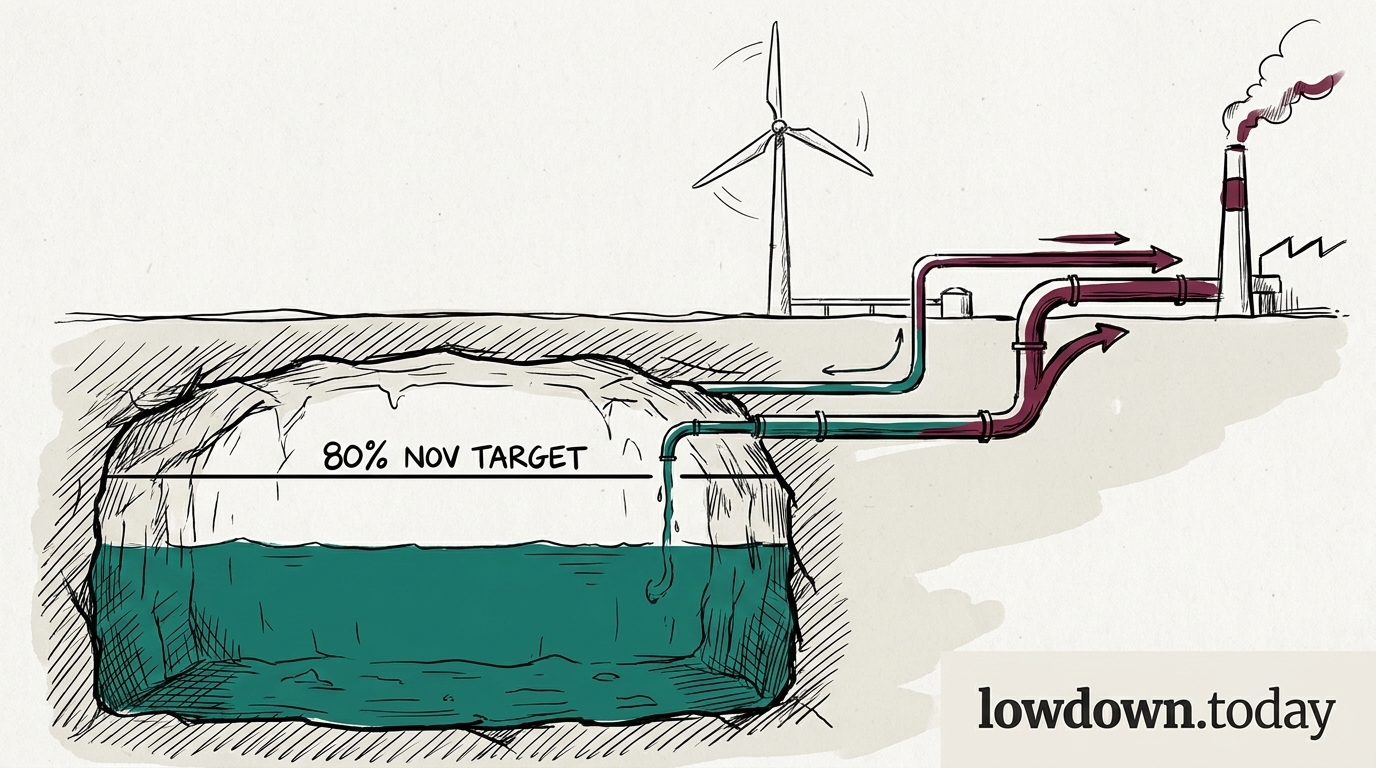
Brussels holds the bloc to 90% on a flexible window while Germany, holding roughly a quarter of EU storage capacity, tracks toward missing its own lower 80% figure by 21 points. A national shortfall this size in the anchor market matters more to bloc security than the flexible timetable alone can absorb.
French power exporters and CRE
French day-ahead rose in step with Germany but by less, reopening a EUR 7-17 premium that makes northward export flows commercially attractive again after the EUR 43.09 discount evaporated in days. CRE separately authorised RTE and Enedis to buy flexibility locally, betting the coming winter's binding constraint is grid congestion rather than a shortage of firm capacity.
TTF trading desk
TTF trading desk
A visible national shortfall like Germany's 21-point gap is a directional signal, not noise, for a desk holding the summer-winter spread. TTF's flat EUR 58-60 range through this week's German price swings says the market has not yet chosen to reprice refill risk into the front of the curve.
German cavern and CCGT operators
German caverns kept buying prompt gas at TTF near EUR 58-60 through the inversion; the wind collapse to 2.4 GW then flipped the spark spread to plus EUR 29 and put turbines back in the same queue. Every day turbines win that bid, injection at a third of the 877 GWh/day pace needed falls further behind.
Slovakia
Slovakia
Slovakia says it dropped its hold-out on the 21st sanctions package only after Ursula von der Leyen personally signed written gas-price and supply guarantees. The Council of the European Union's own 17,238-character release on the package names neither Slovakia nor any guarantee, leaving Bratislava's account unconfirmed by the institutional record.



