Skip to content
You can now search across every topic, entity and event.What's new
European Energy Markets
31JUL

Hungary CJEU challenge; Slovakia preparing to join

3 min read
09:44UTC

Hungary filed a CJEU challenge against the EU Russian gas ban on 2 February 2026 arguing the regulation required unanimous Council approval as a sanction rather than trade policy, with Slovakia preparing to join, while the European Commission's TurkStream derogation deadline is 5 August 2026.

EconomicDeveloping
Key takeaway

Hungary's CJEU challenge runs in parallel with the Commission's 5 August TurkStream derogation deadline.

Hungary filed a CJEU challenge against the EU Russian gas ban on 2 February 2026, arguing the regulation required unanimous Council approval as a sanction rather than trade policy 1. Slovakia is preparing a parallel filing to join the Hungarian challenge. No CJEU ruling or preliminary injunction has been issued. The case sits in Luxembourg before the Court of Justice of the European Union, which adjudicates EU institutional and legal questions.

The filing runs in parallel with the TurkStream derogation process. ACER named Hungary and Slovakia among seven national regulatory authorities in its 6 May advisory opinions on TurkStream-entry derogation requests . The European Commission's deadline to rule on those seven requests, including Hungary and Slovakia, is 5 August 2026. The two legal tracks operate on different timelines: the CJEU challenge has no set ruling date; The Commission's TurkStream decision is due by 5 August.

Hungary's EUR 123.23/MWh day-ahead clearing on 12 May, EUR 54 above Spain, is the largest single-market premium in the briefing series. The clearing price compounds the political case for the derogation while the legal challenge runs in parallel. Hungary's reliance on TurkStream-routed Russian gas through the Balkans is the supply-side fact underneath the legal argument; the CJEU filing tests the procedural question, while The Commission's August deadline determines the operational outcome.

For procurement desks the calendar matters more than the legal theory. A Commission ruling against the derogations before 5 August closes the operational route; a ruling in favour preserves the supply line into Q3 and Q4. The CJEU has signalled no intervention date ahead of The Commission deadline. Slovakia's decision to join lifts the political weight of the challenge without changing the timetable.


Deep Analysis

In plain English

Russia sends natural gas to Hungary and Slovakia through a pipeline called TurkStream, which runs under the Black Sea through Turkey and into Central Europe. The European Union passed a law to phase out Russian gas as part of its response to the Ukraine war. Hungary challenged this law in the EU's highest court, the Court of Justice of the European Union (CJEU) in Luxembourg, arguing the law was passed incorrectly. At the same time, Hungary and several other countries asked for an exemption from another related EU gas rule, called the TurkStream derogation. The EU energy regulator ACER published opinions on these requests on 6 May, and the European Commission must make a final decision by 5 August 2026. Slovakia is preparing to join Hungary's court challenge. There is also an important political change in Hungary: a new, more pro-EU government took power in May 2026 after elections in April. It is not yet clear whether the new government will continue the legal challenge that the old government started.

Deep Analysis
Root Causes

Hungary's CJEU challenge rests on a structural dependency, not a legal abstraction. Hungary imported approximately 80% of its gas via TurkStream-routed Russian supply as of 2025, with no LNG regasification terminal and limited interconnection capacity for Norwegian pipeline gas. The ban removes Hungary's dominant supply source without a Commission-approved replacement pathway.

The political context complicates the challenge's future. Hungary's 12 April 2026 election gave Péter Magyar's Tisza party 137 of 199 parliamentary seats; the new government formed around 5 May. Magyar is significantly more pro-EU than Orbán and has expressed support for aligning Hungary with EU energy policy. The CJEU challenge was filed under the Orbán government on 2 February; whether the Magyar government maintains or withdraws it is an open question not yet publicly resolved.

What could happen next?
  • Risk

    If the Commission rules against the TurkStream derogation by 5 August, Hungary faces forced spot procurement at Continental clearing prices from Q3 2026, widening its energy cost disadvantage relative to western EU members.

    Short term · 0.74
  • Consequence

    Hungary's new Tisza government may withdraw or fail to prosecute the CJEU challenge, removing the co-applicant anchor for Slovakia's parallel filing and collapsing the legal challenge without a ruling.

    Short term · 0.6
  • Precedent

    If the CJEU upholds the trade-measure basis for the gas ban (consistent with the 2022 Poland coal ruling), it forecloses the legal avenue for any future member state challenging energy-sector sanctions on unanimous-approval grounds.

    Long term · 0.72
First Reported In

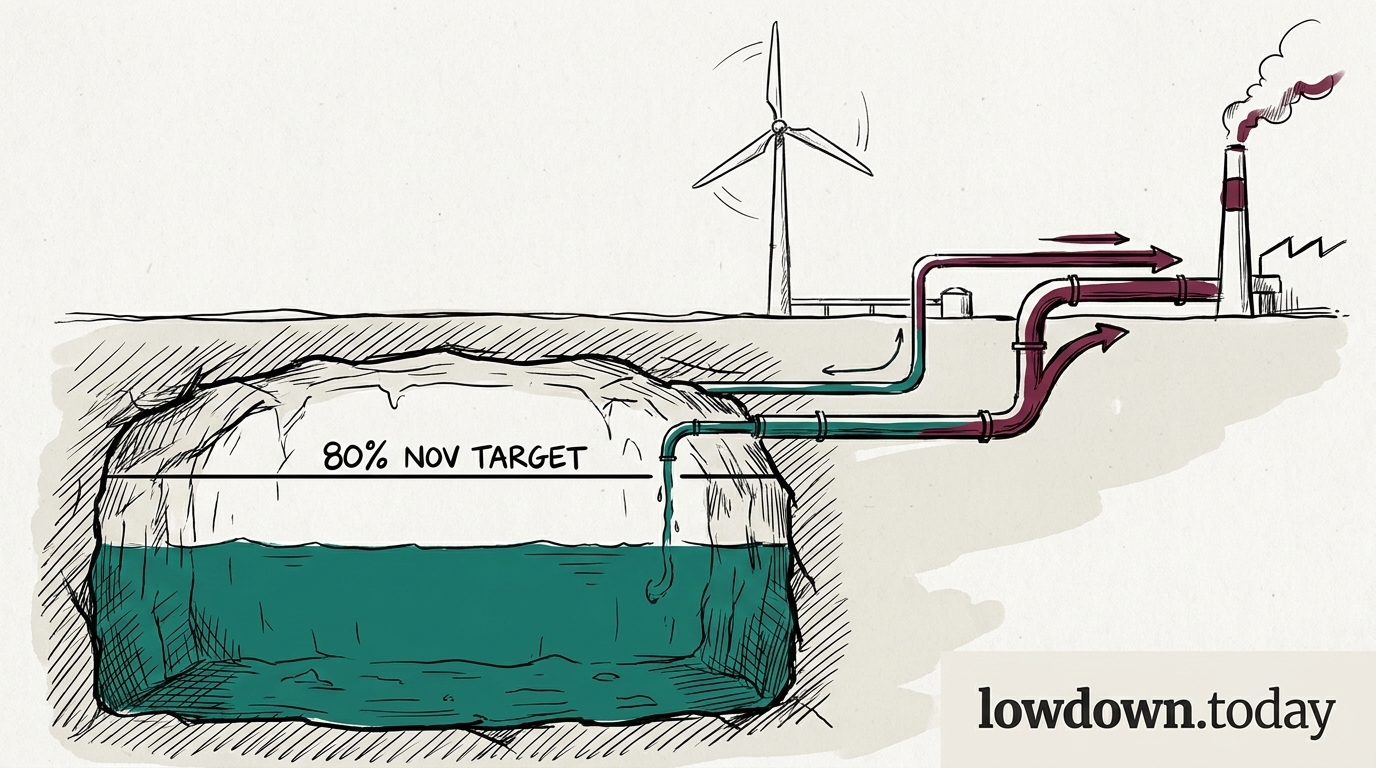
Update #9 · Storage 35% met, 80% trajectory still missed

Xinhua· 12 May 2026
Read original
Different Perspectives
Spain's LNG terminal operators
Spain's 9,145 GWh terminal inventory is the largest single stock in the EU LNG network, an option value that can reroute cargoes wherever the winter strip pays best rather than a cavern gas obligation tied to a fixed date. That flexibility matters more as Germany's cavern shortfall pushes more of the winter security question onto import infrastructure.
European Commission
European Commission
Brussels holds the bloc to 90% on a flexible window while Germany, holding roughly a quarter of EU storage capacity, tracks toward missing its own lower 80% figure by 21 points. A national shortfall this size in the anchor market matters more to bloc security than the flexible timetable alone can absorb.
French power exporters and CRE
French day-ahead rose in step with Germany but by less, reopening a EUR 7-17 premium that makes northward export flows commercially attractive again after the EUR 43.09 discount evaporated in days. CRE separately authorised RTE and Enedis to buy flexibility locally, betting the coming winter's binding constraint is grid congestion rather than a shortage of firm capacity.
TTF trading desk
TTF trading desk
A visible national shortfall like Germany's 21-point gap is a directional signal, not noise, for a desk holding the summer-winter spread. TTF's flat EUR 58-60 range through this week's German price swings says the market has not yet chosen to reprice refill risk into the front of the curve.
German cavern and CCGT operators
German caverns kept buying prompt gas at TTF near EUR 58-60 through the inversion; the wind collapse to 2.4 GW then flipped the spark spread to plus EUR 29 and put turbines back in the same queue. Every day turbines win that bid, injection at a third of the 877 GWh/day pace needed falls further behind.
Slovakia
Slovakia
Slovakia says it dropped its hold-out on the 21st sanctions package only after Ursula von der Leyen personally signed written gas-price and supply guarantees. The Council of the European Union's own 17,238-character release on the package names neither Slovakia nor any guarantee, leaving Bratislava's account unconfirmed by the institutional record.



